Use planned time, run time, total production and good units with common boundaries; multiply the factors rather than adding their percentages.
Fix equipment, product and planned time
The fictional exercise observes one machine, one product and 480 minutes during which production was intended. That time already excludes periods without production intent; it does not automatically equal the whole shift or weekly calendar.
The stated ideal cycle is one minute per unit under optimal conditions. It is not the takt time required by demand. Keep the reference supporting that cycle: changing it without explanation changes the metric even if operations remain unchanged.
Record stops and units separately
The 480 minutes include 60 recorded stop minutes, leaving 420 minutes of run time. Total production is 400 units, with 380 passing the first time; twenty require correction or rejection under the exercise’s criteria.
Vorne defines OEE quality around good units without rework. If some are recovered later, preserve that result separately rather than retroactively making them first-time good units. Nor should a repair count as a newly manufactured part in the same record.
Calculate three linked factors
Availability = 420 / 480 = 87.5%. Performance = (1 minute per unit × 400 units) / 420 minutes, approximately 95.24%. Quality = 380 / 400 = 95%. Each denominator preserves a different stage.
Multiply unrounded fractions: OEE = (420 / 480) × (400 / 420) × (380 / 400) = 380 / 480, approximately 79.17%. Do not add 87.5%, 95.24% and 95%, or take their average to obtain OEE.
Reconcile ideal minutes
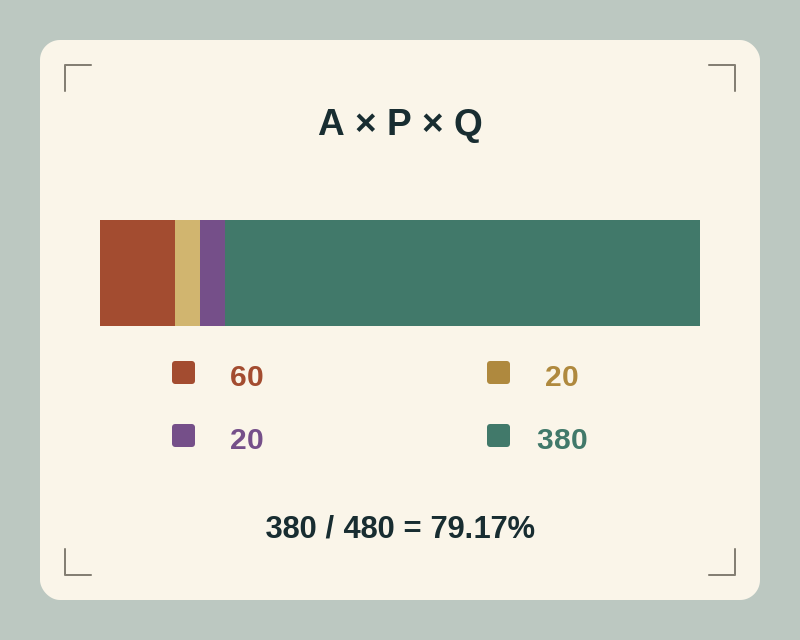
The 380 good units, at one ideal minute each, represent 380 equivalent fully productive minutes. Dividing by 480 planned minutes reproduces 79.17%. This does not mean 380 consecutive problem-free minutes were observed.
In the model, the other hundred minutes comprise 60 stopped, 20 between run time and the 400 parts’ ideal time, and 20 equivalent to units that failed. The sum 60 + 20 + 20 + 380 = 480 checks the reconciliation.
Investigate each loss with evidence
The breakdown helps select records to inspect: stop reasons, slow cycles or defects. It does not identify a cause by itself. Performance above 100% calls for checking ideal cycle, times and counts before celebrating.
Keep machine, product, period, definitions, figures and cycle version. When comparing periods, review product mix and planned time. The result describes this equipment use; it establishes neither satisfied demand, profitability nor a universally appropriate performance level.
Follow the evidence.
Sources checked November 24, 2026. The exercise scenarios and figures are fictional. Our editorial standards.