Usa tiempo planeado, tiempo funcionando, producción total y unidades buenas con límites comunes; multiplica los factores, sin sumar sus porcentajes.
Fija equipo, producto y tiempo planeado
El ejercicio ficticio observa una máquina, un producto y 480 minutos en los que se planeaba producir. Ese tiempo ya excluye periodos sin intención de producción; no equivale automáticamente a toda la jornada ni al calendario de la semana.
El ciclo ideal declarado es un minuto por unidad en condiciones óptimas. No es el tiempo takt exigido por la demanda. Conserva la referencia que justifica ese ciclo: cambiarlo sin explicación altera el indicador aunque la operación no cambie.
Registra paros y unidades por separado
Durante los 480 minutos se registran 60 de paro. Quedan 420 minutos funcionando. Se fabrican 400 unidades en total y 380 cumplen a la primera; veinte requieren corrección o rechazo según el criterio del ejercicio.
Vorne define calidad OEE alrededor de unidades buenas sin retrabajo. Si después se recuperan algunas, conserva ese resultado por separado, sin convertirlas retroactivamente en buenas a la primera. Tampoco cuentes una reparación como una nueva pieza fabricada dentro del mismo registro.
Calcula tres factores encadenados
Disponibilidad = 420 / 480 = 87,5%. Rendimiento = (1 minuto por unidad × 400 unidades) / 420 minutos, aproximadamente 95,24%. Calidad = 380 / 400 = 95%. Cada denominador conserva una parte distinta del recorrido.
Multiplica las fracciones sin redondear antes: OEE = (420 / 480) × (400 / 420) × (380 / 400) = 380 / 480, aproximadamente 79,17%. No sumes 87,5%, 95,24% y 95%, ni calcules su media para obtener OEE.
Concilia el resultado en minutos ideales
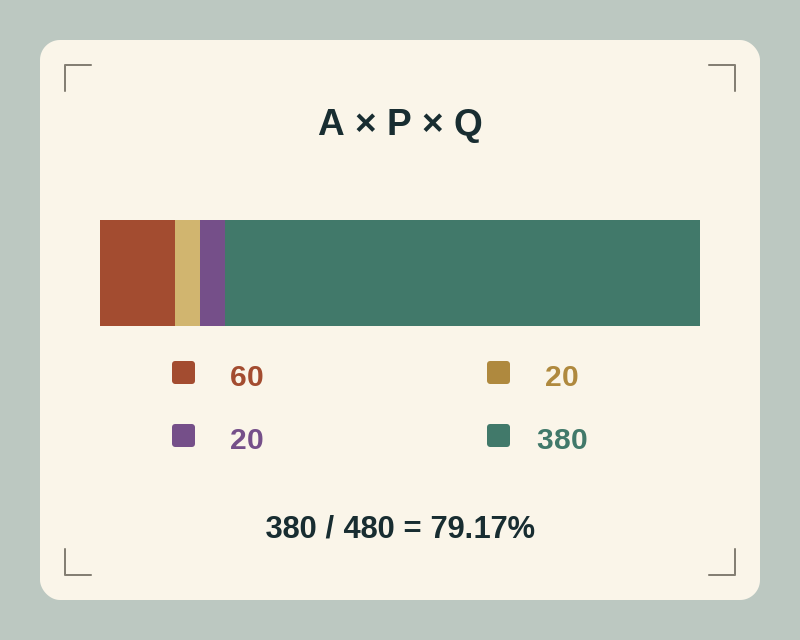
Las 380 unidades buenas, a un minuto ideal cada una, representan 380 minutos plenamente productivos equivalentes. Sobre 480 planeados, reproducen el 79,17%. No significa que se hayan observado 380 minutos consecutivos sin problemas.
En el modelo, los cien minutos restantes se descomponen en 60 de paro, 20 de diferencia entre funcionamiento y tiempo ideal de las 400 piezas, y 20 equivalentes a las piezas que no cumplieron. La suma 60 + 20 + 20 + 380 = 480 permite comprobar la conciliación.
Investiga cada pérdida con evidencia
El desglose ayuda a elegir qué registro abrir: razones de paro, ciclos lentos o defectos. No identifica por sí solo una causa. Un rendimiento superior a 100% invita a comprobar ciclo ideal, tiempos y conteos antes de celebrarlo.
Guarda máquina, producto, periodo, definiciones, cifras y versión del ciclo. Para comparar periodos, revisa mezcla de productos y tiempo planeado. El resultado describe este uso del equipo; no demuestra demanda satisfecha, rentabilidad ni un nivel universal de desempeño adecuado.
OEE: reconstruct availability, performance and quality from one record
A machine can be running while losing speed or making units requiring correction. A single percentage of powered-on time loses those distinctions. OEE separates three factors before combining them.
Use planned time, run time, total production and good units with common boundaries; multiply the factors rather than adding their percentages.
Fix equipment, product and planned time
The fictional exercise observes one machine, one product and 480 minutes during which production was intended. That time already excludes periods without production intent; it does not automatically equal the whole shift or weekly calendar.
The stated ideal cycle is one minute per unit under optimal conditions. It is not the takt time required by demand. Keep the reference supporting that cycle: changing it without explanation changes the metric even if operations remain unchanged.
Record stops and units separately
The 480 minutes include 60 recorded stop minutes, leaving 420 minutes of run time. Total production is 400 units, with 380 passing the first time; twenty require correction or rejection under the exercise’s criteria.
Vorne defines OEE quality around good units without rework. If some are recovered later, preserve that result separately rather than retroactively making them first-time good units. Nor should a repair count as a newly manufactured part in the same record.
Calculate three linked factors
Availability = 420 / 480 = 87.5%. Performance = (1 minute per unit × 400 units) / 420 minutes, approximately 95.24%. Quality = 380 / 400 = 95%. Each denominator preserves a different stage.
Multiply unrounded fractions: OEE = (420 / 480) × (400 / 420) × (380 / 400) = 380 / 480, approximately 79.17%. Do not add 87.5%, 95.24% and 95%, or take their average to obtain OEE.
Reconcile ideal minutes
The 380 good units, at one ideal minute each, represent 380 equivalent fully productive minutes. Dividing by 480 planned minutes reproduces 79.17%. This does not mean 380 consecutive problem-free minutes were observed.
In the model, the other hundred minutes comprise 60 stopped, 20 between run time and the 400 parts’ ideal time, and 20 equivalent to units that failed. The sum 60 + 20 + 20 + 380 = 480 checks the reconciliation.
Investigate each loss with evidence
The breakdown helps select records to inspect: stop reasons, slow cycles or defects. It does not identify a cause by itself. Performance above 100% calls for checking ideal cycle, times and counts before celebrating.
Keep machine, product, period, definitions, figures and cycle version. When comparing periods, review product mix and planned time. The result describes this equipment use; it establishes neither satisfied demand, profitability nor a universally appropriate performance level.
OEE:用同一记录重建可用率、性能率与质量率
机器即使运行,也可能速度下降或产出需要返工的单位。单看开机时间比例,会丢失这些区别。OEE 先区分三个因素,再将它们组合。
计划时间、运行时间、总产量和合格数量必须采用共同边界;应相乘,而不是相加百分比。
固定设备、产品与计划时间
虚构练习观察一台机器、一种产品,以及计划生产的 480 分钟。这已经排除了不打算生产的时段,并不自动等于整个班次或一周日历时间。
设定的理想周期是在最佳条件下每件一分钟,不是需求所要求的节拍时间。保留该周期的依据;无说明地修改它,即使操作不变,也会改变指标。
分开记录停机与数量
480 分钟内记录停机 60 分钟,剩余运行时间 420 分钟。总产量 400 件,其中 380 件首次通过;另外二十件按练习标准需要修正或报废。
Vorne 的 OEE 质量定义关注无需返工的合格品。如果后来修复部分产品,应另存结果,不应追溯改成首次合格;也不能在同一记录内把修理计为新生产的一件。
计算三个相连因素
可用率 = 420 / 480 = 87.5%。性能率 = (每件 1 分钟 × 400 件) / 420 分钟,约 95.24%。质量率 = 380 / 400 = 95%。各分母保留的是不同阶段。
先不要四舍五入,直接相乘:OEE = (420 / 480) × (400 / 420) × (380 / 400) = 380 / 480,约 79.17%。不能把三个百分比相加或取平均后当作 OEE。
用理想分钟数核对
380 件合格品,每件理想时间一分钟,对应等效完全生产时间 380 分钟。除以计划的 480 分钟,同样得到 79.17%。这不代表实际连续观察到 380 分钟毫无问题。
模型中,其余一百分为停机 60 分钟、运行时间与 400 件理想时间之差 20 分钟,以及不合格品对应的理想时间 20 分钟。60 + 20 + 20 + 380 = 480,可用于核对。
根据证据调查各项损失
明细帮助决定查看停机原因、慢周期还是缺陷记录,但本身不能识别原因。性能率超过 100% 时,应先核对理想周期、时间与数量。
保存设备、产品、期间、定义、数值与周期版本。比较期间时检查产品组合和计划时间。结果描述这次设备使用,不证明需求已满足、获得利润或达到某个通用适宜水平。
Fuentes y método
Fuentes consultadas el 24 de noviembre de 2026. Los casos y datos numéricos de los ejercicios son ficticios. Editorial standards · Disclosures.