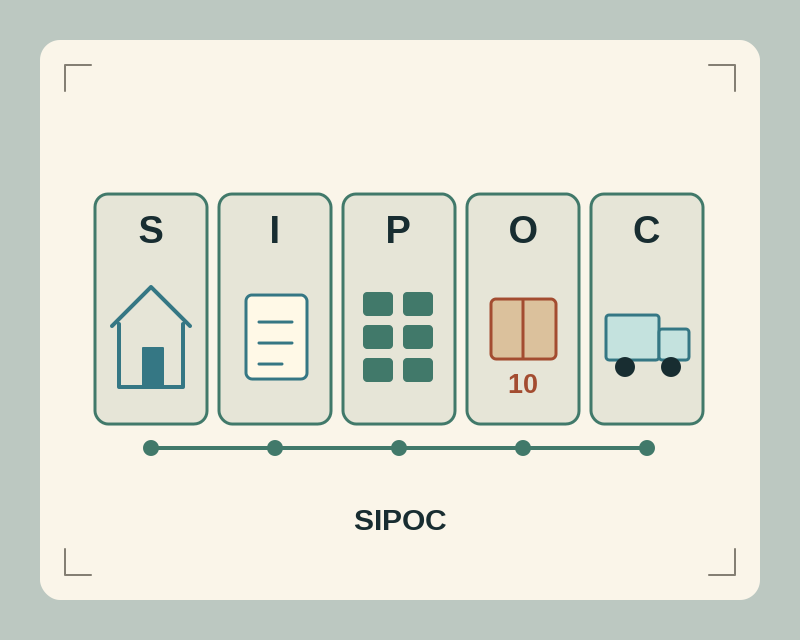
Write observable start and end points. Then follow SIPOC's five letters and check who hands what to whom.
Set two recognizable boundaries
The exercise begins when production receives the confirmed order and ends when it hands packed kits to dispatch. Commercial negotiation and subsequent transport fall outside this map. ASQ recommends defining boundaries before developing a SIPOC. Its SIPOC+CM version adds constraints and measures; here we start with the five base letters.
Identify suppliers and inputs
S means suppliers and I means inputs. In the fictional case, sales provides the order and approved artwork; stores provides paper and packaging. Describe a specific input: order reference, file version, quantity and material specification. One supplier may provide several inputs, and an input may have more than one supplier.
Summarize the main activities
P is the process. The team proposes six activities: receive the order, validate documents, prepare printing, print, check and pack for dispatch handoff. This is a high-level route. Machine instructions, every table movement and timing would be developed later, once scope is agreed.
Name the output and its user
O means outputs and C means process customers. The example's output is an order of ten packed, identified kits with its verification record. Dispatch is the internal customer receiving it to continue its work. A map's customers do not all have to be the people paying for the final purchase.
Walk through an interface together
Ask dispatch what it needs to accept the order and return to the described output. If box identification is missing, add that requirement and review which input or activity enables it. Keep date, version and open questions. SIPOC organizes scope and interfaces; it does not yet establish the delay's cause or how much the process improved.
Follow the evidence.
Sources checked November 21, 2026. The exercise scenarios and figures are fictional. Our editorial standards.