Escribe duraciones y dependencias antes de dibujar fechas. Calcula los caminos completos y vuelve a revisarlos cuando cambie una tarea, un recurso o un calendario.
Define qué significa terminar cada tarea
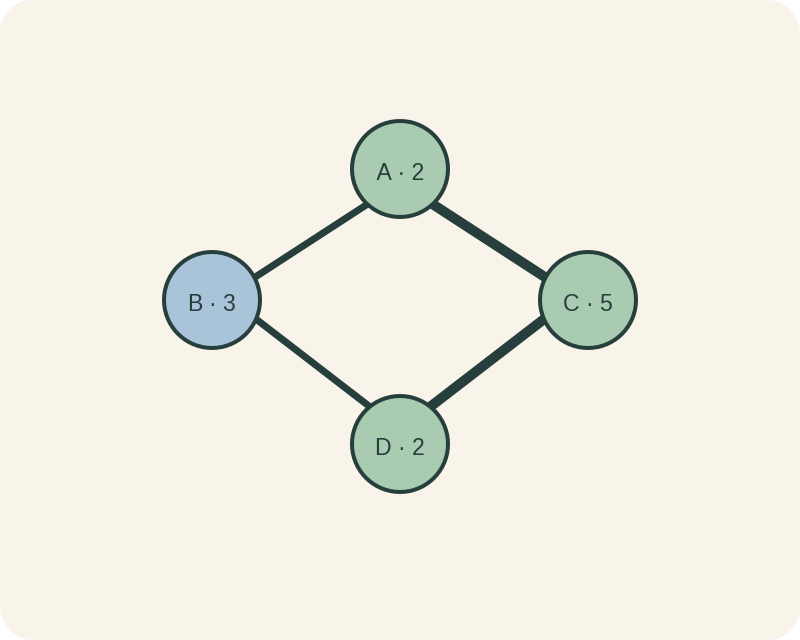
En un taller ficticio, A prepara el diseño, B imprime etiquetas, C reúne materiales y D arma el lote de muestra. La impresión y la preparación de materiales necesitan el diseño. El armado necesita ambos resultados.
Define qué salida permite iniciar la siguiente tarea. “Trabajar en el diseño” deja un límite confuso; “diseño aprobado y archivo listo” permite revisar la dependencia.
Fija las condiciones del cálculo
El ejemplo utiliza días laborables de un calendario común, duraciones estimadas y dependencias de fin a inicio, sin esperas adicionales. Supone recursos disponibles para que B y C trabajen simultáneamente.
APM describe la ruta crítica mediante duraciones y relaciones lógicas. Si una misma persona o máquina debe ejecutar B y C, revisa también esa restricción antes de prometer una fecha.
Calcula el final más temprano
| Tarea | Duración | Predecesora | Fin más temprano |
|---|---|---|---|
| A | 2 días | Ninguna | 2 |
| B | 3 días | A | 5 |
| C | 5 días | A | 7 |
| D | 2 días | B y C | 9 |
El camino A–B–D dura 7 días y A–C–D dura 9. D puede empezar cuando ambos resultados estén disponibles, en el día relativo 7. El final más temprano del conjunto es 9 bajo estos supuestos.
A–C–D es la ruta crítica de esta red. Puede existir más de una ruta crítica cuando varios caminos tienen la misma duración determinante.
Interpreta la espera del camino más corto
B termina en 5 y D necesita esperar hasta 7 por C. En esta red sencilla, B dispone de dos días de holgura total sin mover el final. Si B tarda cuatro días en vez de tres, termina en 6 y el proyecto todavía puede acabar en 9.
La holgura pertenece al plan calculado. Una nueva dependencia, una fecha impuesta o un recurso compartido puede cambiarla.
Prueba un retraso que sí mueve el final
Si C pasa de cinco a seis días y todo lo demás permanece igual, termina en 8 y D en 10. Si B creciera lo suficiente, su camino también podría convertirse en el que determina el final.
Microsoft explica que la ruta crítica puede cambiar a lo largo del proyecto. Recalcula con el trabajo restante y conserva la versión anterior para explicar la diferencia.
Lleva el dibujo a una conversación operativa
Guarda tarea, salida esperada, duración, predecesoras, calendario y responsable. Pregunta qué supuesto necesita confirmarse primero. La ruta permite localizar dependencias que afectan el plazo; la capacidad real y las incertidumbres necesitan su revisión junto al cálculo.
A small project’s critical path starts with dependencies
Four tasks do not always run one after another. Some wait for earlier outputs while others can proceed together. Those relationships determine which path sets the plan’s finish.
Write durations and dependencies before dates. Calculate complete paths and review them when tasks, resources or calendars change.
Define what finishes each task
In a fictional workshop, A prepares the design, B prints labels, C gathers materials and D assembles the sample batch. Printing and material preparation need the design. Assembly needs both outputs.
Define the output allowing the next task to begin. “Working on design” leaves a vague boundary; “approved design and ready file” makes the dependency reviewable.
Set the calculation’s conditions
The example uses working days on one calendar, estimated durations and finish-to-start dependencies without extra lags. Resources are assumed available for B and C to run together.
APM describes critical paths through durations and logical relationships. If B and C need one person or machine, inspect that constraint before promising a finish date.
Calculate the earliest finish
| Task | Duration | Predecessor | Earliest finish |
|---|---|---|---|
| A | 2 days | None | 2 |
| B | 3 days | A | 5 |
| C | 5 days | A | 7 |
| D | 2 days | B and C | 9 |
A–B–D takes 7 days and A–C–D takes 9. D starts when both outputs are available, at relative day 7. The earliest overall finish is 9 under these assumptions.
A–C–D is this network’s critical path. Multiple critical paths can exist when several paths share the determining duration.
Interpret the shorter path’s wait
B finishes at 5 while D waits until 7 for C. In this simple network, B has two days of total float without moving the finish. If B takes four days instead of three, it finishes at 6 and the project can still end at 9.
Float belongs to the calculated plan. A new dependency, imposed date or shared resource can change it.
Try a delay that moves the finish
If C changes from five to six days with everything else unchanged, it finishes at 8 and D at 10. If B grows enough, its path can also become the one determining the finish.
Microsoft explains that the critical path can change during a project. Recalculate remaining work and keep the prior version to explain differences.
Use the diagram in an operational discussion
Keep task, expected output, duration, predecessors, calendar and owner. Ask which assumption needs confirmation first. The path locates dependencies affecting the finish; review real capacity and uncertainty alongside the calculation.
小项目的关键路径从依赖关系开始
四项任务未必逐项串行。有些要等前项输出,有些可同时推进。这些关系决定哪条路径控制计划终点。
先写工期和依赖,再安排日期。计算完整路径,并在任务、资源或日历改变时复核。
定义各任务怎样才算结束
虚构工坊中,A 准备设计,B 印标签,C 备材料,D 组装样品批次。印刷和备料都依赖设计,组装依赖两项结果。
明确什么输出允许下一项开始。“做设计”边界不明,“设计批准且文件可用”则能检查依赖。
确定计算条件
本例采用同一工作日历、估计工期、完成后开始的依赖,无额外等待。假定资源足以让 B 与 C 并行。
APM 用工期与逻辑关系描述关键路径。如果 B 和 C 都依赖同一人或机器,承诺日期前还应检查资源限制。
计算最早结束时点
| 任务 | 工期 | 前置任务 | 最早结束 |
|---|---|---|---|
| A | 2 天 | 无 | 2 |
| B | 3 天 | A | 5 |
| C | 5 天 | A | 7 |
| D | 2 天 | B 与 C | 9 |
A–B–D 为 7 天,A–C–D 为 9 天。D 要等两项输出齐备,最早在相对第 7 天开始。这些假设下,整体最早在 9 结束。
A–C–D 是本网络的关键路径。多条路径具有相同决定性工期时,可以存在多条关键路径。
理解较短路径上的等待
B 在 5 结束,D 因 C 等到 7。本简单网络中,B 有两天总浮动时间而不改变终点。B 从三天变四天时,在 6 结束,项目仍可在 9 完成。
浮动时间属于计算出的计划。新依赖、强制日期或共享资源都可能改变它。
测试会移动终点的延误
若 C 从五天变六天,其他不变,则在 8 结束,D 在 10 结束。如果 B 延长得足够多,它的路径也可能控制终点。
Microsoft 说明关键路径可能在项目中变化。按剩余工作重新计算,保留旧版本以解释差异。
把图用于具体工作讨论
保存任务、预期输出、工期、前置项、日历和负责人,询问首先需确认哪个假设。路径帮助找出影响工期的依赖,实际产能和不确定性仍需结合计算检查。
Fuentes y método
Fuentes consultadas el 6 de noviembre de 2026. Los escenarios y cifras ilustrativos son ficticios. Ejercicios y fichas originales, sin resultados de clientes ni observaciones de campo atribuidos. Editorial standards · Disclosures.