Write durations and dependencies before dates. Calculate complete paths and review them when tasks, resources or calendars change.
Define what finishes each task
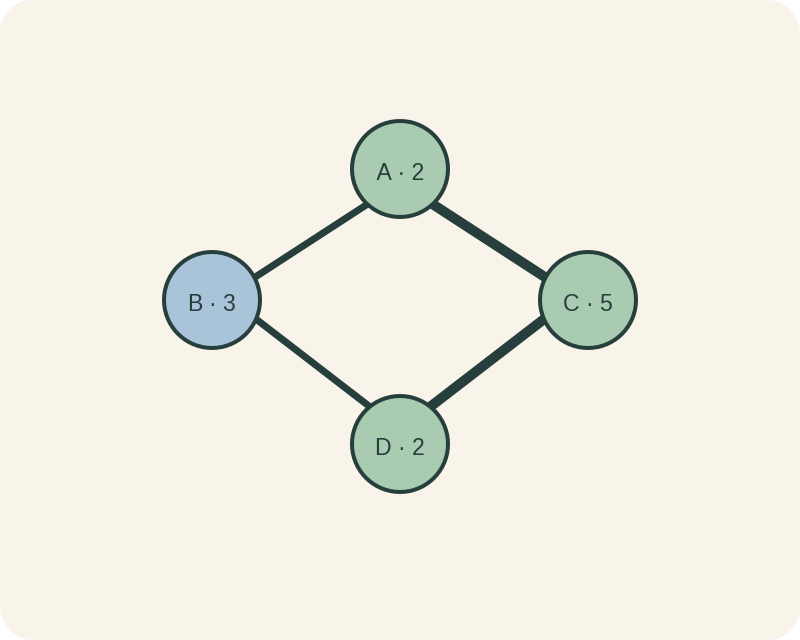
In a fictional workshop, A prepares the design, B prints labels, C gathers materials and D assembles the sample batch. Printing and material preparation need the design. Assembly needs both outputs.
Define the output allowing the next task to begin. “Working on design” leaves a vague boundary; “approved design and ready file” makes the dependency reviewable.
Set the calculation’s conditions
The example uses working days on one calendar, estimated durations and finish-to-start dependencies without extra lags. Resources are assumed available for B and C to run together.
APM describes critical paths through durations and logical relationships. If B and C need one person or machine, inspect that constraint before promising a finish date.
Calculate the earliest finish
| Task | Duration | Predecessor | Earliest finish |
|---|---|---|---|
| A | 2 days | None | 2 |
| B | 3 days | A | 5 |
| C | 5 days | A | 7 |
| D | 2 days | B and C | 9 |
A–B–D takes 7 days and A–C–D takes 9. D starts when both outputs are available, at relative day 7. The earliest overall finish is 9 under these assumptions.
A–C–D is this network’s critical path. Multiple critical paths can exist when several paths share the determining duration.
Interpret the shorter path’s wait
B finishes at 5 while D waits until 7 for C. In this simple network, B has two days of total float without moving the finish. If B takes four days instead of three, it finishes at 6 and the project can still end at 9.
Float belongs to the calculated plan. A new dependency, imposed date or shared resource can change it.
Try a delay that moves the finish
If C changes from five to six days with everything else unchanged, it finishes at 8 and D at 10. If B grows enough, its path can also become the one determining the finish.
Microsoft explains that the critical path can change during a project. Recalculate remaining work and keep the prior version to explain differences.
Use the diagram in an operational discussion
Keep task, expected output, duration, predecessors, calendar and owner. Ask which assumption needs confirmation first. The path locates dependencies affecting the finish; review real capacity and uncertainty alongside the calculation.
Follow the evidence.
Sources checked November 6, 2026. Illustrative scenarios and numbers are fictional. Original exercises and records, without attributed customer results or field observations. Our editorial standards.