Elige un ave y describe pocos rasgos observables. Mantén separadas la nota de campo y la identificación que propones después.
Empieza por la silueta
Observa si el cuerpo parece compacto o alargado y cómo se relacionan cabeza, cola y patas. Audubon recomienda atender tamaño, estructura y proporciones antes de depender solo del plumaje. Si hay otra ave cerca, una comparación relativa puede ayudar; una estimación a distancia no equivale a una medida en centímetros.
Mira el pico y un patrón visible
Anota si el pico se ve corto o largo, grueso o fino, recto o curvado. Añade un contraste concreto, como una franja clara en el ala o una zona oscura alrededor del ojo, si realmente lo distingues. La luz y la distancia pueden ocultar colores. Es mejor conservar «no pude verlo» que completar la ficha de memoria.
Describe una acción sin inventar su motivo
Puedes escribir que saltó entre dos ramas, caminó por el suelo o movió la cola al posarse. Añade lugar, fecha y entorno: patio con árboles, borde de agua u otro contexto observado. «Buscaba comida» ya propone una interpretación si no viste qué tomó. Las acciones pueden aportar pistas junto a la forma.
Prueba con una nota ficticia
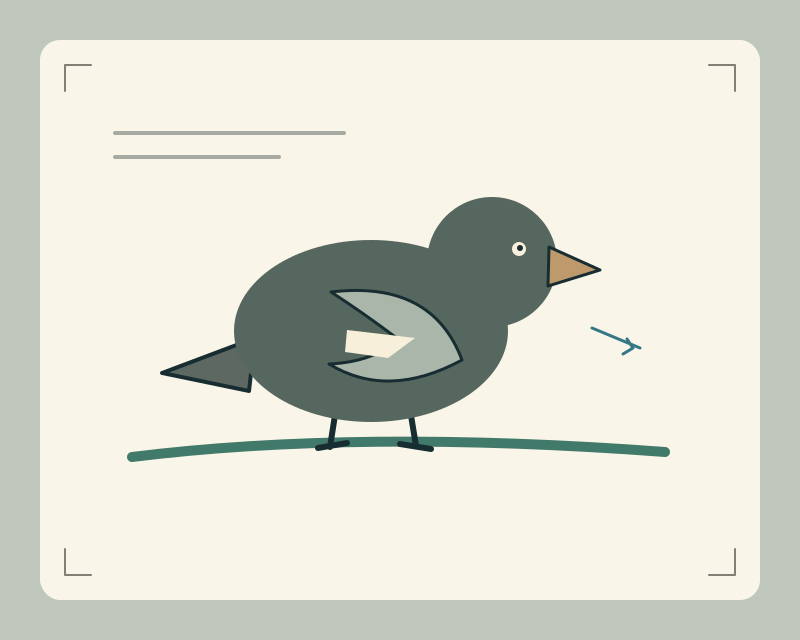
Una ficha de práctica podría decir: «Cuerpo compacto, pico corto y grueso, cola más corta que el cuerpo; una zona clara en el ala; saltó en una rama. Tamaño y color del pecho, sin confirmar». Es un ejemplo inventado que no corresponde aquí a una especie identificada. Un croquis sencillo puede marcar dónde viste el contraste.
Consulta después y conserva la duda
Compara tus rasgos con una guía que cubra la región y la época. Busca qué característica permitiría distinguir las opciones que quedan, sin sustituir lo observado por la imagen del libro. Puedes terminar con dos posibilidades o con el ave sin identificar. La próxima observación servirá para mirar una pista concreta, manteniendo distancia para no alterar su actividad.
Before naming a bird, keep the features you actually saw
You see a bird for a few seconds and remember that it looked brown. Opening a guide reveals many possibilities. The next encounter can be more useful if you first retain its shape, a few contrasts and what it was doing, without rushing to choose a name.
Choose one bird and describe a few observable features. Keep the field note separate from the identification you propose later.
Start with the silhouette
Observe whether the body looks compact or elongated and how head, tail and legs relate. Audubon recommends attending to size, structure and proportions before relying only on plumage. Another nearby bird can provide a relative comparison; a distant estimate is not a measurement in centimeters.
Inspect the bill and a visible pattern
Note whether the bill looks short or long, thick or thin, straight or curved. Add a specific contrast, such as a pale wing stripe or dark area around the eye, if you truly distinguish it. Lighting and distance can obscure colors. “Could not see” is better than completing the note from memory.
Describe an action without inventing its purpose
You might write that it hopped between two branches, walked on the ground or moved its tail on landing. Add location, date and observed surroundings: a tree-filled yard, water's edge or another setting. “Was looking for food” is already an interpretation if you did not see what it took. Actions can offer clues alongside shape.
Try a fictional note
A practice entry could read: “Compact body, short thick bill, tail shorter than body; pale area on wing; hopped on a branch. Size and breast color unconfirmed.” This invented example is not assigned an identified species here. A simple sketch can mark where you saw the contrast.
Consult a guide later and preserve uncertainty
Compare your features with a guide covering the region and season. Look for a characteristic that could distinguish remaining options, without replacing observations with the book's picture. Ending with two possibilities or an unidentified bird is fine. The next observation can focus on one clue, keeping enough distance to avoid disrupting its activity.
给鸟命名前,先保存确实看到的特征
你只看见一只鸟几秒,记得它似乎是褐色,打开图鉴却有很多可能。下次遇见时,可先记下形状、几处对比和行为,不急着选名字。
只选一只鸟,描述少量可观察特征,把现场记录与后来提出的鉴定分开。
从轮廓开始
观察身体紧凑还是修长,头、尾、腿之间的比例如何。Audubon 建议先注意大小、结构和比例,再考虑单靠羽色识别。附近另一只鸟可能提供相对参照,但远处估计并不是以厘米测量。
看鸟喙和可见花纹
记录喙看起来长短、粗细、直或弯。若确实看清,可添加具体对比,如翅上的浅色条纹或眼周深色区域。光线与距离可能遮住颜色。写“没看清”比凭记忆补全记录更合适。
描述动作,不编造目的
可记录它在两根枝条间跳跃、在地面行走,或落下时摆动尾巴。补充地点、日期与所见环境,如有树的庭院、水边或其他场景。若没看到它取到什么,“正在找食物”已属于解释。动作能与形状一起提供线索。
试写一份虚构记录
练习可写:“身体紧凑,喙短且粗,尾比身体短;翅上有浅色区域;在枝上跳。大小和胸部颜色未确认。”这是虚构示例,这里不把它对应到已鉴定物种。简单草图可以标明对比出现的位置。
稍后查阅,并保留疑问
用覆盖本地区和季节的图鉴对照特征,寻找能区分剩余选项的特点,不用书中图片取代观察。最后保留两个可能或暂不鉴定,都可以。下次观察可专注一条线索,并保持不干扰鸟类活动的距离。
Fuentes y método
Fuentes consultadas el 21 de noviembre de 2026. Los casos y datos numéricos de los ejercicios son ficticios. Editorial standards · Disclosures.