Put yourself at the drawing’s center and use your own symbols. Record what you hear, retain uncertainty about sources and compare two moments from one position.
Choose a place where you can stay
Sit in a yard, by a window or somewhere comfortable to pause and listen. Prepare paper and pencil. Note date, time and a short location reference without trying to describe the entire setting.
The National Park Service proposes listening maps to recognize sounds in a landscape. Our exercise adds a legend and two short rounds for comparing personal observations.
Draw a reference for your position
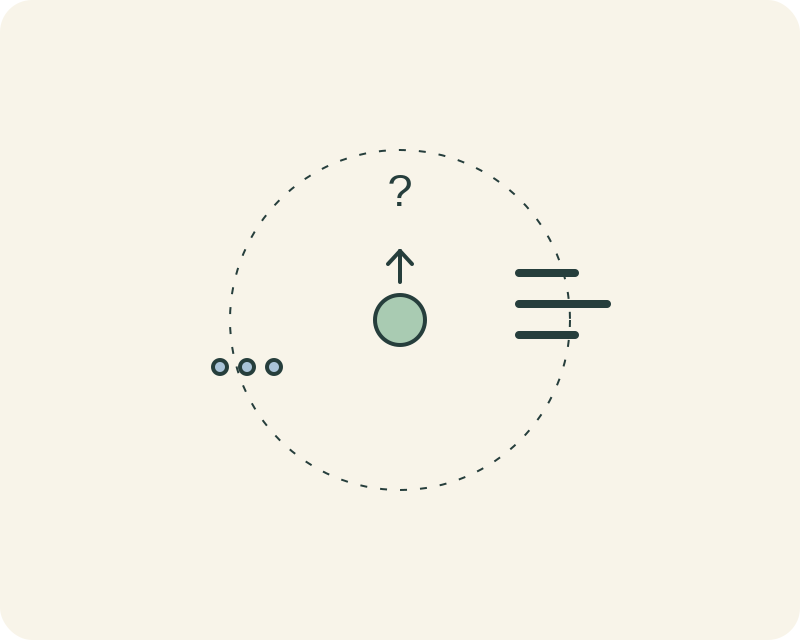
Mark a central point labeled me and an arrow showing where you face. Use ahead, behind, left and right as relative references. Note any change in orientation to avoid mixing drawings.
This is a listening sketch. Drawn distance can express a near or far impression without becoming a measurement in meters.
Invent a few symbols and try them
| Mark | Meaning | Example note |
|---|---|---|
| Long line | Continuous sound | Rumble to the right |
| Separate dots | Intermittent sound | Knocks behind |
| Question mark | Unconfirmed source | Whistle ahead |
The table does not describe an actual listening session. Change symbols if another set is clearer. Leave a legend in the margin to remember their meaning.
Separate audible qualities from an imagined source. “Brief knocks” describes perception; “someone hammering” proposes an origin needing confirmation.
Listen twice with a pause
Try a first round of two or three minutes and mark a few sounds. Pause, then repeat from the same point using the same criteria. Use another color or sheet to distinguish rounds.
Compare what continued, appeared or disappeared. A sound absent in the second round may have stopped or been masked by another. Keep that uncertainty if unresolved.
Read a relationship that interests you
A continuous line might fill one side while brief sounds occupy another. Ask whether you noticed the nearest, most repeated or most surprising sound first. With a partner, compare sheets before seeking an explanation.
Human and animal sounds can share a place. Classifying a source does not by itself determine how the setting should feel.
Keep a small question
Save position, orientation, times and legend with the sketch. On another day, compare conditions and remembered perceptions. You can also leave the page there: the activity may simply mean listening more closely for a few minutes.
Follow the evidence.
Sources checked November 6, 2026. Illustrative scenarios and numbers are fictional. Original exercises and records, without attributed customer results or field observations. Our editorial standards.