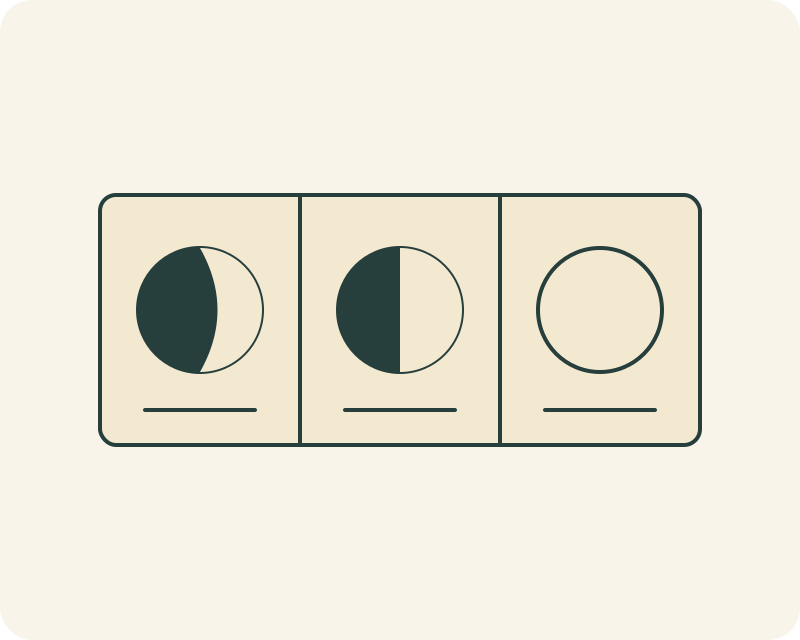
Record date, time, general location and observed shape. Compare the illuminated portion across days and keep uncertainties instead of inventing a missed observation.
Begin with a brief observation
Choose somewhere comfortable for looking at the sky and draw a small circle on paper. If the Moon is visible, roughly mark the bright portion as you see it. This first exercise needs neither a precise drawing nor a telescope.
Write the date, local time, time zone and a general location reference. Avoid turning the notebook into a daily obligation: an incomplete observation can remain a question for another occasion.
Separate light and visible surface
NASA explains that moonlight is reflected sunlight and that the Sun illuminates one half of the Moon. Phases concern how much of that illuminated half we see as its orbital position changes. Darkness in a drawing does not mean surface has disappeared.
The US Naval Observatory distinguishes phases by shape and illuminated proportion. Waxing indicates an increasing visible illuminated fraction; waning indicates a decreasing one. Compare moments instead of relying only on which side looked bright.
Try a record with visible conditions
This is a proposed blank record, not a journal of observations made by the publication. You can copy it without publishing your exact location.
| Field | What to record | Purpose |
|---|---|---|
| Moment | Date, time and time zone | Order observations |
| Context | General place and horizon reference | Interpret orientation |
| Shape | Approximate drawing and bright portion | Compare what was seen |
| Conditions | Clouds, obstructions or incomplete visibility | Retain limits |
If a cloud covers part of the Moon, draw or describe that limitation separately. Do not mistake a passing cloud or building edge for the phase boundary.
Compare drawings before naming a phase
On another occasion, examine whether the bright portion covers more or less of the disk than before. Retain paper orientation too: rotating a drawing can change which side looks illuminated without changing the phase represented.
NASA’s Daily Moon Guide supplies a phase and illuminated-fraction reference to compare with your note. A complete phase cycle takes approximately 29.5 days; do not expect it always to match the same calendar dates.
Separate observation and reference lookup
Write “I saw roughly half a bright disk” as an observation and put the phase name found in a source on another line. If they seem inconsistent, inspect date, time and orientation before redrawing from memory.
This guide offers neither a city visibility forecast nor a phase assigned to tonight. Horizon, timing and local conditions require their own checks. Not finding the Moon during a quick look does not establish a new Moon.
Choose a question for next time
Follow one relationship: changing shape, location relative to the horizon or uncertainty left by the sketch. The notebook supports looking again rather than assembling a perfect phase collection in one week.
The related contour exercise follows a nearby object from different positions. Here we compare a celestial object over time and retain observing conditions. If you simply enjoy the view one night, the exercise can end there too.
Follow the evidence.
- NASA · Moon phases ↗
- US Naval Observatory · Phases and percent illuminated ↗
- NASA · Daily Moon Guide ↗
Sources checked November 2, 2026. Illustrative scenarios and numbers are fictional. Original exercises and records, without attributed customer results or field observations. Our editorial standards.