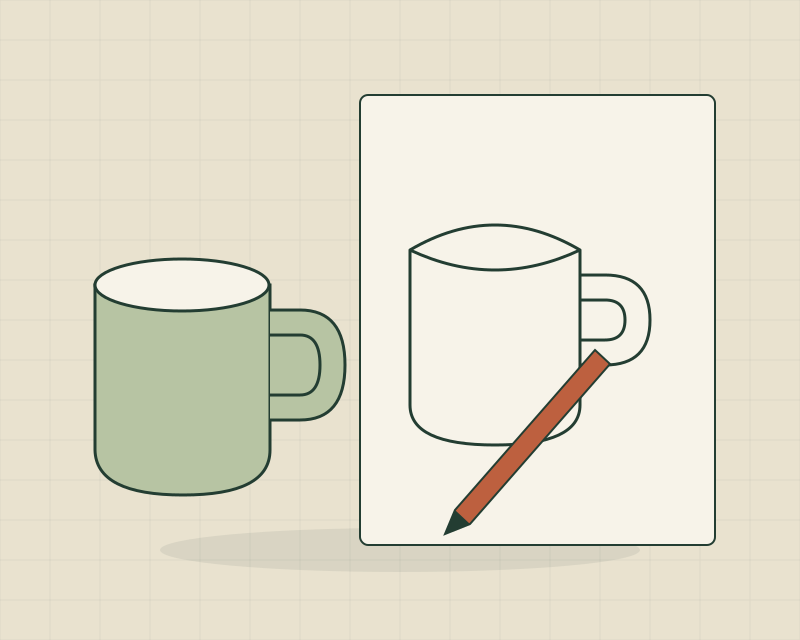
Sigue un borde visible, conserva el punto de vista y compara otra posición del mismo objeto. El dibujo puede quedarse en un ensayo privado, con sus diferencias y preguntas.
Elige un objeto que puedas mantener quieto
Busca una taza propia, un zapato o una botella vacía, papel y una herramienta que ya uses. Coloca el objeto donde puedas verlo con comodidad y deja espacio para apoyar la hoja. No necesitas comprar un juego de materiales ni preparar una naturaleza muerta completa.
El ejercicio propuesto utiliza una taza sin decoraciones como ejemplo. No reproducimos una obra del museo ni afirmamos haber realizado la sesión. La guía del espacio creativo puede ayudar a preparar y recoger una mesa compartida.
Distingue un borde de un nombre
La National Gallery of Art describe el dibujo de contorno mediante líneas continuas largas que expresan la forma del objeto. Aquí tomamos esa idea para observar una taza desde una posición elegida, sin trasladar toda su lección a una receta obligatoria.
Mira dónde cambia la dirección del borde: abertura, cuerpo, base y asa visible. Una taza reconocible puede tener proporciones distintas de las que esperas. Si no ves el extremo posterior del asa, no hace falta inventarlo para completar el objeto “correcto”.
Haz una primera versión siguiendo lo visible
Escoge un punto reconocible del borde y recórrelo con la mirada mientras avanzas con el lápiz. Puedes detenerte y volver a mirar. Intenta que una línea explique un recorrido antes de añadir muchas correcciones encima. No hay velocidad ni tiempo mínimo que debas cumplir.
Observa relaciones: ¿la abertura parece más ancha que alta?, ¿dónde se une el asa?, ¿qué parte queda oculta? El hueco dentro del asa también tiene forma. Deja sombras y detalles para después si te distraen de esta pregunta inicial.
Cambia una condición para otra versión
| Versión | Condición | Pregunta |
|---|---|---|
| A | Asa hacia un lado | ¿Qué hueco y uniones se ven? |
| B | Giro parcial, misma silla | ¿Qué borde desaparece o se superpone? |
Haz el giro sin cambiar también la altura de la silla y la posición de la hoja si quieres reconocer su efecto. No estás midiendo una perspectiva universal: comparas tus observaciones de dos posiciones. Conserva ambos dibujos, aunque el segundo no te guste más.
El collage organiza formas recortadas. Aquí las líneas se construyen mirando un objeto, y una parte puede desaparecer de la vista cuando gira.
Compara una relación antes de juzgar el conjunto
- ¿Dónde se separan el borde observado y el que dibujaste?
- ¿Qué abertura cambió al girar la taza?
- ¿Qué línea añadiste por recuerdo más que por observación?
- ¿Qué detalle querrías mirar otra vez?
Puedes escribir “dibujé el asa completa aunque una parte estaba oculta”. Esa nota abre otra prueba sin calificar tu capacidad. Si compartes el dibujo, pide que comenten una relación visible, no que decidan si “tienes talento”.
Decide si quieres continuar o dejarlo aquí
Puedes repetir un solo tramo, cambiar de objeto o añadir otra técnica después. Guarda fecha y posición si te interesa volver. No es necesario borrar la primera versión, exponerla ni convertir cada práctica en contenido de marca.
Nuestro paseo de observación atiende decisiones de un lugar; esta sesión explora la relación entre mirada y línea. El resultado puede ser haber visto un borde que antes dabas por hecho, sin promesas profesionales o efectos de salud atribuidos.
Draw an Everyday Object’s Contour to Look at It Again
Knowing what a mug is called does not determine the lines visible from your chair. Drawing its contour invites attention to relationships before completing a remembered shape.
Follow a visible edge, retain the viewpoint and compare another object position. The drawing can remain a private trial with differences and questions.
Choose an object that can stay still
Find your own mug, shoe or empty bottle, paper and an already familiar drawing tool. Place the object where you can comfortably see it and leave space for the sheet. You need neither a new material set nor a complete still life.
Our proposed example uses an undecorated mug. We reproduce no museum work and claim no completed session. The creative space guide can help prepare and clear a shared table.
Separate an edge from a name
The National Gallery of Art describes contour drawing through long continuous lines conveying an object’s shape. We use that idea to observe a mug from one chosen position, without turning its entire lesson into a mandatory recipe.
Look where the edge changes direction: opening, body, base and visible handle. A recognizable mug can have unexpected proportions. An invisible rear handle edge need not be invented to complete the “correct” object.
Make a first version from what is visible
Choose a recognizable edge point and follow it with your gaze while advancing the pencil. Pause and look again where needed. Try letting one line explain a route before layering many corrections. There is no required speed or minimum time.
Notice relationships: does the opening look wider than tall, where does the handle meet the body, and what is hidden? The handle’s empty opening has a shape too. Leave shading and details for later if they distract from this initial question.
Change one condition for another version
| Version | Condition | Question |
|---|---|---|
| A | Handle toward one side | Which opening and joins are visible? |
| B | Partial turn, same chair | Which edge disappears or overlaps? |
Avoid changing chair height and sheet position simultaneously if you want to recognize the turn’s effect. You are comparing two observations, rather than measuring a universal perspective. Keep both drawings even if you prefer the first.
Collage arranges cut shapes. Here lines emerge from looking at an object, and part can disappear from view when it turns.
Compare one relationship before judging the whole
- Where do observed and drawn edges diverge?
- Which opening changed after turning the mug?
- Which line came from memory rather than observation?
- Which detail would you like to inspect again?
A note could say: “I drew the whole handle although part was hidden.” That opens another trial without rating ability. If sharing, request comments on a visible relationship rather than a verdict on talent.
Choose whether to continue or stop here
Repeat one section, change objects or add another technique later. Keep date and position if useful. The first version need not be erased, exhibited or turned into brand content.
Our observation walk considers place-design decisions; this session explores looking and line. Noticing a previously overlooked edge can be the result, without professional promises or attributed health effects.
画日常物品的轮廓,再看它一次
知道“杯子”这个名称,不代表知道从椅子上能看见哪些线。画轮廓邀请你先看具体关系,再补上记忆中的形状。
跟随可见边缘,保持观察位置,比较同一物体的另一摆放角度。图画可以只是私人练习,保留差异和问题。
选一个能保持静止的物品
准备自己的杯子、鞋或空瓶、纸和熟悉的绘画工具。把物品放在能舒适观察的位置,为纸张留出空间。无需购买整套材料,也不用布置完整静物。
本练习以没有装饰的杯子为例,不复制博物馆作品,也不声称实际开展了这次练习。本站创作空间指南可以帮助准备和收拾共用桌面。
区分边缘与名称
National Gallery of Art 用连续长线表达物体形状来说明轮廓绘画。这里借用该想法,从选定位置观察杯子,不把其整份课程变成必须遵守的步骤。
看边缘在哪里改变方向:杯口、杯身、底部和可见杯把。熟悉的杯子可能有意料之外的比例。若看不到杯把后侧,不必凭空补齐来画出“正确”的物品。
根据可见内容画第一版
选择容易识别的边缘起点,视线沿边移动,铅笔随之推进。可以停下来重新看。先尝试用一条线说明路径,再考虑叠加修改。没有规定速度,也没有必须坚持的最低时间。
观察关系:开口是否看起来宽于高?杯把在哪里与杯身相接?哪些部分被遮住?杯把内部空隙也有形状。若阴影和细节分散注意,可留待以后。
第二版只改变一个条件
| 版本 | 条件 | 问题 |
|---|---|---|
| A | 杯把朝一侧 | 能看到什么空隙和连接? |
| B | 部分转动,椅子不变 | 哪条边消失或重叠? |
若想识别转动效果,不要同时改变椅子高度和纸张位置。这不是测定通用透视规律,而是比较你的两次观察。即使更喜欢第一版,也保留两张。
本站拼贴练习安排剪下的形状;这里的线来自观察物体,转动后有些部分可能不再可见。
先比较一项关系,再评价整体
- 观察到的边缘和画出的边缘在哪里不同?
- 转动杯子后哪个空隙改变?
- 哪条线更多来自记忆?
- 还想重新看哪个细节?
可以写:“虽然杯把部分被遮住,我仍画了完整杯把。”这会开启下一次尝试,不必评价能力。若分享图画,可请对方评论可见关系,而不是判断你“有没有天赋”。
决定继续,或停在这里
可以只重画一段、换物品,或以后再加其他技法。若想回看,可记日期和位置。不必擦掉第一版、展示作品,也不必把每次练习转成品牌内容。
本站观察散步关注场所的设计决定,这次则探索视线与线条的关系。结果可以只是注意到曾被忽略的边缘,无需专业承诺或健康效果说法。
Fuentes y método
Fuentes consultadas el 27 de octubre de 2026. Los escenarios y cifras ilustrativos son ficticios. Las fichas y ejercicios son propuestas editoriales originales, sin resultados de clientes ni pruebas de proveedores atribuidos. Editorial standards · Disclosures.