Locate the leaf base and its axillary bud; if the junction is hidden, preserve uncertainty instead of counting every leaflet as a leaf.
Find a visible connection to the stem
Choose an accessible plant you can observe without removing parts. You need more than a blade: include the stem, its junction and the small space beside the leaf base. A photograph of a detached piece can lose that evidence.
NC State explains that an axillary bud marks the base of the entire leaf. A compound leaf’s leaflets lack that bud at their own bases. The clue lies in the structural junction rather than just the green part’s size or color.
Distinguish petiole, axis and leaflets
In a petiolate leaf, the petiole connects the leaf to the stem. A compound leaf can divide its blade into several leaflets; in a pinnate arrangement, these lie along an axis called the rachis. That axis can resemble a twig.
Follow one green part toward its base and then the stem. Mark where you observe an axillary bud without confusing it with a terminal bud at a stem’s tip. You do not need a species name to start drawing those connections.
Compare two drawings with three blades
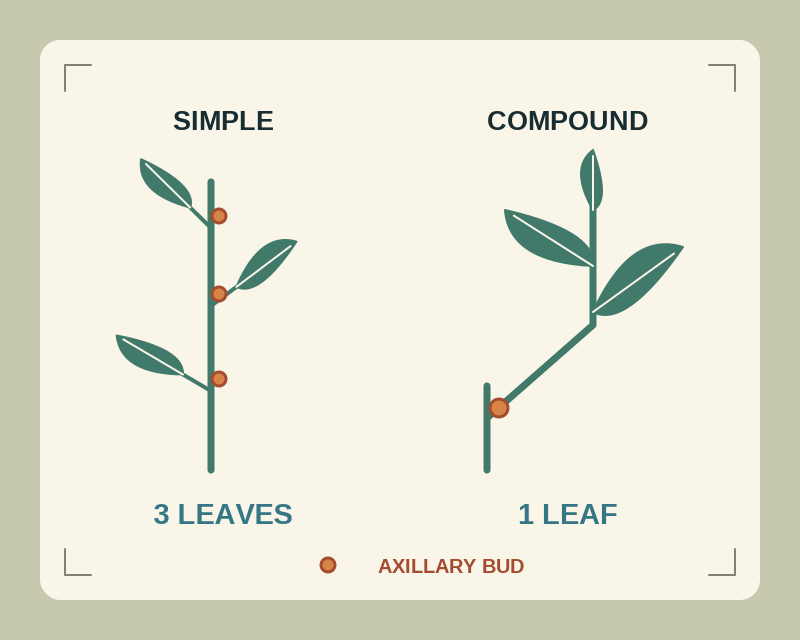
The schematic illustration’s left side shows three simple leaves attached to a stem, each with an axillary bud at its base. The right side shows one compound leaf with three leaflets and one axillary bud at the whole leaf’s junction with the stem.
Both drawings emphasize three green parts. Yet the complete-leaf count is three versus one. Orange circles mark the diagram’s axillary buds; they are not fruit and do not imply that real buds always have that color or size.
Do not decide from cut edges alone
The American Museum of Natural History resource distinguishes simple leaves, which can be lobed, from compound leaves with separate leaflets. A deeply cut outline therefore does not by itself establish that several leaflets are present.
If the base is hidden, record “unit unconfirmed” and take another view including the junction. A small or concealed bud can be hard to recognize. Do not turn “I cannot see it” into “it does not exist,” or force a count from an incomplete photograph.
Keep an observation you can revisit
Draw the stem, attachment point, observed bud and path to the blade or leaflets. Add date, location and an overview photograph. You can repeat the observation from another angle without cutting the plant.
The goal is to describe the unit counted and its supporting clue. It confirms neither species name, edibility nor medicinal use. A reader of your note should be able to separate what you saw from what still needs checking.
Follow the evidence.
- NC State Extension: Botany, leaves and axillary buds ↗
- American Museum of Natural History: Leaf Type ↗
Sources checked November 25, 2026. The exercise scenarios and figures are fictional. Our editorial standards.