Localiza la base de la hoja y su yema axilar; si la unión no se ve, conserva la duda en lugar de contar cada folíolo como una hoja.
Busca una unión visible con el tallo
Elige una planta accesible donde puedas observar sin arrancar partes. Necesitas ver algo más que una lámina: incluye el tallo, su unión y el pequeño espacio situado junto a la base de la hoja. Una fotografía de una pieza suelta puede perder esa evidencia.
NC State explica que la yema axilar delimita la base de la hoja completa. Los folíolos de una hoja compuesta carecen de esa yema en su propia base. La pista está en la unión estructural, no solo en el tamaño o el color de la parte verde.
Distingue pecíolo, eje y folíolos
En una hoja con pecíolo, este conecta la hoja con el tallo. Una hoja compuesta puede dividir su lámina en varios folíolos; en una disposición pinnada, estos se distribuyen a lo largo de un eje llamado raquis. Ese eje puede parecer una ramita.
Sigue una parte verde hacia su base y después hacia el tallo. Marca dónde observas una yema axilar, sin confundirla con una yema terminal en la punta de un tallo. No hace falta identificar la especie para empezar a dibujar esas conexiones.
Compara dos dibujos con tres láminas
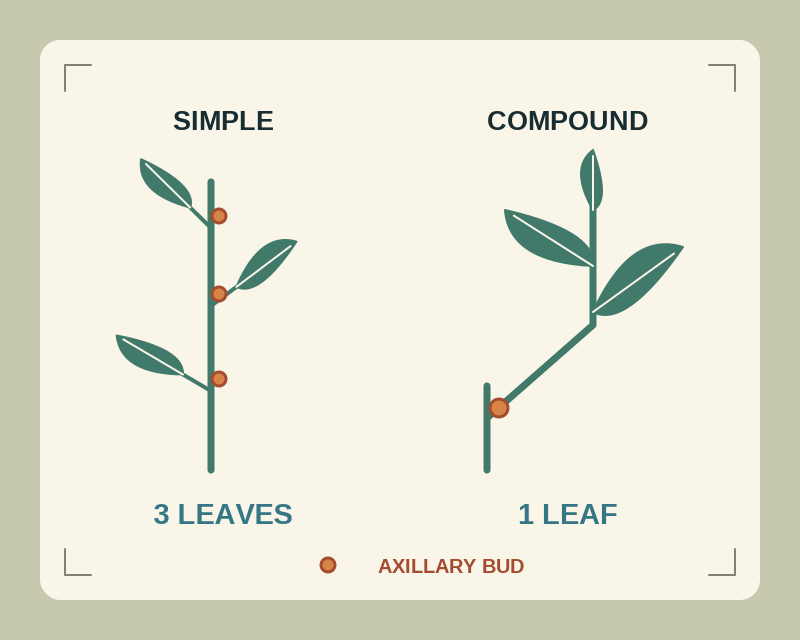
La ilustración esquemática de la izquierda muestra tres hojas simples unidas al tallo, cada una con una yema axilar en la base. El dibujo de la derecha muestra una hoja compuesta de tres folíolos y una sola yema axilar en la unión de la hoja completa con el tallo.
Ambos dibujos tienen tres partes verdes destacadas. Sin embargo, el conteo de hojas completas es tres frente a una. Los círculos naranjas marcan las yemas axilares del esquema; no representan frutos ni indican que toda yema real tenga ese color o tamaño.
No decidas solo por los cortes del borde
El recurso del American Museum of Natural History distingue hojas simples, que pueden tener lóbulos, de hojas compuestas con folíolos separados. Por eso una silueta muy recortada no demuestra por sí misma que estés viendo varios folíolos.
Si no puedes ver la base, anota «unidad sin confirmar» y toma otra vista con la unión incluida. Una yema pequeña u oculta puede ser difícil de reconocer. No conviertas «no la veo» en «no existe», ni fuerces el conteo a partir de una fotografía incompleta.
Guarda una observación que puedas revisar
Haz un dibujo con tallo, punto de unión, yema observada y recorrido hasta la lámina o los folíolos. Añade fecha, lugar y una fotografía general. Puedes repetir la observación desde otro ángulo sin cortar la planta.
El resultado buscado es describir la unidad que contaste y la pista que la sostiene. No confirma un nombre de especie, comestibilidad ni un uso medicinal. Si alguien revisa tu nota, debería poder distinguir lo que viste de lo que quedó pendiente de comprobar.
Leaf or leaflet: follow the connection to the axillary bud
Three green blades may be three leaves or parts of a single compound leaf. An isolated outline does not always settle the question. Follow the connection to the stem to observe the whole unit.
Locate the leaf base and its axillary bud; if the junction is hidden, preserve uncertainty instead of counting every leaflet as a leaf.
Find a visible connection to the stem
Choose an accessible plant you can observe without removing parts. You need more than a blade: include the stem, its junction and the small space beside the leaf base. A photograph of a detached piece can lose that evidence.
NC State explains that an axillary bud marks the base of the entire leaf. A compound leaf’s leaflets lack that bud at their own bases. The clue lies in the structural junction rather than just the green part’s size or color.
Distinguish petiole, axis and leaflets
In a petiolate leaf, the petiole connects the leaf to the stem. A compound leaf can divide its blade into several leaflets; in a pinnate arrangement, these lie along an axis called the rachis. That axis can resemble a twig.
Follow one green part toward its base and then the stem. Mark where you observe an axillary bud without confusing it with a terminal bud at a stem’s tip. You do not need a species name to start drawing those connections.
Compare two drawings with three blades
The schematic illustration’s left side shows three simple leaves attached to a stem, each with an axillary bud at its base. The right side shows one compound leaf with three leaflets and one axillary bud at the whole leaf’s junction with the stem.
Both drawings emphasize three green parts. Yet the complete-leaf count is three versus one. Orange circles mark the diagram’s axillary buds; they are not fruit and do not imply that real buds always have that color or size.
Do not decide from cut edges alone
The American Museum of Natural History resource distinguishes simple leaves, which can be lobed, from compound leaves with separate leaflets. A deeply cut outline therefore does not by itself establish that several leaflets are present.
If the base is hidden, record “unit unconfirmed” and take another view including the junction. A small or concealed bud can be hard to recognize. Do not turn “I cannot see it” into “it does not exist,” or force a count from an incomplete photograph.
Keep an observation you can revisit
Draw the stem, attachment point, observed bud and path to the blade or leaflets. Add date, location and an overview photograph. You can repeat the observation from another angle without cutting the plant.
The goal is to describe the unit counted and its supporting clue. It confirms neither species name, edibility nor medicinal use. A reader of your note should be able to separate what you saw from what still needs checking.
叶还是小叶:沿连接处找到腋芽
三片绿色叶状结构,可能是三片叶,也可能属于一片复叶。孤立的轮廓不一定能解答。沿它与茎的连接观察,才能了解完整单位。
找到整片叶的基部及其腋芽;连接处看不清时保留疑问,不要将每片小叶都计为一片叶。
寻找与茎相连的可见位置
选择容易接近、无需摘取就能观察的植物。画面不能只有叶片,还应包括茎、连接处,以及叶基旁的小空间。脱落部分的照片可能丢失这些证据。
NC State 说明,腋芽标示整片叶的真正基部;复叶的小叶在自身基部没有这种腋芽。线索在结构连接处,而不只是绿色部分的大小或颜色。
区分叶柄、叶轴和小叶
对于有叶柄的叶,叶柄将叶连接到茎。复叶的叶片可以分为多个小叶;羽状排列时,小叶沿称为叶轴的轴线分布。这条轴线可能看起来像一根小枝。
从一片绿色结构向下追踪到其基部,再到茎。标出看到的腋芽,不要与茎尖的顶芽混淆。开始画这些连接时,并不需要先知道物种名称。
比较都有三片绿色结构的图
示意图左侧是连接到茎的三片单叶,每片基部各有一个腋芽。右侧是一片具有三个小叶的复叶,整片叶与茎连接处只有一个腋芽。
两个图都突出三片绿色结构,但完整叶的数量分别是三片和一片。橙色圆点标示图中的腋芽,不是果实,也不表示真实腋芽总有这种颜色或大小。
不只根据边缘缺刻判断
美国自然历史博物馆的资料区分可有裂片的单叶,与具有分离小叶的复叶。因此,轮廓切分很深,本身不能证明存在多个小叶。
看不清基部时,记录“单位尚未确认”,再拍包含连接处的视角。小型或被遮住的芽可能难以辨认。不要把“看不到”当成“不存在”,也不要从不完整照片强行确定数量。
保存可复核的观察
画出茎、着生点、观察到的芽,以及通向叶片或小叶的路径。加入日期、地点和整体照片。不切割植物,也可以换角度重复观察。
目标是描述所计数的单位及其依据,不是确认物种名称、可食用性或药用用途。阅读记录的人应能区分你实际看到的内容,以及仍待核查的部分。
Fuentes y método
- NC State Extension: Botany, leaves and axillary buds ↗
- American Museum of Natural History: Leaf Type ↗
Fuentes consultadas el 25 de noviembre de 2026. Los casos y datos numéricos de los ejercicios son ficticios. Editorial standards · Disclosures.