Identify the turn that causes the error, make a guide with an asymmetric reference and test correct and incorrect cases before adoption.
Locate the moment the part turns
A fictional workshop packs cardboard dividers. Each has an end tab that belongs toward the envelope opening. When several are prepared together, a divider can turn halfway around between table and envelope.
Observe that step and sketch where the tab belongs. Reproduce the error with a sample part.
Give the tab a recognizable place
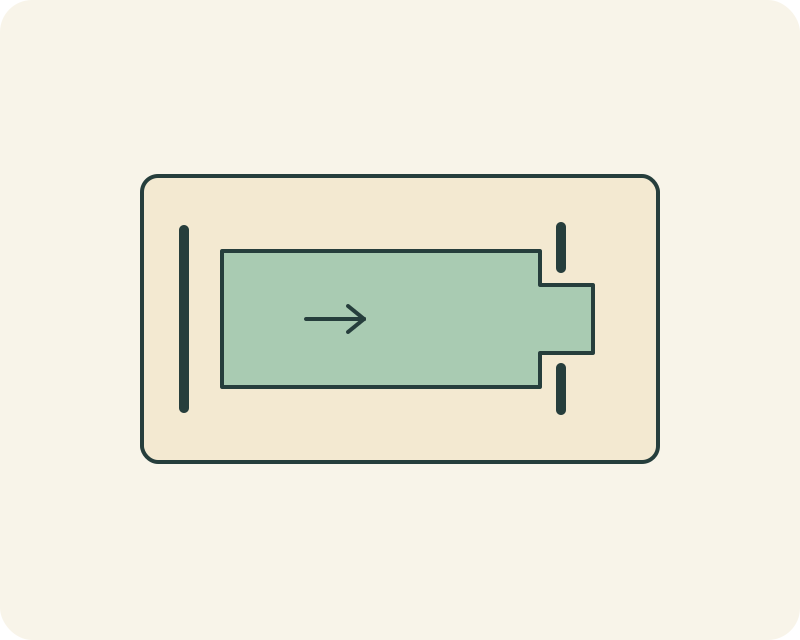
Make a base with cardboard edges. Leave a notch for the tab at the opening end and a continuous stop at the other end. The expected orientation allows the part to sit flat.
ASQ describes mistake proofing as preventing an error or making it immediately evident. This prototype uses shape to prevent one specific turn.
Try three sample parts
| Part | Observation | Expected outcome |
|---|---|---|
| Tab facing notch | Part rests fully | Continue |
| Tab against stop | Part sits raised | Turn before continuing |
| Part without tab | May sit flat | Verify its variant separately |
Try all three without forcing the cardboard. The last case defines the aid’s scope. The shape orients a present tab, and part identity has its own reference.
Test the route into the envelope
Ask another person to place a sample and move it into the envelope. Observe whether it can rotate after leaving the guide. If it still can, move the guide nearer the opening and repeat.
Check whether the part bends during insertion. A useful aid preserves material condition and permits the intended operation.
Document the prototype and boundaries
Record part model, dimensions, guide version and results for all three cases. Include a drawing or photograph of the notch. When tab or envelope size changes, test the correct and rotated parts again.
Identify how a worn or displaced edge will be noticed before another batch.
Decide with a small sample
In a trial batch, record placements, detected turns and new problems. Compare with an earlier sample under similar conditions. If adopting the guide, assign someone to repeat the check when material changes.
Follow the evidence.
Sources checked November 8, 2026. Illustrative scenarios and numbers are fictional. Original exercises and records, without attributed customer results or field observations. Our editorial standards.