Identifica el giro que produce el error, prepara una guía con una referencia asimétrica y pruébala con casos correctos e incorrectos antes de incorporarla.
Localiza el momento en que ocurre el giro
Un taller ficticio empaca separadores de cartón. Cada separador tiene una pestaña en un extremo que debe quedar hacia la abertura del sobre. Al preparar varios juntos, la pieza puede girar media vuelta entre la mesa y el sobre.
Observa ese paso y dibuja dónde debería quedar la pestaña. Usa una pieza de prueba para comprobar que el error que quieres evitar se puede reproducir.
Da a la pestaña un lugar reconocible
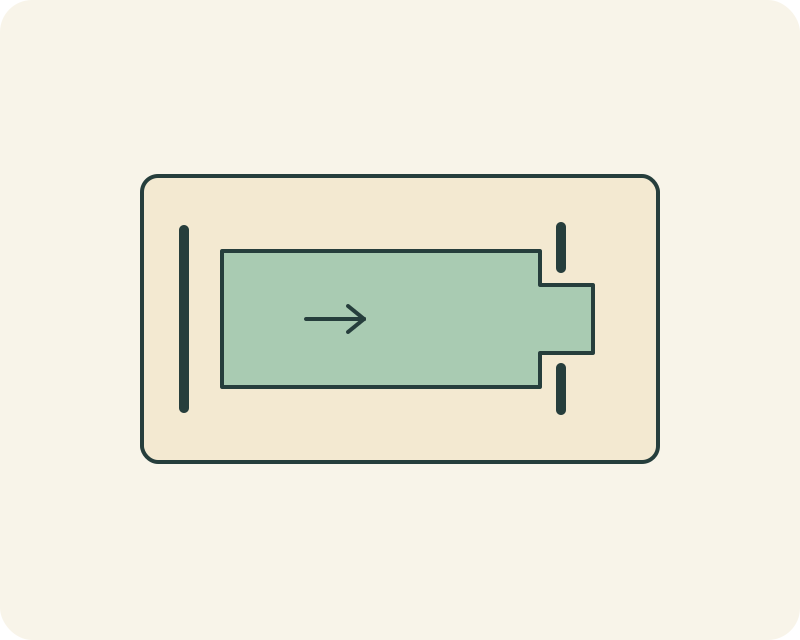
Prepara sobre la mesa una base con bordes de cartón. En el extremo de la abertura, deja un hueco para la pestaña. En el otro, coloca un tope continuo. La pieza orientada como se espera puede asentarse en la base.
ASQ describe el poka-yoke como un método que impide un error o lo vuelve evidente en el momento. Este prototipo busca impedir un giro concreto mediante la forma.
Ensaya tres piezas de prueba
| Pieza | Qué observar | Resultado esperado |
|---|---|---|
| Pestaña hacia el hueco | La pieza se apoya completa | Se puede continuar |
| Pestaña contra el tope | La pieza queda levantada | Girar antes de continuar |
| Pieza sin pestaña | Puede asentarse en la base | Revisar la variante por separado |
Comprueba las tres sin forzar el cartón. La última prueba define el alcance de la ayuda. La forma orienta una pestaña presente y la identidad de la pieza se comprueba con su propia referencia.
Prueba el recorrido hasta el sobre
Pide a otra persona que coloque una pieza de muestra y la pase al sobre. Observa si puede girarla después de retirarla de la guía. Si el giro sigue siendo posible en ese tramo, acerca la guía a la abertura y repite el ensayo.
Revisa también si la pieza se dobla al entrar. Una ayuda útil conserva el estado del material y permite completar la operación prevista.
Documenta el prototipo y sus límites
Anota modelo, medidas, versión de la guía y resultados de los tres casos. Incluye una fotografía o dibujo del hueco. Si cambian la pestaña o el tamaño del sobre, vuelve a probar la pieza correcta y la girada.
Identifica cómo se reconocerá un borde gastado o desplazado antes de usar la guía en otro lote.
Decide con una muestra pequeña
En un lote de prueba registra piezas colocadas, giros detectados y cualquier nuevo problema. Compara con una muestra anterior hecha bajo condiciones semejantes. Si la guía se incorpora, deja a una persona encargada de repetir la comprobación cuando cambie el material.
A stop guide for preventing a packing orientation error
An almost symmetrical part can rotate during packing without being noticed immediately. A physical guide makes orientation visible where placement happens.
Identify the turn that causes the error, make a guide with an asymmetric reference and test correct and incorrect cases before adoption.
Locate the moment the part turns
A fictional workshop packs cardboard dividers. Each has an end tab that belongs toward the envelope opening. When several are prepared together, a divider can turn halfway around between table and envelope.
Observe that step and sketch where the tab belongs. Reproduce the error with a sample part.
Give the tab a recognizable place
Make a base with cardboard edges. Leave a notch for the tab at the opening end and a continuous stop at the other end. The expected orientation allows the part to sit flat.
ASQ describes mistake proofing as preventing an error or making it immediately evident. This prototype uses shape to prevent one specific turn.
Try three sample parts
| Part | Observation | Expected outcome |
|---|---|---|
| Tab facing notch | Part rests fully | Continue |
| Tab against stop | Part sits raised | Turn before continuing |
| Part without tab | May sit flat | Verify its variant separately |
Try all three without forcing the cardboard. The last case defines the aid’s scope. The shape orients a present tab, and part identity has its own reference.
Test the route into the envelope
Ask another person to place a sample and move it into the envelope. Observe whether it can rotate after leaving the guide. If it still can, move the guide nearer the opening and repeat.
Check whether the part bends during insertion. A useful aid preserves material condition and permits the intended operation.
Document the prototype and boundaries
Record part model, dimensions, guide version and results for all three cases. Include a drawing or photograph of the notch. When tab or envelope size changes, test the correct and rotated parts again.
Identify how a worn or displaced edge will be noticed before another batch.
Decide with a small sample
In a trial batch, record placements, detected turns and new problems. Compare with an earlier sample under similar conditions. If adopting the guide, assign someone to repeat the check when material changes.
用带挡边的导向板减少包装朝向错误
包装近似对称的零件时,旋转可能一时不被察觉。实体导向板让朝向在放置位置可见。
找出导致错误的旋转,制作带不对称参照的导向板,采用前测试正确和错误情况。
找出转向发生的时点
虚构工坊包装纸板隔片。一端有凸耳,应朝信封开口。一次准备多件时,隔片可能在桌面与信封之间转半圈。
观察该步骤,画出凸耳应在的位置,再用样件复现错误。
给凸耳一个易认的位置
在桌上用纸板边条做底座。朝开口的一端留凸耳缺口,另一端用连续挡边。正确朝向的零件可平放到底。
ASQ 介绍防错方法能防止错误或让错误立即显现。此原型用形状限制一种具体旋转。
试放三种样件
| 零件 | 观察 | 预期结果 |
|---|---|---|
| 凸耳朝缺口 | 完全落座 | 继续操作 |
| 凸耳顶挡边 | 零件翘起 | 转向后继续 |
| 无凸耳件 | 可能落座 | 另查款型 |
三种都试,避免硬压纸板。最后一项界定辅助范围。形状引导已有凸耳,零件身份用自己的参照检查。
测试进入信封的路径
请另一人放样件并移进信封。观察离开导向板后是否还能旋转。若能,将板移近开口并重试。
也检查放入时会否弯折。辅助应保留材料状态并允许完成预定操作。
记录原型及边界
记录款型、尺寸、导向板版本及三项结果,附缺口图或照片。凸耳或信封尺寸变化时,再试正确件和转向件。
在另一个批次使用前,明确怎样发现边条磨损或移位。
用小批样品决定
试验批次记录放置件数、发现的转向及新问题,与条件相近的早期样本比较。若采用导向板,指定材料变化后重做检查的人员。
Fuentes y método
Fuentes consultadas el 8 de noviembre de 2026. Los escenarios y cifras ilustrativos son ficticios. Ejercicios y fichas originales, sin resultados de clientes ni observaciones de campo atribuidos. Editorial standards · Disclosures.