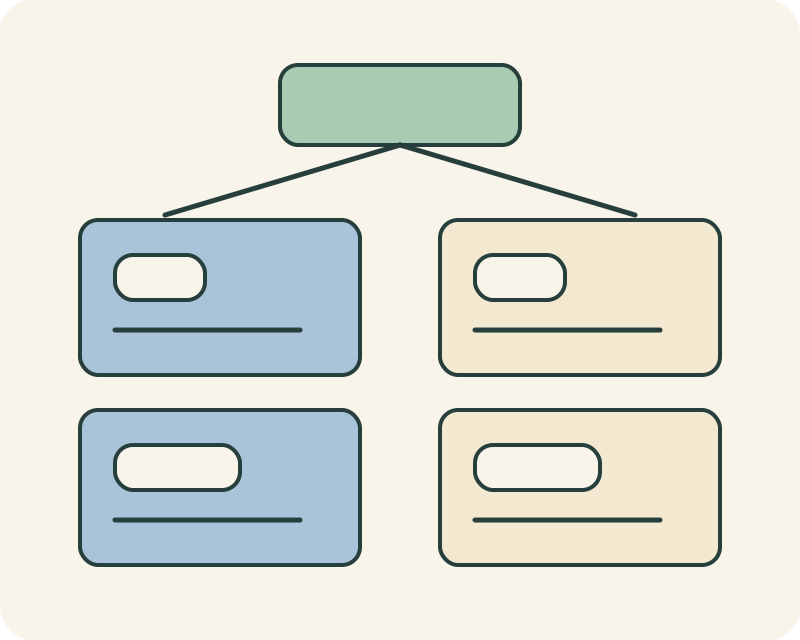
Define the family, list only real combinations and give each variant a stable identity. Review a selection’s entire journey before publishing.
Separate the family from the sellable option
Here, a family groups options of the same product, while a variant is a specific combination someone can select. A SKU is an internal inventory reference you can assign to that option. Explain these conventions to writers, photographers and order preparers; do not assume everyone uses model to mean the same thing.
Merchant Center documentation distinguishes a unique identifier for each variant from a shared item_group_id that groups variants. This helps explain the levels. An internal record with two codes is not a complete product data source and does not guarantee approval by that service.
Build a small matrix
Fictional example: the Loma shirt family is sold in blue and cream, with M and L available in both colors. There are four actual combinations. These invented codes are internal references, not GTINs or manufacturer-assigned identifiers.
| Family | Color | Size | Internal SKU |
|---|---|---|---|
| LOMA | Blue | M | LO-AZ-M |
| LOMA | Blue | L | LO-AZ-L |
| LOMA | Cream | M | LO-CR-M |
| LOMA | Cream | L | LO-CR-L |
If cream L is never manufactured, remove it from the matrix of possible options. If it exists but is sold out, keep its identity and record that status. Distinguishing these situations prevents an absence of stock becoming an imaginary product.
Complete one record per combination
Add a description, image reference, price and availability to each row, with a review date. Retain the source of the information, such as inventory confirmation or an approved specification. An unknown field should remain pending rather than borrowing a neighboring value for convenience.
Agree which attributes create a variant and which describe the whole family. An editorial name change should not reassign a code to another combination. When correcting an error, retain a note of the previous mapping for people handling historical orders.
Follow one choice through to the cart
Test blue M: check the visible name, active selection, image, price and status. Add it to the cart and inspect the reference received. Repeat for other options and mobile navigation. This is a proposed review; we do not claim to have tested a real store.
When an image represents several options, explain what it shows. A photograph of the whole family should not silently replace confirmation of the chosen variant. Document discrepancies with the exact combination so another person can reproduce them.
Map the record to the destination channel
Before sending data to a commercial channel, consult its current specifications and full requirements. Maintain an explicit mapping between internal codes, submitted identifiers and landing pages. Do not group different products merely because they are sold together.
Also check translated names: text may change language while the combination keeps its identity. Avoid creating duplicate records when copying a row to translate its description.
Leave a maintenance rule
Name the person who confirms new options and the person who updates images and availability. Before opening another family, ask one person to choose a combination and another to find it using only the record. Their questions reveal which information needs a clearer definition.
Continue image review with the related product photography guide. Here, the intended result is a readable mapping between a choice and its reference; visual quality and comparisons between products have their own reviews.
Follow the evidence.
Sources checked October 31, 2026. Illustrative cases, people, codes and numbers are fictional. These are original editorial proposals and exercises, without claiming actual server-log analysis, store tests, sowing or customer results. Our editorial standards.