Mueve las mismas piezas antes de fijarlas. Compara qué atrae la mirada y qué queda oculto; elige una relación que quieras conservar, sin buscar una composición universalmente correcta.
Reúne un conjunto pequeño
Usa una hoja base, papeles de tres colores, pegamento y una forma de cortar o rasgar adecuada para ti. Puedes trabajar con papeles ya disponibles y piezas preparadas. No hace falta comprar material especial ni convertir el ejercicio en una reproducción de una obra conocida.
La National Gallery of Art propone explorar formas mediante papel recortado, mover piezas y experimentar con capas antes de pegarlas. Nuestro ejercicio desarrolla una comparación propia de dos composiciones; no reproduce la actividad completa del museo ni sus obras.
Recorta relaciones diferentes
Prepara un rectángulo ancho, otro estrecho, una forma redondeada y una pieza de borde irregular. Conserva también algún sobrante: el hueco que deja un recorte puede servir como una forma más. Estas cantidades organizan este ensayo, no son una regla del collage.
Coloca todo fuera de la base al empezar. Mira qué piezas se parecen por color o tamaño y cuáles producen una diferencia visible. Si dos tonos se confunden a la luz que tienes, puedes cambiar su tamaño o separación para explorar otra relación.
Construye una primera composición sin pegar
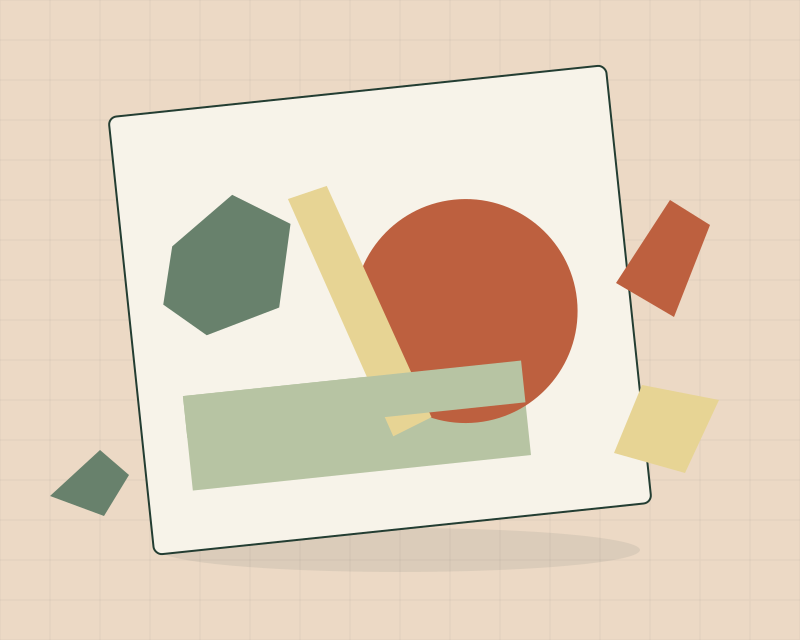
En el ejemplo propuesto, el rectángulo ancho queda cerca del borde inferior; la forma redondeada se apoya parcialmente sobre él y la tira estrecha apunta hacia una esquina. Deja un espacio amplio sin cubrir. No necesitas llamarlo paisaje ni decidir qué representa.
Observa qué miras primero. ¿Lo produce el tamaño, el contraste con la base o la separación respecto al resto? Puedes girar la hoja y ver si cambia tu lectura. Las respuestas son observaciones tuyas sobre este arreglo, no propiedades obligatorias de cada color o forma.
Cambia una relación y conserva las piezas
Antes de desmontar, dibuja un croquis sencillo o toma una foto propia si deseas comparar. Después mueve la forma redondeada detrás del rectángulo y separa la tira hacia el lado opuesto. Mantén el mismo fondo para reconocer mejor el efecto del cambio.
Compara lo que quedó tapado, el contorno que todavía reconoces y el espacio entre las piezas. La superposición puede sugerir delante y detrás sin que exista un objeto figurativo. No necesitas elegir la versión más llena: un espacio vacío también participa en la composición.
Decide qué relación quieres conservar
- ¿Qué elemento atrae ahora tu mirada?
- ¿Qué borde se reconoce mejor en cada versión?
- ¿La separación une visualmente algunas piezas o las aísla?
- ¿Qué cambia si retiras una pieza en vez de añadir otra?
Elige un arreglo y pega por capas, levantando cada pieza con cuidado para mantener su lugar. Si prefieres seguir explorando otro día, guarda las formas sin pegar. El espacio creativo compartido puede ayudarte a preparar y recoger materiales sin ocupar toda la mesa.
Conserva una observación, si te interesa
Una nota podría decir: “Al mover la forma redondeada detrás, su borde se reconoce menos; quiero probar un tamaño mayor”. Esa frase da una pregunta para otra sesión, sin exigir valoración artística ni un resultado que debas publicar.
La secuencia de fotografías conserva recuerdos; la escena de ficción construye acciones. Este ejercicio se queda en relaciones de papel, color y espacio. Puedes disfrutar la exploración sin atribuirle un efecto terapéutico ni transformarla en trabajo.
Explore Shape, Contrast and Overlap with a Paper Collage
You can start a collage without drawing a recognizable figure. A few cut shapes let you explore what changes when their apparent size, position and relationship to the background shift.
Move the same pieces before fixing them. Compare what draws your eye and what becomes hidden; retain a relationship you want to explore without seeking a universally correct composition.
Gather a small set
Use a base sheet, three paper colors, glue and a way of cutting or tearing suitable for you. Existing paper and prepared pieces are enough. You need neither special purchases nor a reproduction of a known artwork.
The National Gallery of Art proposes exploring shapes through cut paper, moving pieces and trying layers before gluing. Our exercise develops an original comparison of two compositions; it reproduces neither the museum’s full activity nor its artworks.
Cut different relationships
Prepare a wide rectangle, a narrow one, a rounded shape and an irregular-edged piece. Keep some offcuts: the opening left by cutting can serve as another shape. These quantities organize this trial; they are no rule of collage.
Start with everything outside the base. Notice which pieces resemble one another in color or size and which create a visible difference. If two colors merge under your light, change their size or separation to explore another relationship.
Build a first composition without glue
In the proposed example, the wide rectangle sits near the bottom edge, the rounded shape partly overlaps it and the narrow strip points toward a corner. Leave a large uncovered area. You need not call it a landscape or decide what it represents.
Notice what you look at first. Is that due to size, contrast with the base or distance from the others? Rotate the sheet and see whether your reading changes. These are your observations about this arrangement, rather than compulsory properties of each color or shape.
Change one relationship and retain the pieces
Before dismantling, make a simple sketch or take your own photo if you want a comparison. Then move the rounded shape behind the rectangle and separate the strip toward the opposite side. Keep the background to make the change easier to recognize.
Compare what is covered, which outline remains recognizable and the gaps between pieces. Overlap can suggest front and back without a figurative object. You need not choose the fullest version: empty space participates in the composition too.
Choose a relationship to keep
- Which element attracts your eye now?
- Which edge is clearer in each version?
- Does separation visually join pieces or isolate them?
- What changes if you remove a piece rather than adding another?
Choose an arrangement and glue in layers, carefully lifting each piece to retain its position. If you prefer another session, store shapes without gluing. Our shared creative workspace guide can help with setup and clearing without occupying the whole table.
Keep an observation if you wish
A note might say: “Moving the rounded shape behind makes its edge less recognizable; I want to try a larger size.” That gives another session a question, without requiring an artistic judgment or a result to publish.
A photo sequence preserves memories; a fiction scene builds actions. This exercise explores paper, color and space relationships. Enjoy it without attributing a therapeutic effect or making it work.
用纸拼贴探索形状、对比与重叠
开始拼贴不必先画出可辨认的形象。几块纸片就能让你探索:它们看起来的大小、位置及与背景的关系改变时,会发生什么。
固定前先移动同样的纸片,比较哪里吸引视线、哪里被遮住,选择想保留的关系,无需寻找普遍正确的构图。
准备少量材料
准备底纸、三种颜色的纸、胶水,以及适合自己的剪切或撕纸方式。可以使用现有纸张和预先准备的形状,无需购买特殊材料,也不必临摹已有作品。
National Gallery of Art 提议用剪纸探索形状,粘贴前移动纸片并尝试层次。本练习自行设计两种构图的比较,不复制博物馆完整活动或艺术作品。
剪出不同关系
准备宽矩形、窄矩形、圆润形状与边缘不规则的纸片。保留一些边角料:剪后留下的空洞也可以成为另一形状。这些数量只为组织本次尝试,不是拼贴规则。
开始时把纸片放在底纸外,观察哪些颜色或大小相近,哪些产生明显差异。若两种颜色在当前光线下难以分辨,可以改变大小或间距,探索另一种关系。
先做不粘贴的构图
在拟定示例中,宽矩形靠近下边缘,圆润形状部分叠在它上面,窄条朝向角落。留下较大空白。不必叫它风景,也不必决定它代表什么。
观察首先看哪里。原因是大小、与底纸的对比,还是与其余纸片的距离?可以旋转底纸,看阅读是否改变。这些是你对当前排列的观察,不是每种颜色或形状必须具备的性质。
保留纸片,改变一项关系
拆开前,可画简单草图或拍自己的照片方便比较。然后把圆润形状移到矩形后,把窄条移向另一边。保持背景不变,以便辨认这次变化。
比较什么被遮住、什么轮廓仍可辨认,以及纸片之间的空隙。即使没有具象物体,重叠也能暗示前后。不必选择最满的版本,留白也参与构图。
选择想保留的关系
- 现在什么元素吸引视线?
- 两种版本中,哪个边缘更清楚?
- 间距让某些纸片在视觉上相连,还是分离?
- 移除一片而非添加一片,会改变什么?
选好排列后分层粘贴,小心抬起纸片,保留其位置。若想改天继续,也可以先不粘。本站共享创作空间指南帮助准备和收拾材料,不必占满桌面。
愿意的话,保留一项观察
可以记:“圆润形状放到后面后,边缘更难辨认;下次想试大一些。”这为下一次留下问题,不要求艺术评判,也不要求产生可发布成果。
Fuentes y método
Fuentes consultadas el 24 de octubre de 2026. Los escenarios y cifras ilustrativos son ficticios. Las fichas y ejercicios son propuestas editoriales originales, sin resultados de clientes ni pruebas de proveedores atribuidos. Editorial standards · Disclosures.