Calcula el índice de precios de exportación dividido entre el de importación. Conserva aparte los valores de compraventa, que también dependen de cantidades y mezcla.
Encuentra los dos índices compatibles
La OCDE define los términos de intercambio como la razón entre el índice de precios de exportación y el de importación. Comprueba que ambas series cubran el mismo territorio, periodo y tipo de comercio, y que compartan la base. En el ejercicio ambas valen 100 en el periodo de referencia.
Calcula con dos caídas distintas
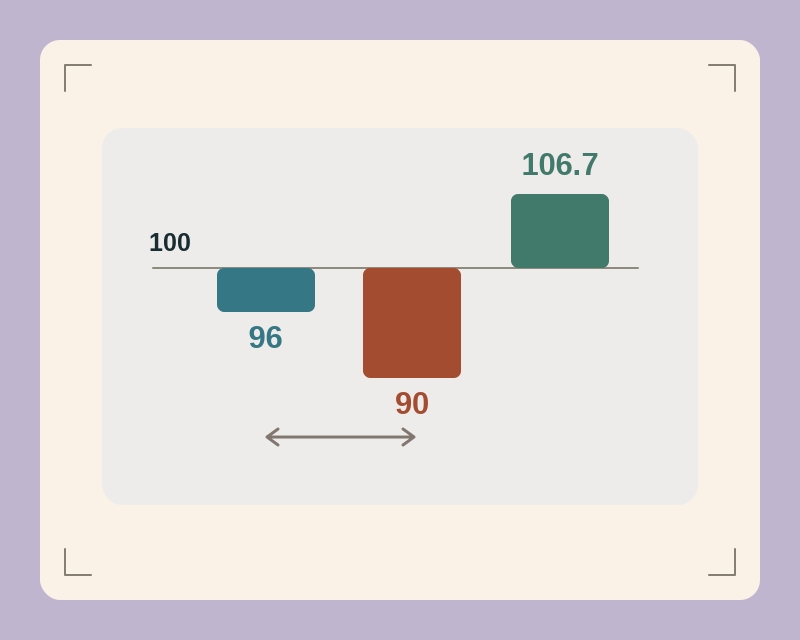
En la segunda observación ficticia, el índice de exportación baja a 96 y el de importación a 90. Divide 96 entre 90 y multiplica por 100. El resultado es aproximadamente 106,7. En relación con la base de 100, los precios de exportación ganaron peso relativo frente a los de importación, aunque cada índice por separado cayó.
Comprueba qué pasaría con otro denominador
Mantén exportación en 96 y prueba con importación en 98. El cociente pasa a aproximadamente 98,0. En este segundo escenario los dos índices bajan, pero ahora los precios de exportación caen más. Comparar las direcciones de subida o bajada sin sus magnitudes ocultaría el cambio de resultado.
Lee por separado el saldo comercial
Supón que el informe del primer escenario también muestra exportaciones por 240 e importaciones por 260, en la misma moneda y periodo. El saldo de ese cuadro es −20. Puede coexistir con un índice de 106,7 porque el saldo resta valores monetarios y el índice compara precios relativos.
Escribe la comparación con su referencia
Al citar un dato, anota qué serie y base usaste, si incluye bienes o también servicios y si hubo revisiones. Para el ejercicio, basta con decir que el cociente aumentó frente al periodo base porque el índice de importación cayó más que el de exportación.
Terms of trade: how to compare export and import prices
A country sells abroad at lower prices than in the base period. It also buys from abroad at lower prices, and those prices fell further. The ratio of the two indexes rises. To understand what changed, start by looking at both sides of the ratio.
Divide the export price index by the import price index. Keep the values of purchases and sales separate, as they also depend on quantities and mix.
Find two compatible indexes
The OECD defines terms of trade as the ratio of the export price index to the import price index. Check that both series cover the same territory, period and kind of trade, and that they share a base. In the exercise both equal 100 in the reference period.
Work through two unequal falls
In the second fictional observation, the export index falls to 96 and the import index to 90. Divide 96 by 90 and multiply by 100. The result is about 106.7. Against the base of 100, export prices gained relative to import prices even though each index fell on its own.
See what happens with another denominator
Keep exports at 96 and try an import index of 98. The ratio becomes about 98.0. In this scenario both indexes fall, but export prices now fall further. Comparing directions without looking at the size of the changes would hide the different result.
Read the trade balance separately
Suppose the first scenario also reports exports worth 240 and imports worth 260 in the same currency and period. The table's balance is −20. That can coexist with an index of 106.7 because the balance subtracts monetary values and the index compares relative prices.
Write the comparison with its reference
When citing a figure, note which series and base you used, whether it covers goods or services too, and whether it has been revised. For the exercise, say the ratio increased against the base period because the import price index fell further than the export price index.
贸易条件:怎样比较出口和进口价格
一个国家对外出售商品的价格低于基期,从国外购买商品的价格也低于基期,而且降得更多。两个指数的比值因此上升。要弄清发生了什么,先看比值的分子和分母。
用出口价格指数除以进口价格指数。买卖金额另行查看,因为它也受到交易数量和构成的影响。
找到可以配对的两个指数
经合组织把贸易条件定义为出口价格指数与进口价格指数的比值。核对两个序列是否覆盖相同的地区、时期和贸易类别,是否采用同一基期。本练习中,两个指数在基期都等于 100。
计算两种不同幅度的下跌
在第二个虚构观测期,出口价格指数降到 96,进口价格指数降到 90。用 96 除以 90,再乘以 100,约为 106.7。与基期的 100 相比,出口价格相对于进口价格提高了,尽管两个指数各自都在下降。
换一个分母试试看
保持出口价格指数为 96,把进口价格指数改为 98,比值约为 98.0。第二种情况下两个指数依然下降,出口价格却降得更多。只比较升降方向,不看变化幅度,就会看不出结果的差别。
另看贸易差额
假设第一种情景的报表还列出同一货币、同一时期的出口额 240 和进口额 260,表内贸易差额就是 −20。它可以和 106.7 的指数同时出现,因为贸易差额相减的是金额,而该指数比较的是相对价格。
写出比较时采用的参照
引用数据时,注明使用的序列和基期、仅含货物还是也包括服务,以及是否经过修订。就本练习而言,可以说比值高于基期,因为进口价格指数比出口价格指数降得更多。
Fuentes y método
Fuentes consultadas el 15 de noviembre de 2026. Los casos y datos numéricos de los ejercicios son ficticios. Editorial standards · Disclosures.