Retain nominal amount, compatible index and base period. Adjustment supports comparison under that reference; it turns neither revenue into profit nor establishes units sold.
Define the comparison you need
Nominal describes an amount at its period’s monetary prices. Real expresses a price-reference adjustment for comparison. The distinction matters when reading income, production or purchasing-power series, but the appropriate index depends on the question.
St. Louis Fed introduces this distinction. Merely labeling a column real is insufficient: identify the adjustment and base. Keep the original figure so its accounting meaning remains available.
Read the index and its base
A base-100 index uses a period as reference. In this exercise, 110 means a level 10% above that base, not additional inflation of 110%. Identify frequency, coverage and unit before applying it to another series.
BLS explains conversion to constant amounts through index ratios. Its material concerns the US CPI: we present it as neither Mexico’s index nor a company price list. A general index can address purchasing power without representing every business cost.
Adjust two fictional amounts
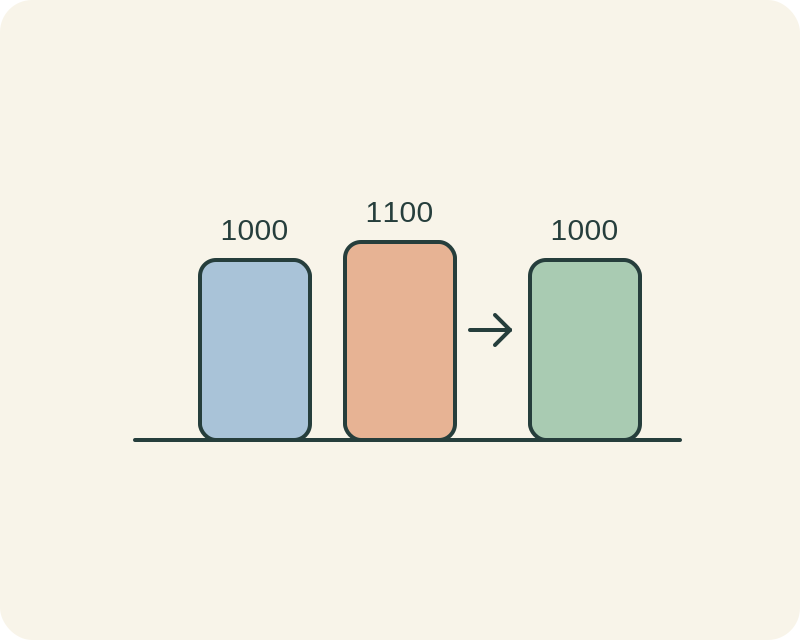
Entirely constructed example: a monetary series rises from 1,000 to 1,100 units. Assume the chosen index suits the comparison and rises from 100 to 110. These are neither observed inflation figures nor revenue records.
| Measure | Period A | Period B |
|---|---|---|
| Nominal amount | 1,000 | 1,100 |
| Chosen index | 100 | 110 |
| Amount at A prices | 1,000 | 1,000 |
Dallas Fed documents dividing the nominal amount by the index expressed as a factor. For B: 1,100 / (110 / 100) = 1,000. The 10% nominal increase produces no adjusted increase in this example.
Do not confuse adjustment with subtracting rates
The adjusted change here can also be calculated as (1.10 / 1.10 − 1) × 100 = 0%. Subtracting rates happens to give the same zero, but that coincidence does not make subtraction the general formula.
If neither period’s index equals 100, retain the ratio between the base index and the period being converted. Combining differently based series without reconciliation can change the result even when every cell was copied correctly.
Check what the result does not answer
This adjustment says nothing about costs, profit, cash or product counts. It also does not identify why the nominal amount changed. Sales with a changing product mix may need other separations besides a price index.
The order-mix guide investigates composition at constant prices. Here we change the monetary reference using an explicit index. Do not replace that analysis with this adjustment or present it as an exact volume measure for every business.
Publish the reference with the conclusion
A reproducible sentence is: “The amount rose from 1,000 to 1,100 nominal units; using the assumed 100→110 index, both equal 1,000 at A prices.” Identify the scenario as fictional.
For a real series, retain source, period, currency, index, base and formula alongside coverage limits. If the index is not yet justified, present the nominal comparison and leave the adjustment pending instead of inventing a rate.
Follow the evidence.
- Dallas Fed · Deflating nominal values to real values ↗
- BLS · Purchasing power and constant dollars ↗
- St. Louis Fed · What are real values? ↗
Sources checked November 2, 2026. Illustrative scenarios and numbers are fictional. Original exercises and records, without attributed customer results or field observations. Our editorial standards.