Conserva importe nominal, índice compatible y periodo base. El ajuste permite una comparación bajo esa referencia; no convierte ingresos en beneficio ni demuestra cuántas unidades se vendieron.
Define qué comparación necesitas
Nominal describe un importe en los precios monetarios de su periodo. Real expresa un ajuste por una referencia de precios para comparar. La distinción importa al leer series de ingresos, producción o poder adquisitivo, pero el índice apropiado depende de la pregunta.
La explicación de St. Louis Fed introduce esta diferencia. No basta poner la palabra real junto a una columna: debe poder identificarse qué ajuste se hizo y respecto a qué base. Conserva el dato original para no perder su significado contable.
Lee el índice y su base
Un índice con base 100 utiliza un periodo como referencia. En el ejercicio, 110 significa un nivel 10 % mayor que esa base, no una inflación adicional de 110 %. Identifica frecuencia, cobertura y unidad antes de aplicarlo a otra serie.
BLS explica la conversión a importes constantes mediante razones entre índices. Su material se refiere al IPC estadounidense: no lo presentamos como índice de México ni como lista de precios de una empresa. Un índice general puede responder una pregunta de poder adquisitivo sin representar todos sus costos.
Ajusta dos importes ficticios
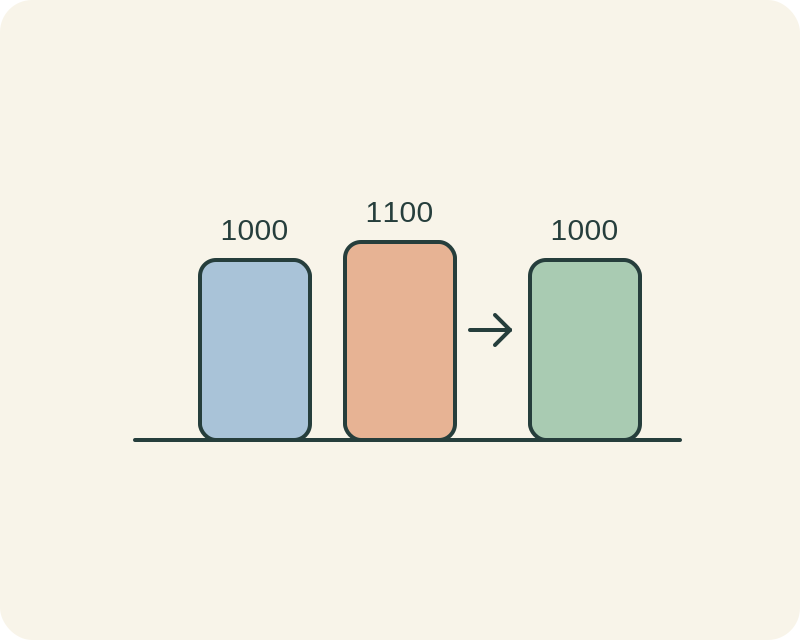
Ejemplo enteramente construido: una serie monetaria pasa de 1,000 a 1,100 unidades. Suponemos que el índice elegido es compatible con la comparación y pasa de 100 a 110. No son cifras de inflación ni ingresos observados.
| Dato | Periodo A | Periodo B |
|---|---|---|
| Importe nominal | 1,000 | 1,100 |
| Índice elegido | 100 | 110 |
| Importe en precios de A | 1,000 | 1,000 |
Dallas Fed documenta la operación: dividir el importe nominal entre el índice expresado como factor. Para B: 1,100 / (110 / 100) = 1,000. El aumento nominal del 10 % no produce aumento ajustado en este caso.
No confundas ajuste y resta de porcentajes
Para el ejemplo también puede calcularse el cambio ajustado como (1.10 / 1.10 − 1) × 100 = 0 %. Aquí restar las tasas daría el mismo cero, pero esa coincidencia no convierte la resta en la fórmula general.
Si ambos periodos usan índices distintos de 100, conserva la razón entre el índice base y el del periodo a convertir. Mezclar series con bases diferentes sin reconciliarlas puede alterar el resultado aunque cada celda esté bien copiada.
Revisa qué no responde el resultado
El ajuste del ejemplo no informa costos, beneficio, caja ni número de productos. Tampoco identifica por qué cambió el importe nominal. Una serie de ventas con mezcla variable puede necesitar otras separaciones además de un índice de precios.
La guía de mezcla de pedidos investiga composición con precios constantes. Aquí cambiamos la referencia monetaria con un índice explícito. No sustituyas aquel análisis por este ajuste ni lo presentes como una medición exacta del volumen de cualquier negocio.
Publica la referencia junto a la conclusión
Una frase reproducible para el ejercicio es: “El importe pasó de 1,000 a 1,100 nominales; con el índice supuesto 100→110, ambos equivalen a 1,000 en precios de A”. Añade que el escenario es ficticio.
En una serie real, conserva fuente, periodo, moneda, índice, base y fórmula, además de sus límites de cobertura. Si todavía no puedes justificar el índice, presenta la comparación nominal y deja pendiente el ajuste en lugar de inventar una tasa.
Nominal and real values: compare amounts against a price reference
A larger monetary figure can buy the same as a smaller figure from another period. Before calling the entire difference growth, ask which prices each amount represents.
Retain nominal amount, compatible index and base period. Adjustment supports comparison under that reference; it turns neither revenue into profit nor establishes units sold.
Define the comparison you need
Nominal describes an amount at its period’s monetary prices. Real expresses a price-reference adjustment for comparison. The distinction matters when reading income, production or purchasing-power series, but the appropriate index depends on the question.
St. Louis Fed introduces this distinction. Merely labeling a column real is insufficient: identify the adjustment and base. Keep the original figure so its accounting meaning remains available.
Read the index and its base
A base-100 index uses a period as reference. In this exercise, 110 means a level 10% above that base, not additional inflation of 110%. Identify frequency, coverage and unit before applying it to another series.
BLS explains conversion to constant amounts through index ratios. Its material concerns the US CPI: we present it as neither Mexico’s index nor a company price list. A general index can address purchasing power without representing every business cost.
Adjust two fictional amounts
Entirely constructed example: a monetary series rises from 1,000 to 1,100 units. Assume the chosen index suits the comparison and rises from 100 to 110. These are neither observed inflation figures nor revenue records.
| Measure | Period A | Period B |
|---|---|---|
| Nominal amount | 1,000 | 1,100 |
| Chosen index | 100 | 110 |
| Amount at A prices | 1,000 | 1,000 |
Dallas Fed documents dividing the nominal amount by the index expressed as a factor. For B: 1,100 / (110 / 100) = 1,000. The 10% nominal increase produces no adjusted increase in this example.
Do not confuse adjustment with subtracting rates
The adjusted change here can also be calculated as (1.10 / 1.10 − 1) × 100 = 0%. Subtracting rates happens to give the same zero, but that coincidence does not make subtraction the general formula.
If neither period’s index equals 100, retain the ratio between the base index and the period being converted. Combining differently based series without reconciliation can change the result even when every cell was copied correctly.
Check what the result does not answer
This adjustment says nothing about costs, profit, cash or product counts. It also does not identify why the nominal amount changed. Sales with a changing product mix may need other separations besides a price index.
The order-mix guide investigates composition at constant prices. Here we change the monetary reference using an explicit index. Do not replace that analysis with this adjustment or present it as an exact volume measure for every business.
Publish the reference with the conclusion
A reproducible sentence is: “The amount rose from 1,000 to 1,100 nominal units; using the assumed 100→110 index, both equal 1,000 at A prices.” Identify the scenario as fictional.
For a real series, retain source, period, currency, index, base and formula alongside coverage limits. If the index is not yet justified, present the nominal comparison and leave the adjustment pending instead of inventing a rate.
名义值与实际值:用价格参照比较金额
另一个时期较大的金额,可能只能购买与过去较小金额相同的东西。把全部差额称为增长之前,先问每个金额以什么价格表示。
保留名义金额、适用指数与基期。调整支持该参照下的比较,不会把收入变成利润,也不能单独证明销售数量。
定义需要的比较
名义值按所属时期的货币价格表示金额;实际值则采用价格参照调整以便比较。阅读收入、产出或购买力序列时,这一区别有用,但应选什么指数取决于问题。
St. Louis Fed 介绍了这一区别。只给一列加上“实际”标签并不足够,还需说明调整方法和基期。保留原始金额,使其账务含义仍可查阅。
阅读指数与基期
基期为 100 的指数把某个时期当作参照。本练习中,110 表示比基期水平高 10%,不是额外通胀 110%。应用到其他序列前,核对频率、覆盖与单位。
BLS 说明可利用指数比率换算不变金额。其资料涉及美国 CPI,本文不把它称为墨西哥指数,也不当作某公司的价目表。一般指数可回答购买力问题,但未必代表全部企业成本。
调整两个虚构金额
完全构造的案例:某金额序列从 1,000 增至 1,100 单位。假设选定指数适合该比较,并由 100 增至 110。这些不是实际观测的通胀或收入数据。
| 项目 | A 期 | B 期 |
|---|---|---|
| 名义金额 | 1,000 | 1,100 |
| 选定指数 | 100 | 110 |
| 按 A 期价格表示 | 1,000 | 1,000 |
Dallas Fed 说明应把名义金额除以换成因子的价格指数。B 期为 1,100 / (110 / 100) = 1,000。本例名义增加 10%,调整后没有增加。
不要把调整当成百分比相减
本例调整后的变化也可写为 (1.10 / 1.10 − 1) × 100 = 0%。直接相减两种变化率碰巧也为零,但这种巧合不能让减法成为通用公式。
两期指数都不等于 100 时,保留基期指数与待换算时期指数之间的比率。不同基期的序列若不先统一,即使每个数都抄对,也可能改变结果。
核对结果没有回答什么
这个调整没有说明成本、利润、现金或产品数量,也没有识别名义金额为何改变。产品组合变化的销售序列,除了价格指数,还可能需要其他拆分。
订单组合指南在价格不变时分析构成;这里用明确指数改变货币参照。不要用本调整替代那项分析,也不要把它当成对任何企业实物销量的精确测量。
结论同时公布参照
可复核的表述是:“名义金额从 1,000 增至 1,100;采用假设指数 100→110,两者均等于按 A 期价格表示的 1,000。”同时说明情境虚构。
实际序列应保留来源、时期、货币、指数、基期与公式,以及覆盖限制。指数依据未明确时,先公布名义比较,把调整留待确认,而非编造变化率。
Fuentes y método
- Dallas Fed · Deflating nominal values to real values ↗
- BLS · Purchasing power and constant dollars ↗
- St. Louis Fed · What are real values? ↗
Fuentes consultadas el 2 de noviembre de 2026. Los escenarios y cifras ilustrativos son ficticios. Ejercicios y fichas originales, sin resultados de clientes ni observaciones de campo atribuidos. Editorial standards · Disclosures.