Congela la estimación antes del desenlace y compara frecuencias dentro de un horizonte común; conserva visibles el tamaño del grupo y los casos aún incompletos.
Define el evento y su reloj
En el ejercicio, el evento es «venta ganada dentro de los 30 días posteriores a la captura». No es «ganará algún día» ni «cerrará este mes» cuando cada captura ocurre en una fecha distinta. Anota fecha de captura, probabilidad y final de la ventana por oportunidad.
La documentación de calibración de scikit-learn explica la relación entre probabilidades y frecuencias observadas. Aquí usamos esa idea para revisar registros comerciales; no afirmamos haber entrenado o validado un modelo con datos reales.
Guarda la estimación sin reescribirla
Conserva el porcentaje que existía al inicio. Si lo reemplazas por el actualizado después de una llamada o de ganar la venta, estarías comparando el resultado con información que no estaba disponible al estimar.
Define también la unidad: una oportunidad por captura en esta revisión. Mezclar varias actualizaciones de la misma operación puede darle más peso por el simple hecho de haberse editado más. Conserva el historial aparte si necesitas estudiar cómo cambió la estimación.
Construye dos grupos completos
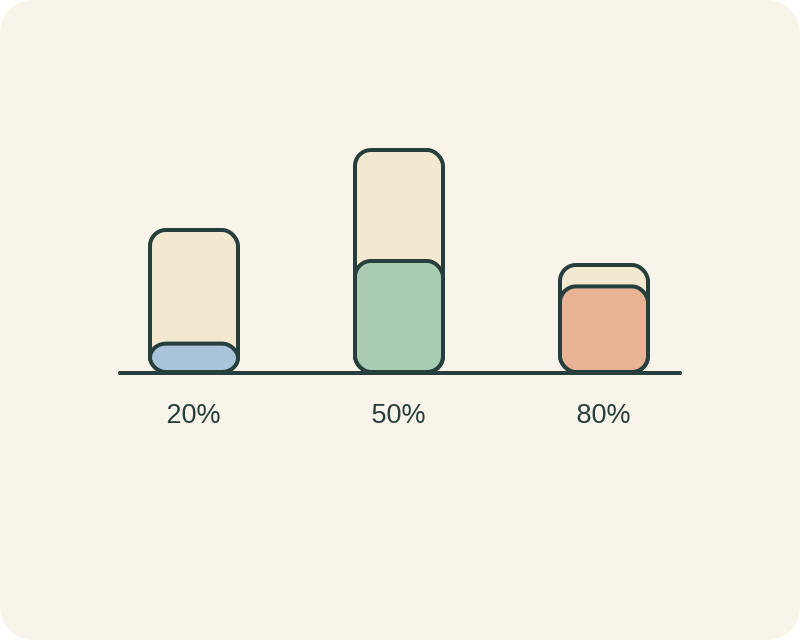
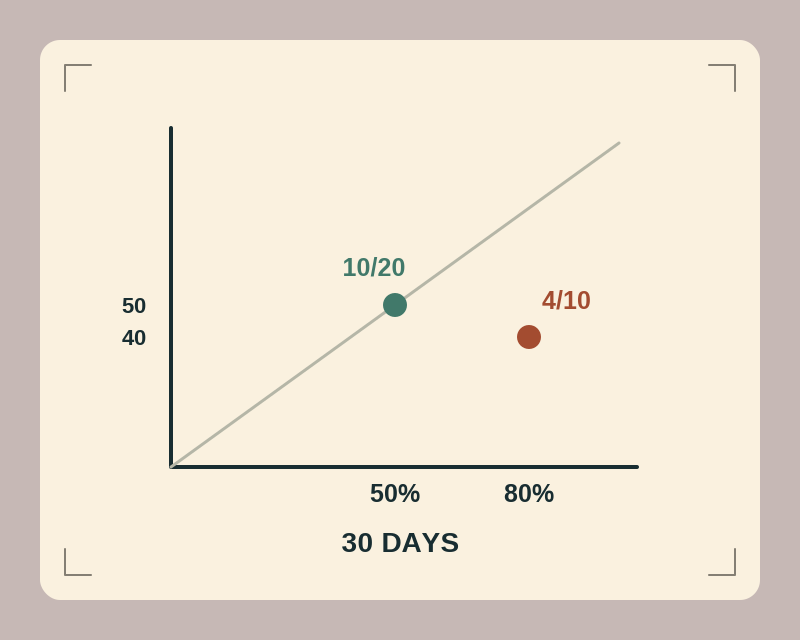
Supón 20 oportunidades con estimación inicial de 50%, todas con 30 días de seguimiento terminados. Diez se ganaron dentro del plazo: la frecuencia observada es 10 / 20 = 50%. Otro grupo tiene diez oportunidades al 80%; cuatro se ganaron en plazo: 4 / 10 = 40%.
En un diagrama, coloca probabilidad estimada en el eje horizontal y frecuencia observada en el vertical. Los puntos son (50%, 50%) y (80%, 40%). Si agrupas porcentajes distintos en intervalos, usa la probabilidad media del grupo y conserva sus límites, no solo el nombre de la etiqueta.
Trata el tiempo pendiente de forma coherente
Una operación que lleva diez días desde la captura todavía no completa la ventana de 30. No la registres como fracaso para cerrar la tabla antes. Espera a completar el seguimiento o mantenla fuera de la comparación terminada, identificando cuántos casos faltan.
Una oportunidad aún abierta al día 30 no cumplió el evento «ganada dentro de 30 días». Eso no equivale a declararla perdida en el CRM. El estado comercial y el resultado del evento temporal son campos diferentes.
Interpreta sin automatizar una corrección
Los dos grupos ficticios sugieren revisar cómo se usa el 80%, pero diez casos no justifican una regla universal. Muestra cantidades y condiciones de selección; repite con más cohortes comparables y examina cambios de proceso o mezcla de oportunidades.
No conviertas automáticamente todos los 80% en 40%. La calibración revisa correspondencia entre porcentajes y frecuencias; la suma ponderada calcula un importe. Guarda ambas lecturas separadas para saber qué decisión respalda cada una.
Sales probabilities: compare the percentage with wins inside the same window
An opportunity marked 80% does not promise an individual sale. Calibration becomes a question across comparable cases: among those assigned similar probabilities, what proportion reached the predicted outcome?
Freeze the estimate before the outcome and compare frequencies within a common horizon; keep group size and incomplete cases visible.
Define the event and its clock
In the exercise, the event is “sale won within 30 days after the snapshot.” It is not “will win eventually” or “will close this month” when snapshots occur on different dates. Record the snapshot date, probability and window end for each opportunity.
The scikit-learn calibration documentation explains the relationship between probabilities and observed frequencies. Here we apply that idea to reviewing sales records; we do not claim to have trained or validated a model with real data.
Preserve the estimate without rewriting it
Keep the percentage that existed at the start. Replacing it with a value updated after a call or a win would compare the result with information unavailable at estimation time.
Also define the unit: one opportunity per snapshot in this review. Mixing several updates of the same deal can give it more weight simply because it was edited more often. Keep its history separately if you need to study changing estimates.
Build two complete groups
Suppose 20 opportunities started at 50%, all with completed 30-day follow-up. Ten were won within the window: the observed frequency is 10 / 20 = 50%. Another group contains ten opportunities at 80%; four were won in time: 4 / 10 = 40%.
On a chart, place estimated probability on the horizontal axis and observed frequency on the vertical axis. The points are (50%, 50%) and (80%, 40%). If you bin different percentages, use the group’s mean probability and preserve its boundaries, rather than just the label’s name.
Handle pending time consistently
A deal whose snapshot was ten days ago has not completed the 30-day window. Do not record it as a failure to finish the table early. Wait for complete follow-up or leave it outside the completed comparison, identifying how many cases remain pending.
An opportunity still open on day 30 did not satisfy “won within 30 days.” That does not mean declaring it lost in the CRM. Commercial status and the time-bounded event outcome are separate fields.
Interpret without automating a correction
The fictional groups suggest reviewing how 80% is used, but ten cases do not justify a universal rule. Show counts and selection conditions; repeat with more comparable cohorts and examine process changes or shifts in opportunity mix.
Do not automatically change every 80% to 40%. Calibration reviews correspondence between percentages and frequencies; a weighted sum calculates an amount. Preserve those readings separately so each decision has an identifiable basis.
销售概率:用同一时间窗口内的成交比例进行核对
标为 80% 的商机不保证单笔成交。校准需要汇集可比较的案例:在被赋予相近概率的商机中,有多少比例最终实现了预期结果?
在结果出现前冻结估计,使用共同期限比较频率,同时明确展示分组数量和观察尚未完成的案例。
定义事件及其计时起点
练习中的事件是“从记录快照起 30 天内赢单”。它不是“最终会成交”,也不是在不同日期记录快照后都写成“本月成交”。每条商机都应记录快照日期、概率和窗口结束日期。
scikit-learn 的校准文档解释了概率与实际频率的对应关系。本文把这一思路用于检查销售记录,并不声称已使用真实数据训练或验证模型。
保留估计,不要事后改写
保存起点时的百分比。如果用电话沟通之后或成交之后更新的数值替换它,就会使用估计当时尚不可得的信息来比较结果。
还应定义统计单位:本次检查中,每条商机使用一次快照。混合同一交易的多次更新,会使它仅因编辑次数较多而获得更大权重。如果需要研究估计变化,应另存历史记录。
建立两个观察完整的组
假设 20 条商机的初始估计均为 50%,而且都已完成 30 天跟踪。其中十条在期限内赢单,实际频率为 10 / 20 = 50%。另一组有十条初始估计为 80% 的商机,其中四条按期赢单,即 4 / 10 = 40%。
作图时,横轴为预测概率,纵轴为实际频率。两点分别为 (50%, 50%) 和 (80%, 40%)。如果把不同概率放入区间,应使用组内概率均值,并保留区间边界,不能只留下分组标签。
一致处理尚未结束的时间
快照只过去十天的交易,尚未完成 30 天窗口。不能为了提前完成表格而把它记为失败。应等待完整跟踪,或将它留在已完成比较之外,并注明尚待观察的数量。
到第 30 天仍开放的商机,没有满足“30 天内赢单”这个事件。但这不等于要在 CRM 中把它标成丢单。商业状态与限时事件结果是不同字段。
解读结果,避免自动改写规则
虚构分组提示可以检查 80% 的使用方式,但十个案例不足以支持普遍规则。应展示数量和筛选条件,用更多可比较批次重复观察,并检查流程或商机结构是否变化。
不要自动把所有 80% 改为 40%。校准检查百分比与实际频率是否对应,加权求和计算的是金额。分别保留两种解读,才能辨明每项决策的依据。
Fuentes y método
Fuentes consultadas el 22 de noviembre de 2026. Los casos y datos numéricos de los ejercicios son ficticios. Editorial standards · Disclosures.