Absolute advantage compares output with equivalent resources; comparative advantage compares opportunity cost expressed in the other good.
Fix the exercise’s possibilities
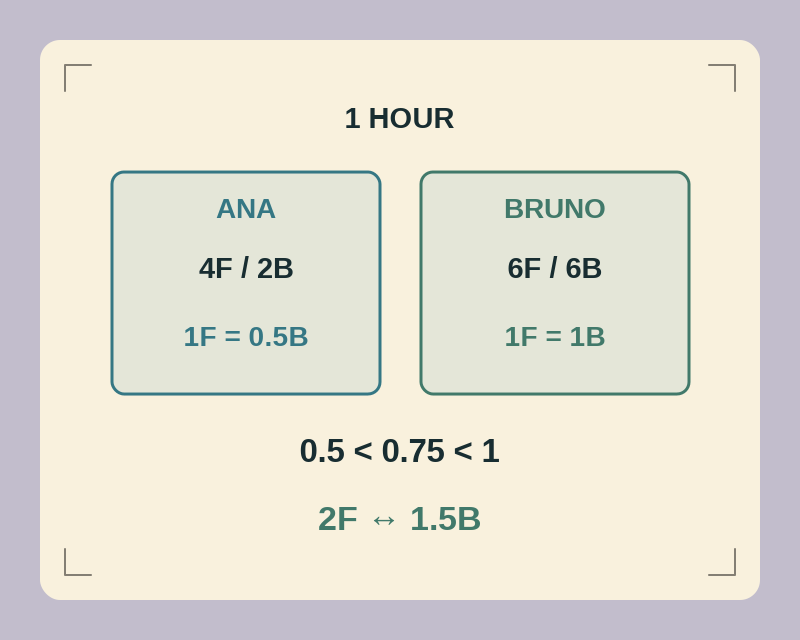
Ana can make four covers or two bags per hour. Bruno can make six covers or six bags. Assume equivalent product quality, one hour available per person and divisible possibilities at constant rates. There are no transport costs or other resource constraints in the example.
Bruno has absolute advantage in both products: one hour yields more covers and more bags. That does not yet calculate what each person sacrifices by switching activities. OpenStax uses opportunity cost to define comparative advantage.
Express each cost in the other product
For Ana, one cover costs the opportunity to make 2 / 4 = 0.5 bags. For Bruno, one cover costs 6 / 6 = one bag. Ana has the lower opportunity cost in covers despite making fewer per hour.
Reverse the comparison for bags: Ana gives up 4 / 2 = two covers per bag; Bruno gives up 6 / 6 = one cover. Bruno has comparative advantage in bags. Always write the unit: bags per cover and covers per bag are different ratios.
Build a reference without trade
Suppose Ana spends half an hour on each product, obtaining two covers and one bag. Bruno spends one third of an hour on covers and two thirds on bags, obtaining two covers and four bags.
Together they produce four covers and five bags in two hours of labor. This starting allocation is a fictional reference chosen for comparison; it is neither the only possible allocation nor an observation of real workshops.
Follow a trade between both costs
If Ana spends her hour making covers, she obtains four. If Bruno spends his hour making bags, he obtains six. They exchange two covers for 1.5 bags: the ratio is 0.75 bags per cover, between Ana’s cost of 0.5 and Bruno’s cost of one.
Ana finishes with two covers and 1.5 bags; Bruno with two covers and 4.5 bags. Relative to the reference, each retains two covers and has half an additional bag. Assumed divisibility permits these fractions; we are not proposing cutting up a finished product.
Keep assumptions visible
The result shows one possibility inside the model. It sets no real price and does not require full specialization in every business. Different quality, additional costs, demand, indivisible capacity or changing productivity can alter the comparison.
Keep hourly capacities, opportunity costs, starting allocation and exchange ratio. Comparative advantage explains a relative difference between alternatives; it does not independently establish profitability, fair benefit distribution or the merits of a specific contract.
Follow the evidence.
Sources checked November 23, 2026. The exercise scenarios and figures are fictional. Our editorial standards.