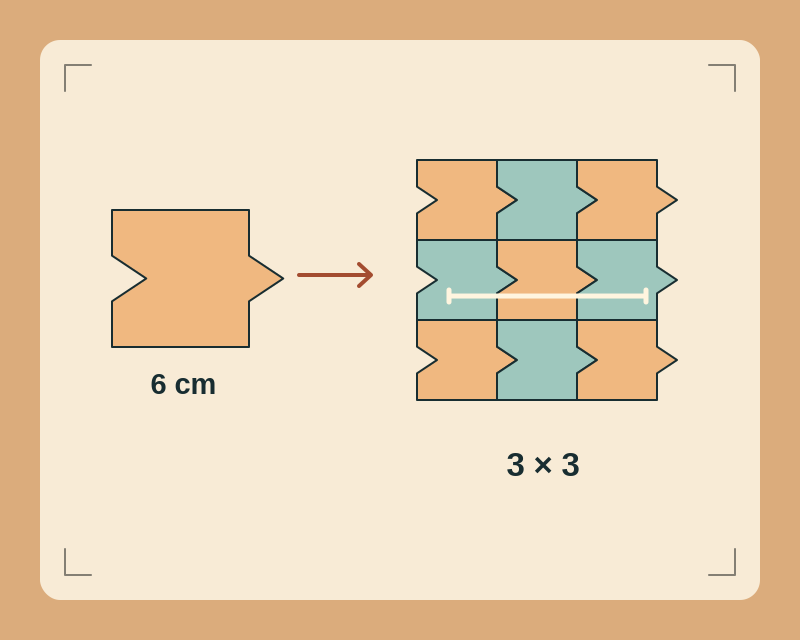
Cut a shape from one edge and slide it to the opposite edge without turning it. Try a three-by-three grid and use any gaps to find where the cutout shifted.
Prepare a square with a clear orientation
Draw a square with 6 cm sides on cardstock. Mark the top edge with an arrow. Get scissors, tape and a large sheet of paper. The Seattle Universal Math Museum uses translation to make patterns by sliding a shape. Here we will start with one pair of edges.
Cut a notch between two marks
On the left edge mark two points 2 and 4 cm down from the top. Make a third mark 1.5 cm inward and 3 cm down. Connect the marks to form a triangle whose straight side lies on the edge. Cut it out and keep it.
The remaining paper has a notch on the left side. Keep the top arrow visible while you move the cutout.
Slide the cutout six centimeters
Move the triangle horizontally to the right, without flipping or rotating it. Its straight edge should line up with the segment from 2 to 4 cm down the right edge and its tip should stick out. Tape it from behind. The outline now has a notch and protrusion at the same height.
Trace the outline and cut out two copies. Put them beside the template with the arrows up. One protrusion should fill the next notch.
Try three rows before decorating
Make nine copies or trace nine positions on paper. Put three in each row, sliding each 6 cm to the right. Move the rows 6 cm down. The top and bottom edges remain straight and the side joins still fit.
If a strip of blank paper shows between two triangles, compare the heights of the marks. If one tip overlaps another tile, check that both copies are the same size.
Use the fit to design
Try two alternating colors or draw a line that continues from one tile to the next. A line can make the slide visible even when the design inside changes. Keep one undecorated tile as a template and record the two moves that make the pattern grow.
Follow the evidence.
- Seattle Universal Math Museum · At-Home Translational Tessellations ↗
- Queen’s University · Making Tessellations ↗
Sources checked November 10, 2026. The exercise scenarios and figures are fictional. Our editorial standards.