Keep the scene stable and change one action between captures. Review image order and playback speed before adding more objects or a larger story.
Choose something that can happen in one shot
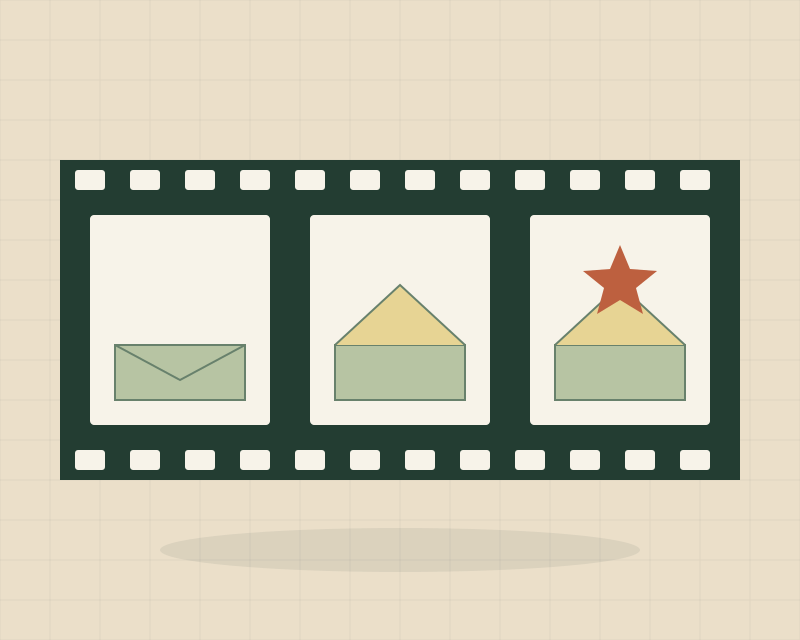
Our exercise proposes an envelope opening to reveal a paper star. Use your own materials and a clear surface. Characters, dialogue and multiple sets are unnecessary for exploring how an action is perceived.
Into Film explains animation through individual captures with small changes between them. We apply that principle in an original proposal, without reproducing its sequence or claiming to have filmed this envelope scene. The aim is experimenting with continuity and time.
Prepare a repeatable image
Place the device on stable support and check framing can remain fixed. Avoid hand-holding it throughout capture. Take a trial image and inspect what is inside and outside: table edge, envelope, background and space for the star.
Retain light and position during the trial. If focus and exposure can be locked, check how before starting. Our creative workspace guide helps setup and clearing; home need not become a permanent studio.
Plan the sequence before touching objects
- Start: the closed envelope establishes the situation.
- Change: lift the flap in photographable steps.
- Arrival: the star appears and remains visible.
Between captures, change only what the next state requires and remove hands from frame. Keep files in recognizable order. If a piece moves too far, revisit that section rather than adding photographs without checking the action they describe.
Collage explores a fixed composition. Here meaning depends on changes between frames, even with simple objects.
Compare duration and speed separately
This table uses a hypothetical sequence of 24 photographs, one image per frame and no transitions or duplicates. In an editor supporting these rates, duration equals frame count divided by frames per second.
| Frames | Rate | Duration |
|---|---|---|
| 24 | 8 fps | 3 seconds |
| 24 | 12 fps | 2 seconds |
The calculations are 24 / 8 = 3 and 24 / 12 = 2. These rates compare this exercise; they are no animation standard. Faster playback shortens the action without itself correcting large position jumps.
Watch the whole, then inspect one problem
First ask whether the action is understandable. Then examine one detail: camera movement, changed light, a visible hand or an out-of-order position. Neighboring frames can locate the issue before repeating everything.
A photo sequence organizes existing memories; this exercise makes new images for a movement illusion. A first trial can be useful with its mechanism visible. Choose one improvement for another version.
Keep images and assembly decisions
Retain original captures, their order and each export’s playback rate. Open the resulting video to check intended playback. The project file and exported video support different kinds of review.
A private scene of a few seconds can be the endpoint. To extend it, add another action later and check the connection. Enjoying still images becoming a sequence requires neither new equipment, publication nor professional polish.
Follow the evidence.
Sources checked October 26, 2026. Illustrative scenarios and numbers are fictional. The records and exercises are original editorial proposals, without attributed customer results or provider tests. Our editorial standards.