Retain case boundaries, intervals per person and measurement units. Add effort separately from duration and do not automatically assign a cause to gaps.
Set the case’s beginning and end
Choose an identifiable job and two events, such as receipt of a complete request and delivery of a response. Declare whether you measure continuous minutes or only a service schedule. Keep that rule consistent across cases rather than changing it to make a duration appear smaller.
The Lean Enterprise Institute distinguishes processing time from the complete journey through a process. That difference guides the question. Our exercise adds a per-person record to explain overlaps; it does not establish a universal definition for every tracking tool.
Write the unit beside every number
We use elapsed duration for the interval between case events; person-minutes for each participant’s accumulated work; and activity-covered time for the union of recorded intervals. These quantities answer different questions even though all use minutes.
Two people working simultaneously for fifteen minutes contribute thirty person-minutes. Only fifteen minutes pass on the job’s clock. An effort sum cannot be read as a chronology.
Reconstruct a two-person case
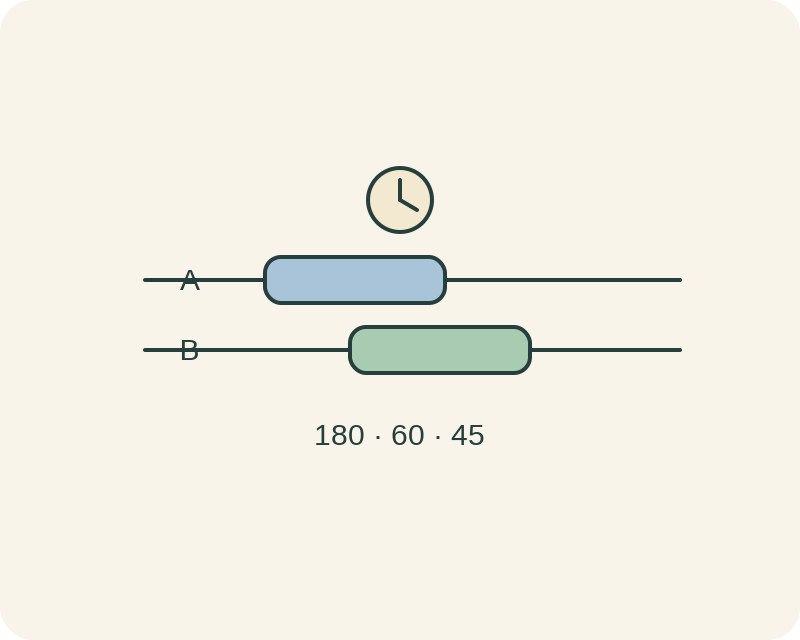
Entirely fictional example: a job starts at 10:00 and ends at 13:00 on the same day, in one time zone. Assume the two intervals below constitute all recorded work for that case.
| Participant | Interval | Person-minutes |
|---|---|---|
| Ana | 11:00–11:30 | 30 |
| Beto | 11:15–11:45 | 30 |
| Total effort | Two per-person intervals | 60 |
Elapsed duration is 180 minutes. Recorded activity runs from 11:00 to 11:45, a union covering 45 minutes. The 11:15–11:30 overlap counts for both participants when adding effort, but only once when constructing the time union.
Investigate time outside the intervals
Here, 180 − 45 = 135 minutes are not covered by recorded activity. That establishes neither waste nor personal inactivity. Reviews, external replies, other tasks or missing information may be involved; each period needs evidence before it is described.
Retain the 60 person-minutes for the effort question. Subtracting them from 180 produces a different indicator from calculating clock coverage. Those minutes alone also establish neither cost, billing nor productivity.
Review records before averaging
Check that every interval belongs to the case, begins before it ends and was not duplicated during export. If someone recorded different tasks simultaneously, clarify what that data represents before allocating it. Keep unresolved information explicitly pending.
Comparisons across jobs need equivalent events, schedules and scope. Do not silently mix a case ending at partial delivery with one ending when everything is approved. A correct average still does not describe every individual situation.
Use the number for a specific question
Effort helps review resources; duration supports investigation of the case’s journey; coverage identifies periods needing explanation. Choose the decision before creating a rate. A percentage without units or boundaries can conceal more than it clarifies.
The related capacity guide decides what enters open work. Here we reconstruct time for an already recorded case. A useful first result is explaining all three quantities without automatically turning them into a new delivery promise.
Follow the evidence.
Sources checked November 1, 2026. Illustrative scenarios and numbers are fictional. The records and exercises are original editorial proposals, without attributed customer results or provider tests. Our editorial standards.