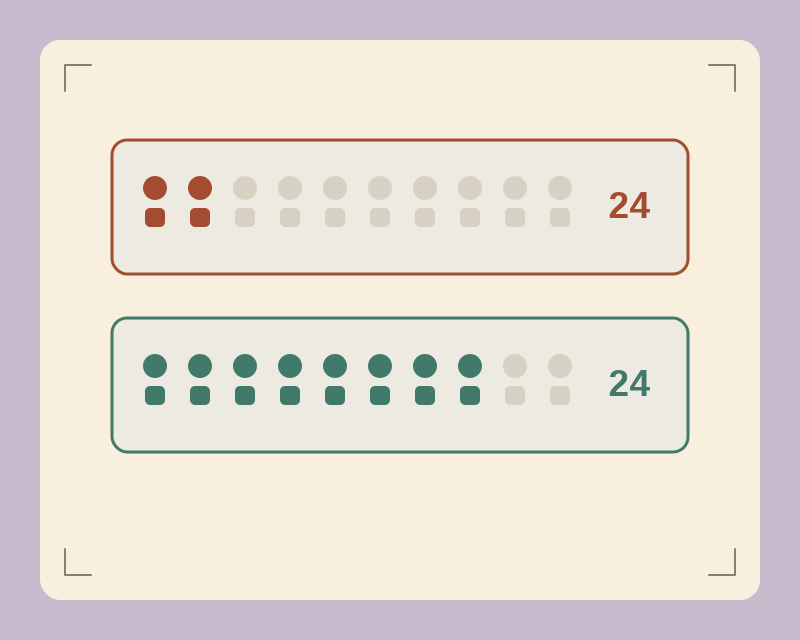
Define when observation ends, which orders qualify and how their amounts are summed. Preserve R, F and M separately before assigning labels.
Choose cutoff and population
The exercise closes on November 1, 2026 at 00:00 in one time zone. It includes completed orders from August 1 inclusive to that cutoff exclusive, identified by customer and order. All amounts use one currency, after discounts and before tax and shipping. This example has no refunds; a real operation must define how to handle them.
Reconstruct the three measures
R is elapsed days from the last eligible purchase to the cutoff, using local dates. F counts distinct eligible orders in the window. M sums their amounts. Shopify explains these three dimensions in its RFM analysis; here we use an original fixed-window exercise without reproducing its product scores or groups.
Read three complete profiles
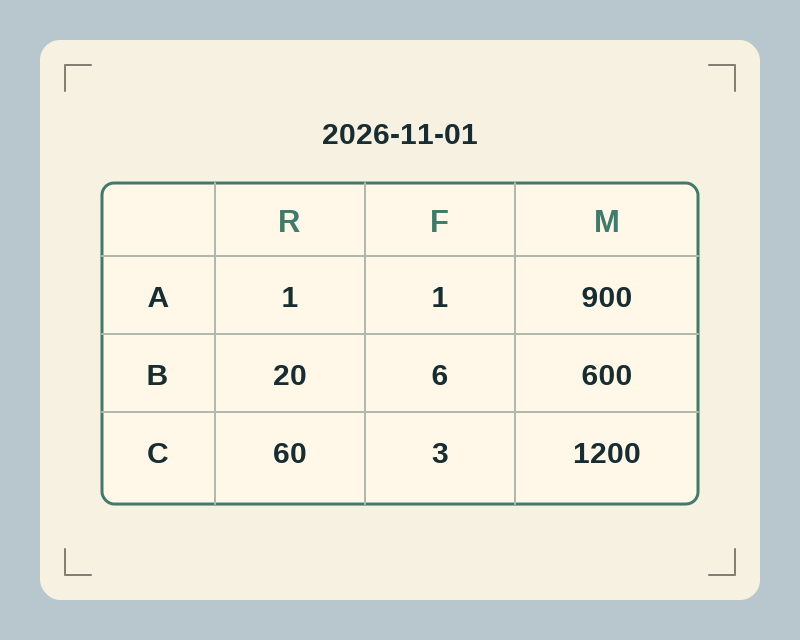
A purchased on October 31: R = 1 day, F = 1 order and M = 900. B last purchased on October 12: R = 20, F = 6 and M = 600. C last purchased on September 2: R = 60, F = 3 and M = 1,200. The most recent purchase, highest frequency and greatest spend belong to different people.
State a rule you can review
As a trial, “R up to 7 days and F equal to 1” selects A for reviewing their first experience within the window. B meets “F at least 5,” while C leads M. These are illustrative rules: one observed purchase does not establish that A is new across all history. Review earlier purchases if you need that classification.
Keep history alongside the label
Save the cutoff, window, order statuses, monetary rules and segment version. If someone has no eligible purchases, mark that condition instead of inventing a recent date. High spend does not establish margin, satisfaction or a future purchase. The snapshot opens questions about different relationships; sending a message still requires reviewing its context and relevance.
Follow the evidence.
Sources checked November 20, 2026. The exercise scenarios and figures are fictional. Our editorial standards.