Define cuándo termina la observación, qué pedidos entran y cómo sumas su importe. Conserva R, F y M por separado antes de asignar etiquetas.
Elige corte y población
El ejercicio cierra el 1 de noviembre de 2026 a las 00:00 en una sola zona horaria. Incluye pedidos completados desde el 1 de agosto, inclusive, hasta ese corte, exclusivo, identificados por cliente y pedido. Todos los importes están en la misma moneda, después de descuentos y antes de impuestos y envío. No hay devoluciones en este ejemplo; una operación real debe definir cómo tratarlas.
Reconstruye las tres medidas
R es el número de días transcurridos desde la última compra elegible hasta el corte, usando fechas locales. F cuenta pedidos elegibles distintos durante la ventana. M suma sus importes. Shopify explica estas tres dimensiones en su análisis RFM; aquí hacemos un ejercicio propio con una ventana fija, sin reproducir sus puntuaciones ni grupos de producto.
Lee tres perfiles completos
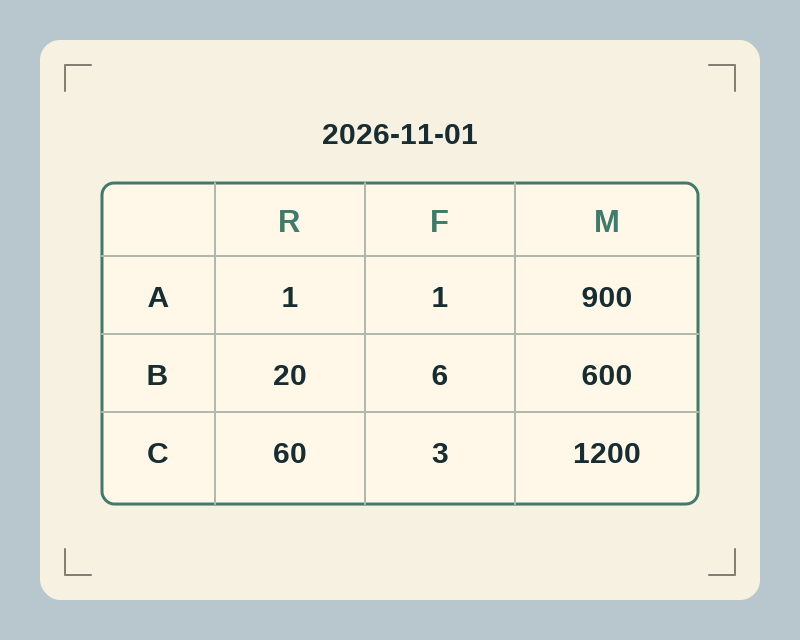
A compró el 31 de octubre: R = 1 día, F = 1 pedido y M = 900. B compró por última vez el 12 de octubre: R = 20, F = 6 y M = 600. C lo hizo el 2 de septiembre: R = 60, F = 3 y M = 1,200. La compra más reciente, la mayor frecuencia y el mayor importe pertenecen a personas diferentes.
Formula una regla que puedas revisar
Como ensayo, «R hasta 7 días y F igual a 1» selecciona A para revisar cómo fue su primera experiencia dentro de la ventana. B cumple «F de al menos 5», mientras C encabeza M. Son reglas ilustrativas: una sola compra observada no demuestra que A sea nuevo en toda la historia. Revisa compras anteriores si necesitas esa clasificación.
Conserva el historial junto a la etiqueta
Guarda corte, ventana, estados de pedido, reglas monetarias y versión del segmento. Si alguien no tiene compras elegibles, marca esa condición en lugar de inventar una fecha reciente. Un importe alto no prueba margen, satisfacción ni una compra futura. La foto sirve para abrir preguntas sobre relaciones distintas; para enviar una comunicación todavía hace falta revisar su contexto y pertinencia.
Customer RFM: keep recency, frequency and spend before creating groups
A fictional store sees one customer who bought yesterday, another who orders often and another with higher accumulated spend. Calling all three “best customers” hides the differences in their histories. An RFM snapshot keeps those three dimensions visible.
Define when observation ends, which orders qualify and how their amounts are summed. Preserve R, F and M separately before assigning labels.
Choose cutoff and population
The exercise closes on November 1, 2026 at 00:00 in one time zone. It includes completed orders from August 1 inclusive to that cutoff exclusive, identified by customer and order. All amounts use one currency, after discounts and before tax and shipping. This example has no refunds; a real operation must define how to handle them.
Reconstruct the three measures
R is elapsed days from the last eligible purchase to the cutoff, using local dates. F counts distinct eligible orders in the window. M sums their amounts. Shopify explains these three dimensions in its RFM analysis; here we use an original fixed-window exercise without reproducing its product scores or groups.
Read three complete profiles
A purchased on October 31: R = 1 day, F = 1 order and M = 900. B last purchased on October 12: R = 20, F = 6 and M = 600. C last purchased on September 2: R = 60, F = 3 and M = 1,200. The most recent purchase, highest frequency and greatest spend belong to different people.
State a rule you can review
As a trial, “R up to 7 days and F equal to 1” selects A for reviewing their first experience within the window. B meets “F at least 5,” while C leads M. These are illustrative rules: one observed purchase does not establish that A is new across all history. Review earlier purchases if you need that classification.
Keep history alongside the label
Save the cutoff, window, order statuses, monetary rules and segment version. If someone has no eligible purchases, mark that condition instead of inventing a recent date. High spend does not establish margin, satisfaction or a future purchase. The snapshot opens questions about different relationships; sending a message still requires reviewing its context and relevance.
客户 RFM:分组前保留最近购买时间、频次和金额
虚构商店看到一位客户昨天刚买,另一位经常下单,还有一位累计金额更高。都称为“最佳客户”会遮住历史差异。RFM 快照把三个维度保留下来。
定义观察何时结束、哪些订单合格及金额如何汇总,分配标签前分别保留 R、F、M。
选择截止点与人群
练习在同一时区的 2026 年 11 月 1 日 00:00 截止,包含 8 月 1 日起、但不包含截止时刻的已完成订单,并用客户和订单标识去重。金额采用同一货币,扣除折扣,未含税费和运费。示例没有退款,实际业务应定义退款处理规则。
重建三项指标
R 按本地日期计算最近一笔合格购买距截止点的天数。F 统计窗口内不同的合格订单数,M 汇总其金额。Shopify 的 RFM 分析解释了这三个维度;这里采用自编的固定窗口练习,不复现其产品中的分数和分组。
阅读三个完整画像
A 在 10 月 31 日购买:R = 1 天,F = 1 单,M = 900。B 最近在 10 月 12 日购买:R = 20,F = 6,M = 600。C 最近在 9 月 2 日购买:R = 60,F = 3,M = 1,200。最近购买、最高频次与最高金额分别属于不同的人。
写出可以复核的规则
试用“R 不超过 7 天且 F 等于 1”,会选中 A,可回顾其窗口内首次购买的体验。B 满足“F 至少为 5”,C 的 M 最高。这些只是示例规则;窗口内只见一次购买,不能证明 A 在全部历史中都是新客户。需要这一分类时,还要查更早购买。
在标签旁保留历史
保存截止点、窗口、订单状态、金额规则和分组版本。没有合格购买时应标明,而非编造最近日期。金额高不证明利润率、满意度或未来购买。快照用于提出不同客户关系的问题;发送消息前仍需检查背景与相关性。
Fuentes y método
Fuentes consultadas el 20 de noviembre de 2026. Los casos y datos numéricos de los ejercicios son ficticios. Editorial standards · Disclosures.