Calculate gross and net retention from the same starting customers; exclude new business and preserve customer or account count as another measure.
Fix customers, period and unit
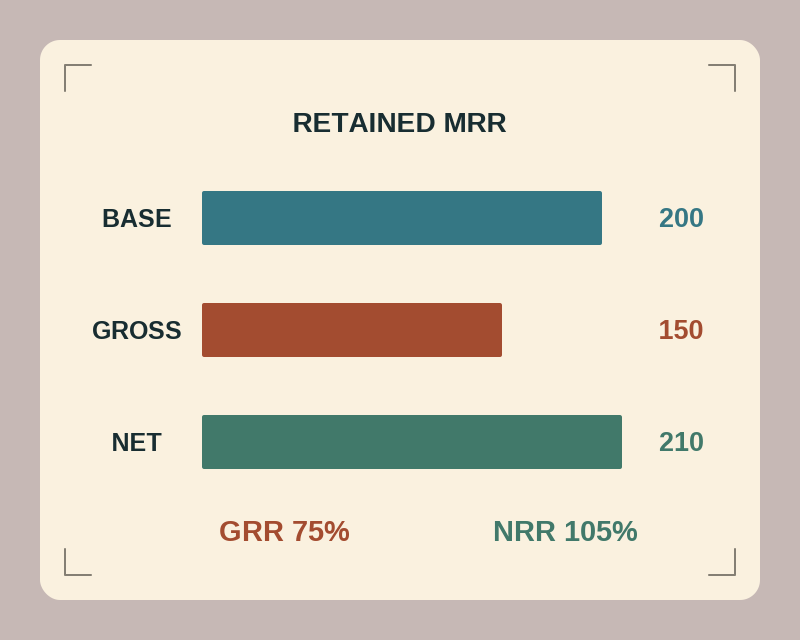
The exercise uses six accounts active at the start of a complete month. Their monthly recurring revenue, or MRR, totals 200 monetary units: A contributes 20; B, 50; C, 40; D, E and F, 30 each.
MRR describes a monthly recurring amount, not cash collected during the month. Use one currency and consistent criteria. New accounts acquired during the period do not belong to this starting base, although they can contribute to the business’s closing total.
Record three distinct changes
A cancels, removing 20 of MRR. B reduces its plan from 50 to 20, losing 30. C expands from 40 to 100, adding 60. D, E and F remain unchanged. There are no reactivations, currency changes or other movements in the fictional example.
The starting customers finish at 0 + 20 + 100 + 30 + 30 + 30 = 210 MRR. A net increase of ten does not mean every relationship was maintained or expanded: one canceled and another contracted.
Calculate gross and net from the same base
Gross revenue retention, GRR, excludes expansion: (200 − 20 − 30) / 200 × 100 = 75%. Net revenue retention, NRR, includes it: (200 − 20 − 30 + 60) / 200 × 100 = 105%.
ChartMogul documents both measures and report options; here we reconstruct a simple case without using a product account. Under the exercise’s rules, the thirty-percentage-point gap corresponds to 60 / 200 of expansion. The 105% does not erase losses visible in the 75%.
Preserve account count too
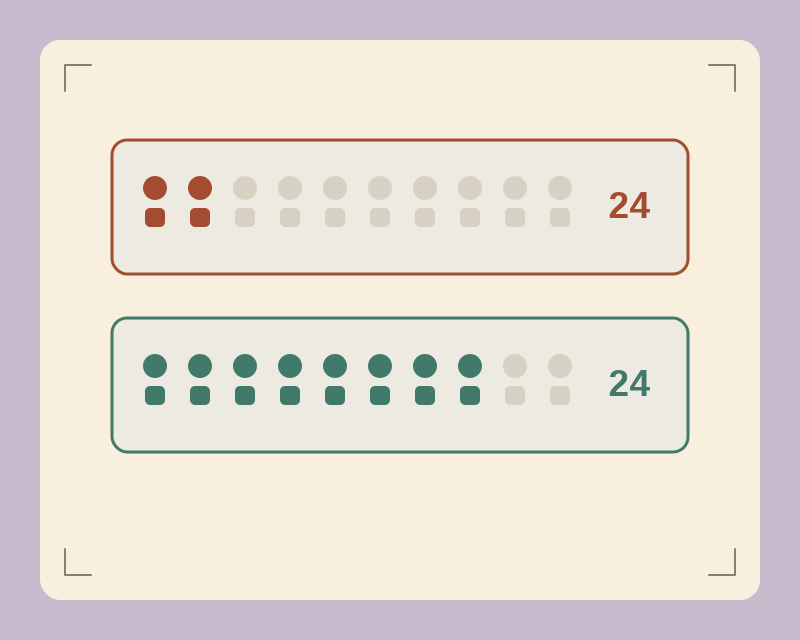
Five of the six starting accounts remain: account retention is 5 / 6, approximately 83.3%. B still counts as one account despite spending less. C also counts once despite contributing more money.
If new accounts bring 40 MRR, the business reaches 250, but this base’s NRR remains 105%, rather than 125%. Adding new business to the numerator changes the question and hides what happened among starting customers.
Record limits before comparing
Keep the starting base, dates, account amounts, movements and formulas. Confirm how your tool treats reactivations, plan filters and incomplete periods. Do not combine differently configured figures as equivalent.
The three readings raise different questions: who left, how much revenue was lost before expansion and how much remained after expansion. They do not establish satisfaction, profitability or a cause of departure. Use the breakdown to prepare conversations instead of replacing it with one favorable percentage.
Follow the evidence.
Sources checked November 23, 2026. The exercise scenarios and figures are fictional. Our editorial standards.