Calcula retención bruta y neta sobre los mismos clientes iniciales; excluye altas nuevas y conserva el conteo de personas o cuentas como otra medida.
Fija clientes, periodo y unidad
El ejercicio usa seis cuentas activas al inicio de un mes completo. Su ingreso mensual recurrente, o MRR, suma 200 unidades monetarias: A aporta 20; B, 50; C, 40; D, E y F, 30 cada una.
MRR describe un importe recurrente mensual, no el dinero cobrado durante el mes. Usa una moneda y criterios consistentes. Las cuentas nuevas del periodo no pertenecen a esta base inicial, aunque sí puedan contribuir al total del negocio al cierre.
Registra tres cambios diferentes
A cancela y retira 20 de MRR. B reduce su plan de 50 a 20: pierde 30. C amplía de 40 a 100: añade 60. D, E y F se mantienen. No hay reactivaciones, cambios de moneda ni otros movimientos en el ejemplo ficticio.
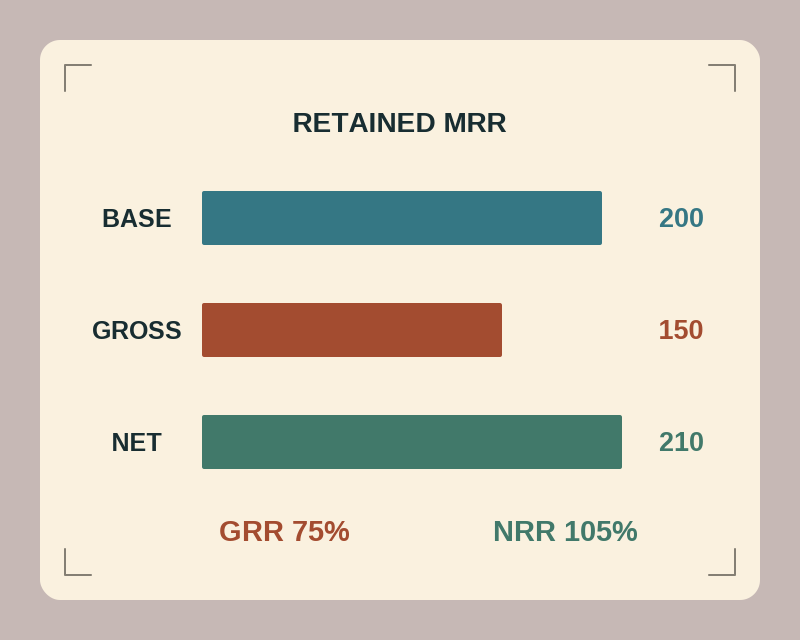
Los clientes iniciales terminan con 0 + 20 + 100 + 30 + 30 + 30 = 210 de MRR. La subida neta de diez no significa que todas las relaciones se hayan conservado o ampliado: una canceló y otra redujo.
Calcula bruta y neta con la misma base
La retención bruta de ingresos, GRR, excluye la ampliación: (200 − 20 − 30) / 200 × 100 = 75%. La retención neta, NRR, la incorpora: (200 − 20 − 30 + 60) / 200 × 100 = 105%.
ChartMogul documenta ambas medidas y sus opciones de informe; aquí reconstruimos un caso simple sin utilizar una cuenta del producto. Con las reglas del ejercicio, la diferencia de treinta puntos porcentuales corresponde a 60 / 200 de ampliación. El 105% no borra las pérdidas visibles en el 75%.
Conserva también la cantidad de cuentas
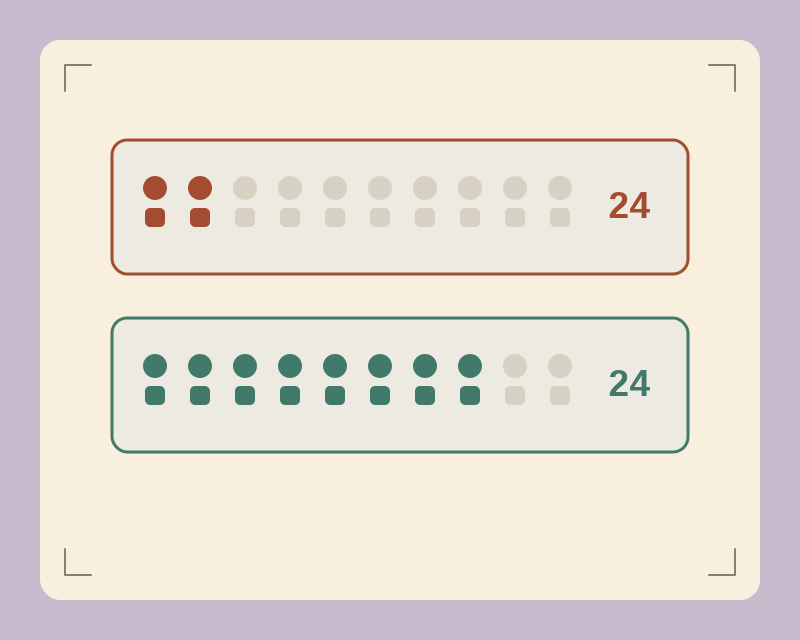
Quedan cinco de las seis cuentas iniciales: retención por cuenta de 5 / 6, aproximadamente 83,3%. B sigue contando como una cuenta, aunque su importe haya bajado. C también cuenta una vez, aunque ahora aporte más dinero.
Si entran cuentas nuevas con 40 de MRR, el negocio llega a 250, pero la NRR de esta base continúa en 105%, no en 125%. Añadir las altas al numerador cambiaría la pregunta y ocultaría qué ocurrió entre los clientes iniciales.
Anota límites antes de comparar
Guarda base inicial, fechas, importes por cuenta, movimientos y fórmulas. Confirma cómo trata tu herramienta las reactivaciones, filtros de planes y periodos incompletos. No combines cifras con configuraciones diferentes como si fueran equivalentes.
Las tres lecturas señalan preguntas distintas: quién se fue, cuánto ingreso se perdió antes de ampliar y cuánto quedó después de ampliar. No prueban satisfacción, rentabilidad ni una causa de abandono. Usa el desglose para preparar conversaciones, sin sustituirlo por un único porcentaje favorable.
Revenue retention: expansion can hide losses in the net total
A customer base can lose an account and finish with more recurring revenue. To understand how, keep cancellations, contractions and expansions separate before presenting a single retention percentage.
Calculate gross and net retention from the same starting customers; exclude new business and preserve customer or account count as another measure.
Fix customers, period and unit
The exercise uses six accounts active at the start of a complete month. Their monthly recurring revenue, or MRR, totals 200 monetary units: A contributes 20; B, 50; C, 40; D, E and F, 30 each.
MRR describes a monthly recurring amount, not cash collected during the month. Use one currency and consistent criteria. New accounts acquired during the period do not belong to this starting base, although they can contribute to the business’s closing total.
Record three distinct changes
A cancels, removing 20 of MRR. B reduces its plan from 50 to 20, losing 30. C expands from 40 to 100, adding 60. D, E and F remain unchanged. There are no reactivations, currency changes or other movements in the fictional example.
The starting customers finish at 0 + 20 + 100 + 30 + 30 + 30 = 210 MRR. A net increase of ten does not mean every relationship was maintained or expanded: one canceled and another contracted.
Calculate gross and net from the same base
Gross revenue retention, GRR, excludes expansion: (200 − 20 − 30) / 200 × 100 = 75%. Net revenue retention, NRR, includes it: (200 − 20 − 30 + 60) / 200 × 100 = 105%.
ChartMogul documents both measures and report options; here we reconstruct a simple case without using a product account. Under the exercise’s rules, the thirty-percentage-point gap corresponds to 60 / 200 of expansion. The 105% does not erase losses visible in the 75%.
Preserve account count too
Five of the six starting accounts remain: account retention is 5 / 6, approximately 83.3%. B still counts as one account despite spending less. C also counts once despite contributing more money.
If new accounts bring 40 MRR, the business reaches 250, but this base’s NRR remains 105%, rather than 125%. Adding new business to the numerator changes the question and hides what happened among starting customers.
Record limits before comparing
Keep the starting base, dates, account amounts, movements and formulas. Confirm how your tool treats reactivations, plan filters and incomplete periods. Do not combine differently configured figures as equivalent.
The three readings raise different questions: who left, how much revenue was lost before expansion and how much remained after expansion. They do not establish satisfaction, profitability or a cause of departure. Use the breakdown to prepare conversations instead of replacing it with one favorable percentage.
收入留存:扩张可能在净额中掩盖流失
客户群可能失去一个账户,却以更高经常性收入结束期间。理解这一点,需要先分别保留取消、降级和扩张,再呈现单一留存百分比。
毛留存与净留存应使用同一期初客户,排除新增业务,并另行保留客户或账户数量指标。
固定客户、期间和单位
练习使用完整月份开始时的六个活跃账户。每月经常性收入 MRR 合计 200 个货币单位:A 为 20,B 为 50,C 为 40,D、E、F 各为 30。
MRR 描述每月经常性金额,不是当月收到的现金。采用同一货币与一致规则。期间新增账户不属于期初集合,尽管它们可能增加期末业务总额。
分开记录三种变化
A 取消,减少 20 MRR;B 从 50 降到 20,减少 30;C 从 40 升到 100,增加 60;D、E、F 保持不变。虚构示例没有重新激活、汇率变化或其他变动。
期初客户最后合计为 0 + 20 + 100 + 30 + 30 + 30 = 210 MRR。净增加十,并不意味着所有关系都得到保留或扩张:一个取消,另一个减少消费。
使用同一基数计算毛额与净额
毛收入留存 GRR 不计扩张:(200 − 20 − 30) / 200 × 100 = 75%。净收入留存 NRR 计入扩张:(200 − 20 − 30 + 60) / 200 × 100 = 105%。
ChartMogul 文档介绍了两项指标及报告选项;本文只是重建简单案例,没有使用产品账户。在练习规则下,三十个百分点的差额对应 60 / 200 的扩张。105% 不会消除 75% 中可见的流失。
同时保留账户数量
期初六个账户剩下五个,账户留存为 5 / 6,约 83.3%。B 虽然金额下降,仍算一个账户;C 虽然贡献增加,也只算一个。
若新增账户贡献 40 MRR,业务总额达到 250,但期初集合的 NRR 仍为 105%,不是 125%。把新增业务放入分子,会改变问题,掩盖原有客户的实际变化。
比较之前写明边界
保存期初集合、日期、各账户金额、变动与公式。核实工具如何处理重新激活、套餐筛选和未结束期间。不同配置的数据不能直接混为等价结果。
三种解读分别提示谁离开、扩张之前损失多少收入,以及扩张之后剩下多少。它们不能证明满意度、利润或离开的原因。用明细准备对话,不要只保留一个好看的百分比。
Fuentes y método
Fuentes consultadas el 23 de noviembre de 2026. Los casos y datos numéricos de los ejercicios son ficticios. Editorial standards · Disclosures.