Divide the period’s fixed costs by each unit’s contribution. The result is a threshold within the model; demand, capacity and collections need their own checks.
Define what counts as one unit
In a fictional studio, one unit is a catalog review with comparable scope and effort. The period is one month. If an assignment adds photography production or multiple revisions, do not count it as another identical unit without adjusting assumptions.
Write what the price includes, the work required and exclusions. Our first service validation guide investigates interest and purchasing; this calculation asks how many units would cover costs if its conditions hold.
Separate fixed and variable costs without omitting work
A fixed cost in the model remains unchanged within the activity range considered for that month. A variable cost increases with each unit. Review tools, materials, collaborators and your own work: an hour does not become free because it is not separately paid today.
Classify each item once and document how the owner’s compensation is treated. Avoid mixing an entire annual expense with one month’s revenue without an explicit allocation. If additional assignments require hiring more capacity, the fixed-cost assumption may stop holding.
Calculate contribution and threshold
The SBA presents break-even units as fixed costs divided by unit price minus unit variable cost. In our example, amounts are fictional monetary units, excluding taxes and financing; price and costs remain constant within the range studied.
Monthly fixed costs = 5,000
Unit price = 700
Unit variable cost = 200
Unit contribution = 700 − 200 = 500
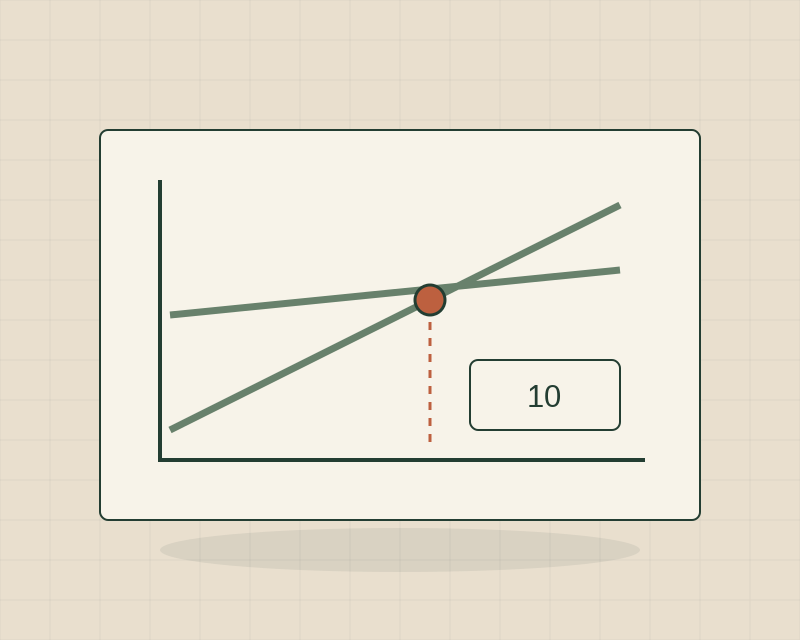
Break-even point = 5,000 / 500 = 10 units
The contribution of 500 first goes toward fixed costs. It is not net profit per sale. If price equaled or fell below variable cost, this model would provide no finite positive threshold that covers positive fixed costs.
Check the result at three volumes
| Units | Revenue | Total cost | Model result |
|---|---|---|---|
| 8 | 5,600 | 6,600 | −1,000 |
| 10 | 7,000 | 7,000 | 0 |
| 12 | 8,400 | 7,400 | 1,000 |
For eight units, total cost is 5,000 plus 8 × 200. For twelve, it is 5,000 plus 12 × 200. The table shows the result under these assumptions, rather than a sales forecast or profitability promise.
If a calculation produces a fraction and you can only sell complete units, round the minimum needed to cover costs upward. Before using it, recalculate revenue and costs at that whole number; do not round the margin to suit a preference.
Compare the threshold with actual operations
- Demand: is there evidence that someone will purchase that volume at the assumed price?
- Capacity: how many complete units can available resources deliver?
- Collections: when does money arrive, and which payments fall due first?
- Mix: are you combining services with different prices and costs?
- Range: does the expected volume require a change in structure or tools?
Our capacity guide helps review workload. A threshold of ten establishes neither the ability to deliver ten nor collection within the same month.
Retain assumptions before changing a price
Keep a record of unit, period, cost list, source of each estimate, contribution and calculated volume. Change one assumption at a time to understand its effect, then review whether the offered scope remains feasible.
Our weekly business review helps revisit those assumptions with evidence. The calculation is a planning tool limited to included items; it neither replaces a complete accounting assessment nor establishes that the business has enough cash.
Follow the evidence.
Sources checked October 21, 2026. Illustrative scenarios and numbers are fictional. The records and exercises are original editorial proposals, without attributed customer results or provider tests. Our editorial standards.