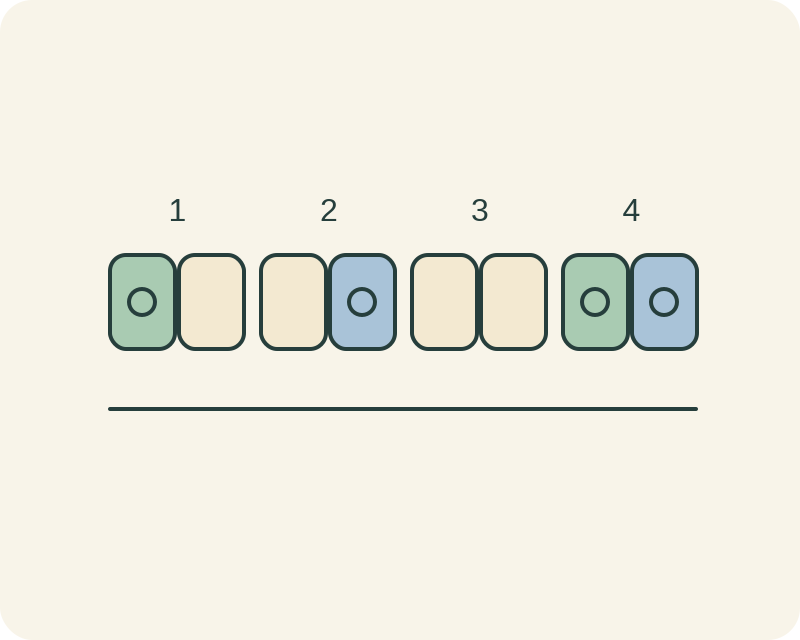
Keep four evenly spaced beats and split each interval in two. Change the claps while holding the count.
Find a speed you can repeat
Tap four gentle beats on a table and repeat. Leave the same time from beat four to the next one as between other beats. Count one, two, three, four with the taps.
Carnegie Hall uses a steady pulse to explore tempo and rhythm. Use a finger or a quiet motion if sound is inconvenient.
Put a syllable halfway through each interval
Say one and two and three and four and. Numbers match taps and each and goes halfway into the following interval. Keep the numbers at the same speed when adding your voice.
The Baylor compendium shows how a quarter-note beat can divide into two eighth notes. Two equal slots per beat let us practice that division without reading a score.
Play a pattern with spaces
| Beat | On the number | On the and |
|---|---|---|
| 1 | Clap | Space |
| 2 | Space | Clap |
| 3 | Space | Space |
| 4 | Clap | Clap |
Count aloud and clap only in the marked slots. To keep another beat marker, use your foot or ask someone to tap the numbers. The voice continues through beat three while your hands stay still.
Restart with the same spacing
After clapping on the and of beat four, beat one arrives after the other half of the interval. Listen for an extra pause at the restart. Try two slow rounds before speeding up.
If you rush into beat two, return briefly to counting and tapping. Add the claps again afterward.
Move one clap and listen
Move the clap on the and of beat two to the number two. Keep the others. The count takes the same time in both versions, while one clap comes earlier in the second.
Alternate two rounds of each version with someone keeping the same beat. Notice which part of the count helps you enter.
Draw your own round
Draw four pairs of boxes, mark the claps and count every slot. Read the drawing aloud before playing. Keep the pattern and a note on where you felt time most easily if it helps.
Follow the evidence.
Sources checked November 8, 2026. Illustrative scenarios and numbers are fictional. Original exercises and records, without attributed customer results or field observations. Our editorial standards.