Separate lot identification, sampling and the decision. Record the units you observed so someone can reconstruct the outcome.
Agree on the decision to make
Record the lot code, size and packaging. Define a nonconforming unit: in the exercise, a folder whose fastener will not close using the agreed motion. If it has two problems, count the folder once for this rule and describe both problems separately.
Set the rule before opening the lot
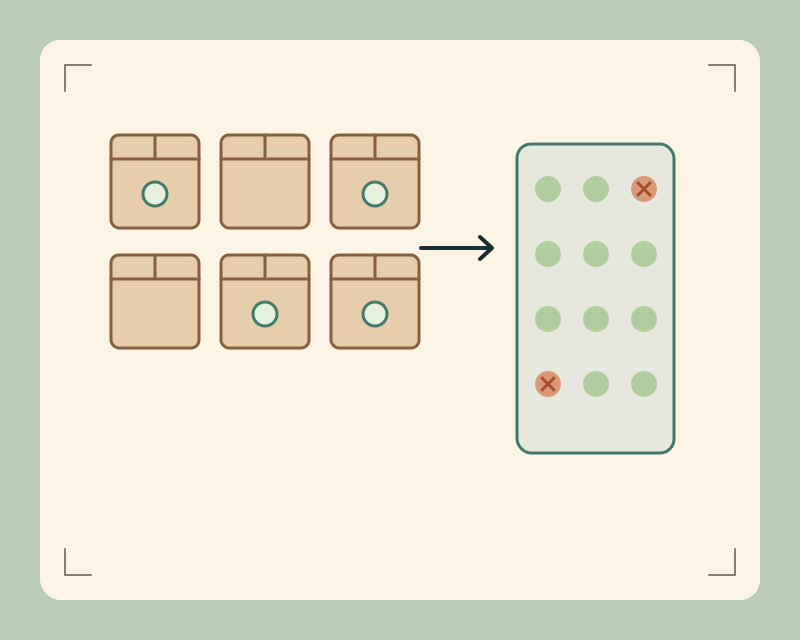
To illustrate the process, the shop decides to draw 12 distinct folders at random. It releases the lot with at most one nonconforming unit and holds it with two or more. The numbers are fictional. When choosing a real plan, document the risks of accepting a poor lot and holding an acceptable one, and check product requirements.
Select positions across the entire lot
If six boxes hold twenty folders each, number them from 1 to 120 and use a random generator to pick twelve without repeats. Keep the numbers and their positions in the boxes. Opening only the top box leaves the units in the other five unseen.
Record and carry out the decision
Two fasteners in the sample will not close. The example's rule calls for holding and labeling the lot so it does not reach packing. Keep the sample and agree on the next action with the supplier, such as a full inspection. Replacing the two sampled folders does not change the original result.
Record what the result covers
The report could say, “Two of the twelve inspected units failed; the lot was held under the agreed rule.” That result guides the decision about this delivery. Estimating process quality calls for a separate measurement design.
Follow the evidence.
- NIST/SEMATECH · What is Acceptance Sampling? ↗
- NIST/SEMATECH · What kinds of lot acceptance sampling plans are there? ↗
Sources checked November 15, 2026. The exercise scenarios and figures are fictional. Our editorial standards.