Define occupation, location and alternatives; many workers facing one employer describe a different relationship from many customers facing one seller.
Change the side of the question
OpenStax presents labor monopsony as a market with a single employer. In that relationship, the employer demands labor and workers supply it. Product monopoly examines another relationship: one seller facing its buyers.
Before using either word, complete a specific sentence: “What is being bought or sold, between whom, and in which market?” Merely saying “there is a large company” omits both the exchange’s side and its boundaries.
Build a case with stated boundaries
The fictional exercise assumes thirty people available for a specific occupation in a valley and one employer hiring that work during the observed period. It also assumes no accessible hiring alternatives within the defined market.
Those conditions are model assumptions rather than a diagnosis of a real valley. If commuting, remote work, other occupations or nearby employers were options, you would need to investigate which are relevant alternatives. The drawing does not settle that boundary.
Count employers rather than buildings or workers
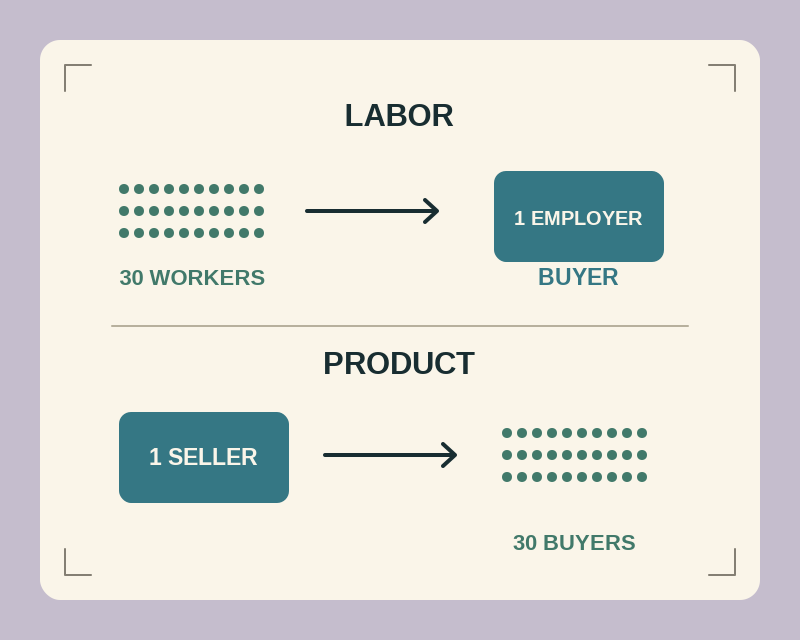
The diagram shows thirty people converging on one employer buying labor. Having two facilities does not by itself create two independent employers. Nor do its thirty workers represent thirty buyers of labor.
For comparison, draw one product seller facing thirty customers. Participant counts may look similar, but the center occupies the opposite side of the transaction. Label “labor” and “product” to avoid confusing the two markets.
Do not turn buying power into unlimited freedom
OpenStax’s model retains labor supply as a constraint: offering too low a wage can leave the employer short of people willing to work. Market power does not eliminate that response.
This exercise calculates neither wages, optimal employment nor policy effects. Doing so requires additional relationships and assumptions. An arrow toward one buyer supports discussing the case’s structure; it cannot establish an arbitrary wage figure or illegal conduct.
Separate an explanation from a real diagnosis
The final example record contains occupation, valley, period, thirty suppliers, one demander and alternatives excluded by assumption. Mark which information would require verification to study a specific situation rather than illustrate the concept.
Product sales shares cannot replace analysis of labor hiring. Keep both markets separate and explain which side you are counting. The useful result is a more clearly bounded question about workers’ options rather than an automatic label for every company with many employees.
Follow the evidence.
Sources checked November 25, 2026. The exercise scenarios and figures are fictional. Our editorial standards.