Define ocupación, lugar y alternativas; muchos trabajadores frente a un empleador describen una relación distinta de muchos clientes frente a un vendedor.
Cambia el lado de la pregunta
OpenStax presenta el monopsonio laboral como un mercado con un solo empleador. En esa relación, el empleador demanda trabajo y los trabajadores lo ofrecen. El monopolio de un producto mira otra relación: un vendedor frente a sus compradores.
Antes de usar cualquiera de las palabras, completa una frase concreta: «se compra o vende qué, entre quiénes y en qué mercado». Decir solo «hay una empresa grande» omite tanto el lado del intercambio como sus límites.
Construye un caso con límites declarados
El ejercicio ficticio supone treinta personas disponibles para una ocupación específica en un valle y un único empleador que contrata ese trabajo durante el periodo observado. Se supone también que no tienen alternativas de contratación accesibles dentro del mercado definido.
Esas condiciones son supuestos del modelo, no un diagnóstico de un valle real. Si hubiera opciones de traslado, trabajo remoto, otras ocupaciones o empleadores cercanos, habría que investigar cuáles constituyen alternativas relevantes. El dibujo no resuelve esa delimitación.
Cuenta empleadores, no edificios ni trabajadores
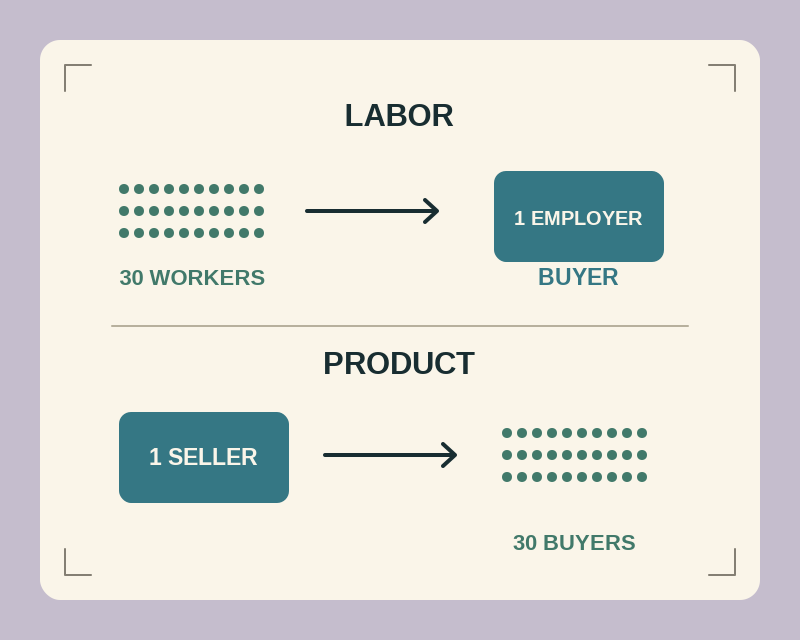
En el esquema, treinta personas convergen hacia un empleador comprador de trabajo. Que este tenga dos instalaciones no crea por sí solo dos empleadores independientes. Tampoco sus treinta trabajadores representan treinta compradores de trabajo.
Para contrastar, dibuja un vendedor de un producto frente a treinta clientes. El número de participantes puede parecer similar, pero el centro ocupa el lado opuesto de la transacción. Rotula «trabajo» y «producto» para no confundir los dos mercados.
No conviertas poder de compra en libertad ilimitada
El modelo de OpenStax mantiene la oferta de trabajo como restricción: ofrecer un salario demasiado bajo puede dejar al empleador sin suficientes personas dispuestas a trabajar. Tener poder de mercado no elimina esa respuesta.
Este ejercicio no calcula salarios, empleo óptimo ni efectos de una política. Para hacerlo necesitarías relaciones y supuestos adicionales. Una flecha hacia un único comprador permite discutir la estructura del caso; no permite deducir cualquier cifra salarial ni atribuir una conducta ilegal.
Separa una explicación de un diagnóstico real
La ficha final del ejemplo recoge ocupación, valle, periodo, treinta oferentes, un demandante y alternativas excluidas por supuesto. Marca qué dato tendrías que comprobar si quisieras estudiar una situación concreta en lugar de ilustrar el concepto.
La participación en ventas de productos no sustituye el análisis de contratación laboral. Conserva ambos mercados por separado y explica qué lado estás contando. El resultado útil es una pregunta mejor delimitada sobre las opciones de los trabajadores, no una etiqueta automática para toda empresa con muchos empleados.
Labor monopsony: identify who buys the work
A company may sell to many customers while being the only hiring option in a local example. Understanding labor monopsony requires looking at the side buying work rather than counting buyers of the finished product.
Define occupation, location and alternatives; many workers facing one employer describe a different relationship from many customers facing one seller.
Change the side of the question
OpenStax presents labor monopsony as a market with a single employer. In that relationship, the employer demands labor and workers supply it. Product monopoly examines another relationship: one seller facing its buyers.
Before using either word, complete a specific sentence: “What is being bought or sold, between whom, and in which market?” Merely saying “there is a large company” omits both the exchange’s side and its boundaries.
Build a case with stated boundaries
The fictional exercise assumes thirty people available for a specific occupation in a valley and one employer hiring that work during the observed period. It also assumes no accessible hiring alternatives within the defined market.
Those conditions are model assumptions rather than a diagnosis of a real valley. If commuting, remote work, other occupations or nearby employers were options, you would need to investigate which are relevant alternatives. The drawing does not settle that boundary.
Count employers rather than buildings or workers
The diagram shows thirty people converging on one employer buying labor. Having two facilities does not by itself create two independent employers. Nor do its thirty workers represent thirty buyers of labor.
For comparison, draw one product seller facing thirty customers. Participant counts may look similar, but the center occupies the opposite side of the transaction. Label “labor” and “product” to avoid confusing the two markets.
Do not turn buying power into unlimited freedom
OpenStax’s model retains labor supply as a constraint: offering too low a wage can leave the employer short of people willing to work. Market power does not eliminate that response.
This exercise calculates neither wages, optimal employment nor policy effects. Doing so requires additional relationships and assumptions. An arrow toward one buyer supports discussing the case’s structure; it cannot establish an arbitrary wage figure or illegal conduct.
Separate an explanation from a real diagnosis
The final example record contains occupation, valley, period, thirty suppliers, one demander and alternatives excluded by assumption. Mark which information would require verification to study a specific situation rather than illustrate the concept.
Product sales shares cannot replace analysis of labor hiring. Keep both markets separate and explain which side you are counting. The useful result is a more clearly bounded question about workers’ options rather than an automatic label for every company with many employees.
劳动买方垄断:明确谁在购买劳动
一家企业可能向许多客户销售,同时在某个本地例子中是唯一招聘选择。理解劳动买方垄断,要看购买劳动的一方,而不是统计成品的购买者。
定义职业、地点和替代选择;许多劳动者面对一个雇主,与许多客户面对一个卖方,是不同关系。
换一个交易方向提问
OpenStax 将劳动买方垄断描述为只有一个雇主的市场。在这种关系中,雇主需求劳动,劳动者供给劳动。产品卖方垄断观察的是另一种关系:一个卖方面对其买方。
使用这些词之前,先补全具体句子:“买卖的是什么、发生在谁之间、属于哪个市场?”只说“有一家大企业”,既省略了交易方向,也省略了边界。
用明确边界建立案例
虚构练习假定,某山谷有三十人可从事特定职业,在观察期间只有一个雇主招聘该项劳动。还假定,在所定义市场内,他们没有可行的其他招聘选择。
这些是模型假设,不是对真实山谷的诊断。如果存在通勤、远程工作、其他职业或附近雇主的选择,就需要调查哪些属于相关替代。画一张图不能解决市场边界问题。
数雇主,而不是楼宇或员工
示意图中,三十名劳动者指向购买劳动的一个雇主。该雇主有两处设施,本身不会创造两个独立雇主。三十名员工也不代表三十个劳动购买者。
作为对照,再画一个产品卖方面对三十名客户。参与者数量看起来相似,但中心节点位于交易的另一侧。标注“劳动”和“产品”,避免混淆两个市场。
买方力量不等于无限自由
OpenStax 的模型仍受劳动供给约束:工资过低,可能招不到足够愿意工作的人。市场力量不会消除这种反应。
本练习不计算工资、最优就业量或政策效果。那些计算需要额外关系和假设。指向单一买方的箭头可用于讨论案例结构,却不能推出任意工资数字,也不能据此认定违法行为。
区分概念解释与真实诊断
最终案例记录包含职业、山谷、期间、三十个供给者、一个需求者,以及按假设排除的替代选择。标明若研究具体情形,哪些信息需要核查,而不是只用于说明概念。
产品销售份额不能代替劳动招聘分析。分别保留两个市场,并解释所统计的是哪一侧。有用的结果是把劳动者选择的问题界定得更清楚,而不是给所有员工众多的企业自动贴标签。
Fuentes y método
Fuentes consultadas el 25 de noviembre de 2026. Los casos y datos numéricos de los ejercicios son ficticios. Editorial standards · Disclosures.