Compara unidades equivalentes y horas trabajadas del mismo periodo. Lee el cociente junto a sus dos cantidades antes de explicar el cambio.
Define qué sale y qué horas entran
El Bureau of Labor Statistics de Estados Unidos describe la productividad laboral como producción real por hora trabajada. Para practicar con un solo producto, el taller cuenta cajas terminadas que pasan la misma revisión. Registra las horas de todas las personas incluidas en el proceso y aplica el mismo criterio a las dos semanas.
Calcula la primera y la segunda semana
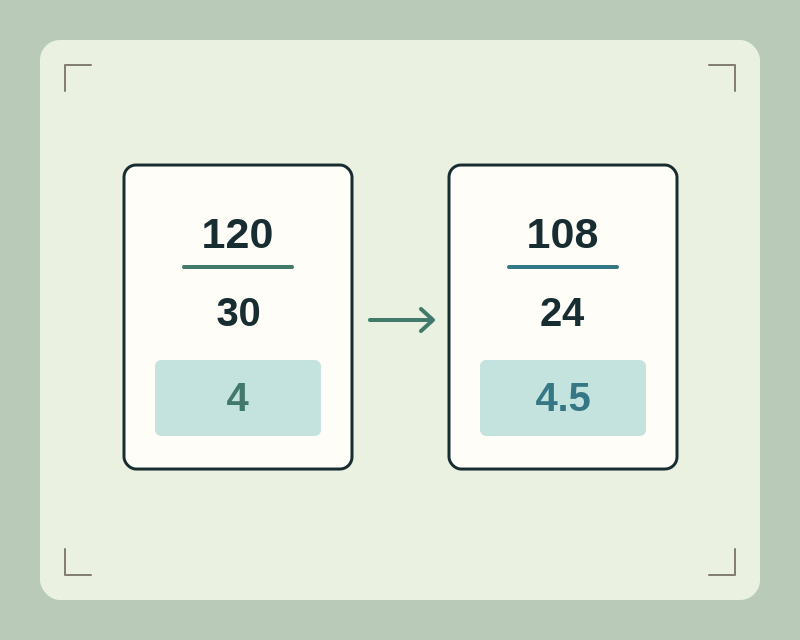
La primera semana salen 120 cajas en 30 horas de trabajo. El cociente da 4 cajas por hora. La segunda salen 108 cajas en 24 horas. El cociente da 4,5 cajas por hora. La producción bajó 10 %, las horas bajaron 20 % y lo producido por hora subió 12,5 %.
Revisa la unidad cuando cambia el trabajo
Si la segunda semana incluye cajas más sencillas, conserva esa diferencia antes de atribuir el cambio a un método. Busca un grupo de cajas comparables y comprueba qué ocurre al aplicar la misma revisión de calidad. Si la empresa mide muchos productos, revisa cómo construye una medida común de producción.
Mira lo que cambió además de las horas
La documentación del BLS explica que maquinaria, experiencia, procesos y otros factores pueden influir en la productividad laboral. En el ejemplo, los dos cocientes permiten describir lo que pasó. Si alguien atribuye el cambio a una herramienta nueva, busca cuándo se usó y con qué encargos.
Escribe una conclusión que se pueda recalcular
Una nota puede decir «Salieron 108 cajas en 24 horas, frente a 120 en 30. El taller produjo menos cajas y pasó de 4 a 4,5 por hora». Para llevar la lectura a un boletín, anota sector, definición de producción, horas, periodo y si la tasa se publica en términos anualizados.
When output falls while production per hour rises
A fictional workshop finishes fewer boxes this week and the report says labor productivity rose. Both can happen when hours worked fall more than output.
Compare equivalent units and hours worked for the same period. Read the ratio alongside both quantities before explaining the change.
Define what leaves the shop and which hours count
The US Bureau of Labor Statistics describes labor productivity as real output per hour worked. To practice with one product, the shop counts finished boxes that pass the same check. Record the hours of everyone included in the process and use the same criterion for both weeks.
Calculate both weeks
The first week yields 120 boxes in 30 work hours, or 4 boxes per hour. The second yields 108 in 24 hours, or 4.5 boxes per hour. Output fell 10%, hours fell 20% and output per hour rose 12.5%.
Check the unit when the work changes
If the second week includes simpler boxes, keep that difference before attributing the change to a method. Look for comparable boxes and see what happens under the same quality check. If the company measures many products, review how it builds a common output measure.
Look at what changed besides hours
BLS documentation explains that machinery, experience, processes and other factors can affect labor productivity. In the example, both ratios describe what happened. If someone attributes the change to a new tool, look at when it was used and for which jobs.
Write a conclusion that can be recalculated
A note might read “We made 108 boxes in 24 hours, compared with 120 in 30. The shop made fewer boxes and went from 4 to 4.5 per hour.” For a bulletin, record the sector, output definition, hours, period and whether the rate is annualized.
为什么每小时产量上升时,总产量仍可能下降
一家虚构作坊这周做完的盒子较少,报告却显示劳动生产率上升。工时下降幅度大于产量降幅时,这两件事可以同时发生。
比较同一时期的等效单位与实际工时。解释变化前,把比值和构成它的两个数量放在一起读。
定义产出和计入的工时
美国劳工统计局把劳动生产率描述为每工作一小时的实际产出。为用单一产品练习,作坊只数通过同一检查的成品盒。记录流程内所有相关人员的工时,两周采用同一标准。
算出两周的比值
第一周 30 个工时完成 120 个盒子,每小时 4 个。第二周 24 个工时完成 108 个,每小时 4.5 个。产量下降 10%,工时下降 20%,每小时产出上升 12.5%。
工作内容变化时核对单位
如果第二周的盒子更简单,先保留这个差异,再考虑能否把变化归因于方法。找一组可比较的盒子,在同一质量检查下核对结果。如果企业衡量许多种产品,查看它怎样构建共同的产出指标。
看工时以外还变了什么
美国劳工统计局说明,机器、经验、流程等因素都可能影响劳动生产率。例子中的比值能说明发生了什么。如果有人把变化归功于新工具,就去查什么时候使用、用于哪些订单。
写一条可以重算的结论
记录可以写“24 小时做出 108 个盒子,之前是 30 小时做 120 个。总产量下降,每小时由 4 个升到 4.5 个。”读统计公报时,记下行业、产出定义、工时、时期,以及变动率是否按年率表示。
Fuentes y método
- U.S. Bureau of Labor Statistics · What is labor productivity? ↗
- U.S. Bureau of Labor Statistics · Productivity overview ↗
Fuentes consultadas el 13 de noviembre de 2026. Los casos y datos numéricos de los ejercicios son ficticios. Editorial standards · Disclosures.