Use the same boundary, unit and clock for L, flow rate and W; interpret the relationship as a check of averages under stated conditions.
Draw the boundary before counting
A fictional studio defines entry as an accepted job with complete materials, and exit as an approved delivery. Production, review and waits between those events remain inside. An inquiry not yet accepted remains outside.
If you count only people waiting, time must refer to that wait. If you count every job within the process, include those being worked on. Combining a partial queue with the complete journey produces quantities describing different systems.
Attach units to the relationship
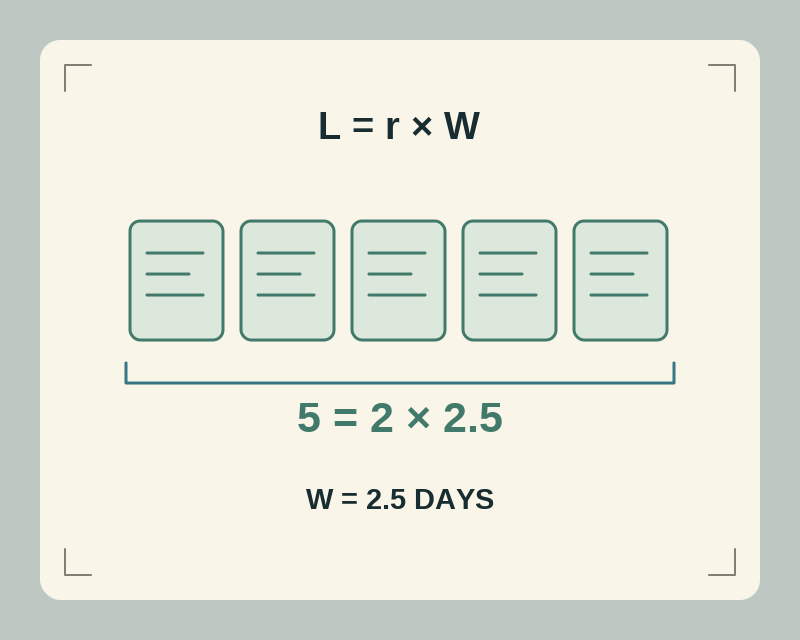
The law is commonly written L = λ × W. Here we call the flow rate r for readability: L = r × W. L is the average number of jobs inside; r is jobs per day; W is average days within the boundary.
MIT’s notes present the relationship in a stationary regime. For this exercise, assume stable, representative flow, with arrivals and departures balanced over the long run. This does not require exactly equal arrivals and departures every day.
Reconstruct an averages example
Suppose the fictional system maintains L = 5 jobs on average and r = 2 jobs per service day. Then W = 5 / 2 = 2.5 service days. The reverse check is 2 × 2.5 = 5 jobs.
Five represents a time average of open work, not a single observation at Monday’s end. A record spending ten hours at four jobs and ten hours at six would average five over those twenty hours; that calculation illustrates time weighting without independently validating the example’s entire system.
Review the record’s assumptions
Preserve entry and exit events, starting and ending state, clock and observation period. A recent opening, continuously growing queue or major capacity change calls for checking whether the stable approximation still makes sense.
Do not mix calendar days with service days. Nor should every incoming contact count toward the rate if many never cross the acceptance boundary. In short periods, jobs already open at the start or still open at the end require explicit treatment; averaging only completed jobs can bias the reading.
Use the identity to investigate
If observed and calculated times differ, first inspect units, boundaries, coverage and stability. The relationship can reveal an inconsistent definition before there is any productivity problem.
Removing board cards does not guarantee an unchanged departure rate or establish causation. Nor does a 2.5-day average promise that deadline to every customer. Keep the relationship as a flow diagnostic and review each commitment against its actual conditions.
Follow the evidence.
- MIT: Queuing models, Spring 2026, Little’s law ↗
- John D. C. Little: A proof for the queuing formula L = lambda W ↗
Sources checked November 23, 2026. The exercise scenarios and figures are fictional. Our editorial standards.