Prepare an alternative for each essential function and exercise it with fictional data. Returning to service requires reconciling pending work and avoiding duplicate actions.
Start with the interrupted function
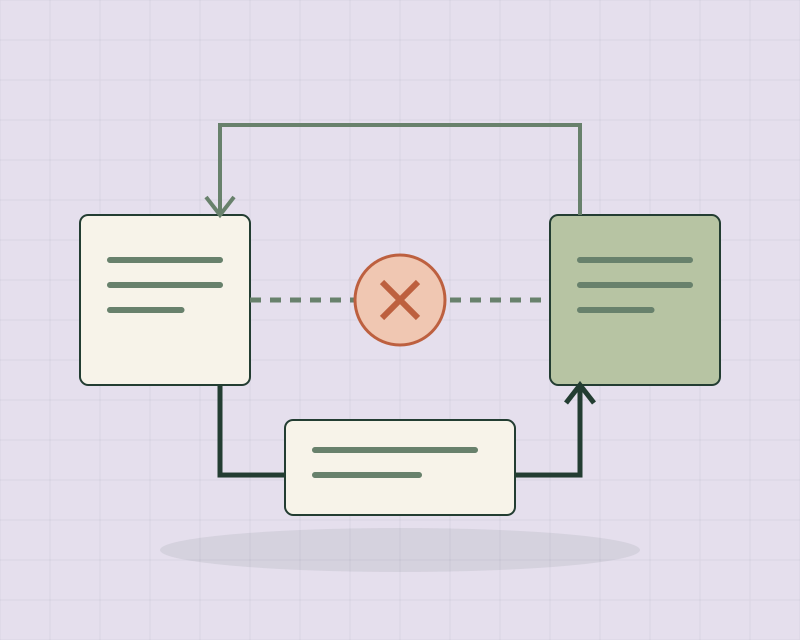
A fictional studio uses a service to deliver approved files. If it stops responding, document preparation can continue, but the studio cannot confirm customer receipt. Separating functions avoids declaring the entire business stopped or treating delivery as complete.
NIST SP 800-34 organizes contingency planning around processes, resources, priorities and testing. Its context is federal information systems; we use those ideas as a reference, without presenting this shortened record as compliance with that framework.
Map the minimum needed to continue
For each essential task, record required files, permission, person and channel. Ask what would fail if the alternative relies on the same unavailable access. A copy that cannot be opened, or lacks an authorized operator, does not solve delivery.
The studio’s proposed alternative is a previously agreed delivery channel with authorized access to the approved version. If that agreement is absent or the file cannot be checked, the task stays pending. Do not improvise a shared account or send material through any available route.
Define the switch before it is needed
| Field | Fictional example |
|---|---|
| Priority function | Deliver the approved document version |
| Activation condition | Responsible person checks that the usual channel cannot complete delivery |
| Alternative | Previously agreed channel and accessible approved file |
| Owner | Designated person confirms the switch and records the action |
| Return | Reconcile deliveries and pending work before resuming sends |
Add a contact, location of the current reference and a condition requiring a stop. Do not copy another business’s recovery time: establish which delay your task can tolerate and which evidence would support that time.
Exercise with a document containing no real data
Prepare a fictional file, assume the usual channel is unavailable and ask the owner to follow the record. Check whether they find the version, recognize their authority and can complete steps in the authorized test environment.
Record unsuccessful steps. A tabletop exercise reveals questions; a trial transfer checks that particular route. Neither guarantees recovery from every interruption. Here we propose the exercise, without claiming to have performed it for the studio.
Communicate a checked status
An original message for this case might say: “The usual delivery channel is unavailable. The document remains prepared; we are checking the agreed alternative. We will confirm the next status after that review.” Adapt it to what you can actually verify and commit to.
Our capacity guide organizes ordinary work and queue blocks. The first delegation guide defines a handoff between people. This record coordinates continuation when a common dependency fails.
Review the return and retain lessons
- Actions taken through the alternative and their references.
- Remaining work and its owner.
- Deliveries requiring reconciliation before a repeat send.
- Checks needed to return to the usual channel.
- Record changes following the exercise or interruption.
Portable business data prepares another decision: retrieving information when changing tools. A temporary interruption may end with the same provider; it still requires knowing what happened through the alternative and what remains unconfirmed.
Follow the evidence.
- NIST · SP 800-34 Rev. 1, Contingency Planning Guide for Federal Information Systems ↗
- NIST · SP 800-34 Rev. 1, sections 3.2 and 3.6 ↗
Sources checked October 24, 2026. Illustrative scenarios and numbers are fictional. The records and exercises are original editorial proposals, without attributed customer results or provider tests. Our editorial standards.