Classify each URL family by content and purpose; agree on the crawlable space before applying blanket rules to every parameter.
Distinguish filtering, sorting and pagination
A filter selects a subset; sorting changes its sequence; pagination divides the result into segments. They can coexist in a URL but represent different editorial decisions. Red-product and blue-product pages can contain different items.
Google describes how parameter-based facets multiply URL space. Its guidance distinguishes allowing potential indexing from preventing crawling when that presence is unnecessary. First decide which families serve a specific search purpose.
Count an example space
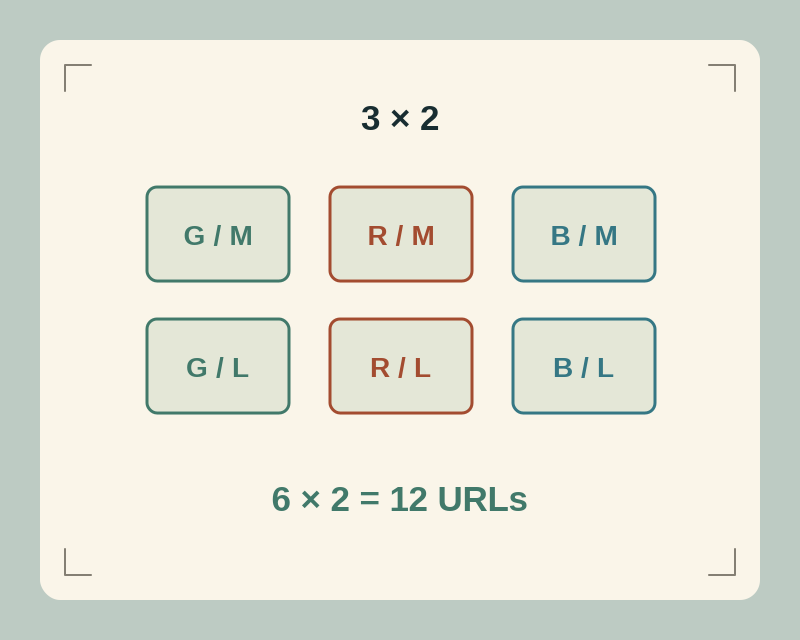
The fictional catalog allows exactly one of three colors and one of two sizes. There are 3 × 2 = 6 complete combinations. If each supports two orders, ascending and descending price, these rules produce 12 addresses.
They are not necessarily twelve distinct sets: each pair of sort orders retains the same products when inventory is fixed. The calculation excludes unselected filters, multiple selections and pagination; adding them expands the space. Record those limits rather than presenting twelve as a universal total.
Prepare a decision matrix
For red and size M, record URL, expected products, purpose and pending decision. Then add the reverse-order variant. If they show the same set, document that equivalence; do not infer it solely from the parameter’s name.
A combination with no results needs another row. Google’s guidance for crawlable facets recommends returning 404 at the URL itself for empty or nonsensical combinations. Distinguish that case from a useful page showing another subset.
Select controls after making the inventory
For families needing no search presence, examine how to prevent crawling while preserving access to product details and the main catalog. For families intended to be crawlable, review standard separators, consistent filter order and absence of duplicates.
Do not treat canonical as an immediate crawl switch. Nor should you block a URL assuming the crawler will subsequently read its noindex or canonical: it needs to retrieve those signals. The choice requires reviewing current URL state and purpose rather than copying a generic rule.
Test a reproducible sample
Check a useful combination, its alternative sort order, an impossible combination and a page beyond the first segment. Record HTTP response, products, links and observed canonical. Compare using the same inventory snapshot.
Keep the dated matrix and its owner. Adding a color or enabling multiple selections changes the space; repeat the count when the interface changes. The exercise organizes what to review without claiming indexing or traffic improvement from limiting URLs.
Follow the evidence.
Sources checked November 24, 2026. The exercise scenarios and figures are fictional. Our editorial standards.