Clasifica cada familia de URLs por contenido y utilidad; acuerda el espacio rastreable antes de aplicar reglas generales a todos los parámetros.
Distingue filtro, orden y paginación
Un filtro selecciona un subconjunto; ordenar cambia la secuencia; paginar divide el resultado en tramos. Pueden convivir en una URL, pero no representan la misma decisión editorial. Una página de productos rojos y otra de productos azules pueden contener artículos diferentes.
Google describe cómo las facetas basadas en parámetros multiplican el espacio de URLs. Su guía distingue entre permitir su posible indexación y evitar el rastreo cuando no se necesita esa presencia. Primero necesitas decidir qué familias tienen una función de búsqueda concreta.
Cuenta un espacio de ejemplo
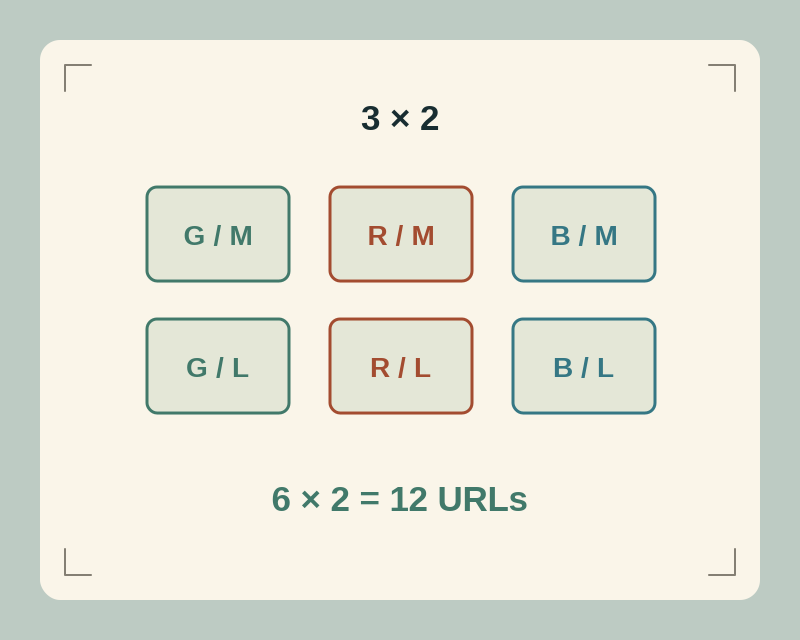
El catálogo ficticio permite elegir exactamente uno de tres colores y una de dos tallas. Hay 3 × 2 = 6 combinaciones completas. Si cada una admite dos órdenes, precio ascendente y descendente, aparecen 12 direcciones bajo estas reglas.
No son necesariamente doce conjuntos distintos: cada pareja de órdenes conserva los mismos productos si el inventario es fijo. El cálculo excluye filtros sin seleccionar, selecciones múltiples y paginación; añadirlos amplía el espacio. Anota esos límites en vez de presentar doce como un total universal.
Prepara una matriz de decisiones
Para color rojo y talla M, registra URL, productos esperados, propósito y decisión pendiente. Después añade su variante con el orden inverso. Si muestran el mismo conjunto, documenta esa equivalencia; no la deduzcas solo por el nombre del parámetro.
Una combinación sin resultados necesita otra fila. Google recomienda responder 404 en la propia URL para combinaciones vacías o incoherentes dentro de su guía de facetas rastreables. La revisión debe distinguir ese caso de una página útil que simplemente muestra otro subconjunto.
Elige controles después del inventario
Para familias que no necesitan presencia en búsquedas, estudia cómo impedir su rastreo conservando acceso a las fichas y al catálogo principal. Para las que sí se desean rastreables, revisa separadores estándar, orden lógico de filtros y ausencia de duplicados.
No confundas canonical con un interruptor inmediato de rastreo. Tampoco bloquees una URL suponiendo que el buscador leerá después su noindex o canonical: necesita poder recuperar esas señales. La elección exige revisar el estado actual de las URLs y el objetivo, no copiar una regla genérica.
Prueba una muestra reproducible
Comprueba una combinación útil, su orden alternativo, una combinación imposible y una página fuera del primer tramo. Registra respuesta HTTP, productos, enlaces y canonical observado. Usa la misma instantánea del inventario para comparar resultados.
Guarda la matriz con fecha y responsable. Añadir un color o permitir selecciones múltiples cambia el espacio; repite el conteo cuando cambie la interfaz. Este ejercicio organiza qué revisar, sin afirmar indexación ni atribuir una mejora de tráfico a limitar URLs.
Catalog filters: map combinations before opening them to crawling
A small catalog can generate many addresses by combining color, size and sorting. Before deciding what a search engine should find, count what actually changes at each address and which combinations the interface can produce.
Classify each URL family by content and purpose; agree on the crawlable space before applying blanket rules to every parameter.
Distinguish filtering, sorting and pagination
A filter selects a subset; sorting changes its sequence; pagination divides the result into segments. They can coexist in a URL but represent different editorial decisions. Red-product and blue-product pages can contain different items.
Google describes how parameter-based facets multiply URL space. Its guidance distinguishes allowing potential indexing from preventing crawling when that presence is unnecessary. First decide which families serve a specific search purpose.
Count an example space
The fictional catalog allows exactly one of three colors and one of two sizes. There are 3 × 2 = 6 complete combinations. If each supports two orders, ascending and descending price, these rules produce 12 addresses.
They are not necessarily twelve distinct sets: each pair of sort orders retains the same products when inventory is fixed. The calculation excludes unselected filters, multiple selections and pagination; adding them expands the space. Record those limits rather than presenting twelve as a universal total.
Prepare a decision matrix
For red and size M, record URL, expected products, purpose and pending decision. Then add the reverse-order variant. If they show the same set, document that equivalence; do not infer it solely from the parameter’s name.
A combination with no results needs another row. Google’s guidance for crawlable facets recommends returning 404 at the URL itself for empty or nonsensical combinations. Distinguish that case from a useful page showing another subset.
Select controls after making the inventory
For families needing no search presence, examine how to prevent crawling while preserving access to product details and the main catalog. For families intended to be crawlable, review standard separators, consistent filter order and absence of duplicates.
Do not treat canonical as an immediate crawl switch. Nor should you block a URL assuming the crawler will subsequently read its noindex or canonical: it needs to retrieve those signals. The choice requires reviewing current URL state and purpose rather than copying a generic rule.
Test a reproducible sample
Check a useful combination, its alternative sort order, an impossible combination and a page beyond the first segment. Record HTTP response, products, links and observed canonical. Compare using the same inventory snapshot.
Keep the dated matrix and its owner. Adding a color or enabling multiple selections changes the space; repeat the count when the interface changes. The exercise organizes what to review without claiming indexing or traffic improvement from limiting URLs.
目录筛选:开放抓取之前,先画出组合空间
小目录也会因颜色、尺码和排序组合而生成大量地址。决定搜索引擎应找到什么之前,先检查各地址实际改变什么,以及界面能够产生哪些组合。
按内容与用途给 URL 家族分类,约定可抓取范围后,再决定参数规则。
区分筛选、排序与分页
筛选选择子集,排序改变顺序,分页将结果分段。三者可以出现在同一地址中,但代表不同编辑决定。红色产品页与蓝色产品页可能包含不同商品。
Google 说明,基于参数的分面会扩大 URL 空间。其指南区分允许潜在索引与在无需搜索展示时阻止抓取。首先应判断哪些家族具有明确的搜索用途。
计算一个示例空间
虚构目录要求从三种颜色中选一种、两种尺码中选一种,共有 3 × 2 = 6 个完整组合。每个组合又能按价格升序或降序排列,因此在这些规则下产生 12 个地址。
它们未必对应十二种不同集合:库存固定时,每对排序仍包含相同产品。计算没有包括未选择筛选、多选或分页,加入这些条件会扩大空间。应写明边界,不要把十二当作通用总数。
建立决策矩阵
针对红色、M 码,记录 URL、预期产品、用途与待定决定,再增加反向排序版本。如果两者集合相同,应记录等价关系,不能只凭参数名称推断。
没有结果的组合另列一行。在可抓取分面指南中,Google 建议空结果或不合理组合在原地址返回 404。应把这种情况与展示另一有用子集的页面区分开。
清点之后再选择控制方式
无需搜索展示的家族,可以研究如何阻止抓取,同时保留产品详情与主目录的访问路径。需要抓取的家族,则检查标准分隔符、固定筛选顺序及重复组合。
不要把 canonical 当作即时关闭抓取的开关。也不要先阻止 URL,再假定爬虫仍会读取其中的 noindex 或 canonical;这些信号需要能够被获取。应根据现有状态和目标选择,而不是照抄通用规则。
检查可重复的样本
检查有用组合、它的另一排序、一个不可能组合,以及第一页之后的页面。记录 HTTP 状态、产品、链接和实际 canonical,并使用同一库存快照比较。
保存带日期和负责人的矩阵。新增颜色或支持多选都会改变空间,界面变化后应重新计数。本练习用于组织检查,不证明索引状态,也不把限制地址直接归因为流量增长。
Fuentes y método
Fuentes consultadas el 24 de noviembre de 2026. Los casos y datos numéricos de los ejercicios son ficticios. Editorial standards · Disclosures.