Give each page a retrievable URL and check sequential links, content and canonical. Review visual loading and the crawlable route as parts of one catalog.
Map the collection before checking buttons
The fictional catalog has 29 products, up to 12 per page, in a fixed order for this exercise. Start by listing which products belong to each segment. A list that changes during testing needs a timed reference.
Record language, filters and selected order. Changing sorting while navigating can move products between pages and complicate comparison.
Keep an address for each segment
| Segment | Example URL | Expected content |
|---|---|---|
| 1 | /catalogo/ | Products 1–12 |
| 2 | /catalogo/?pagina=2 | Products 13–24 |
| 3 | /catalogo/?pagina=3 | Products 25–29 |
These illustrate addresses, not routes on this site. Google recommends distinct URLs and a self-canonical for pages in a sequence. A second page with other products needs review as that page, without automatically canonicalizing it to the first.
Fragments such as #pagina2 do not replace those URLs: Google does not use them to distinguish pages in a collection.
Follow links joining the sequence
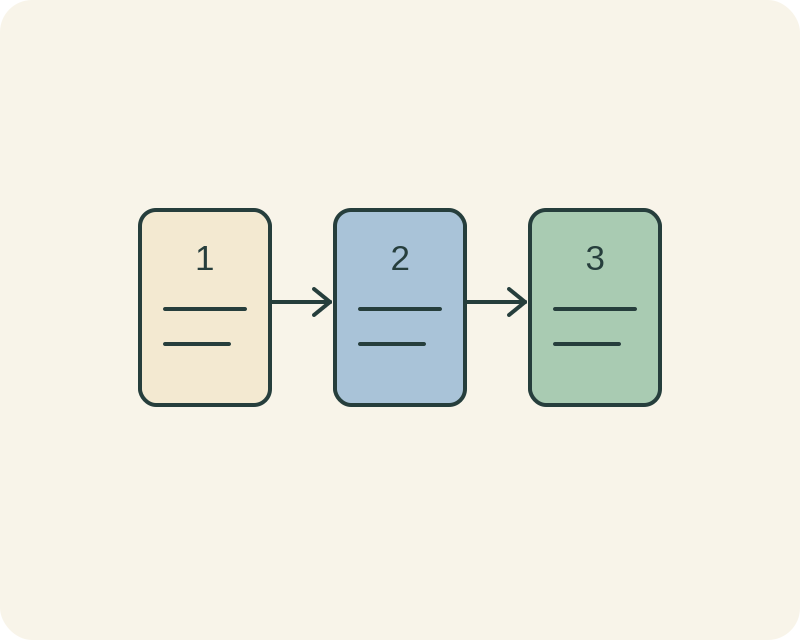
Check a Next link from the first segment to the second and from the second to the third. Keep a clear route back to earlier segments. Link text should identify what opens.
An escaped sample is <a href="/catalogo/?pagina=2">Next</a>. Google recommends a elements with href. A button executing an action needs an additional review of the available route.
Test direct entry too
Open the second page’s address in a fresh window. Confirm it returns the expected segment without requiring the first twelve products to be traversed. Then test reload and return.
For load-more or infinite scrolling interfaces, find the URLs and links supporting each segment. Googlebot generally discovers links but does not click buttons or trigger actions like a person.
Check the beginning and end
The third page should show five products. Check that the end does not indefinitely repeat the last segment or advertise an empty next page as more content. Test an out-of-range address too.
Inspect crawl rules and other instructions if an expected page is unavailable. Links and sitemaps can support discovery; observe indexing separately.
Save a reproducible route
Record origin, link, final destination, HTTP status, expected and observed products, canonical and language. Repeat when page size, sorting or loading technology changes. This helps locate differences in the address, link or delivered content.
Follow the evidence.
- Google Search Central · Pagination and incremental page loading ↗
- Google Search Central · Crawlable links ↗
Sources checked November 6, 2026. Illustrative scenarios and numbers are fictional. Original exercises and records, without attributed customer results or field observations. Our editorial standards.