FEFO prioritizes expiry dates among eligible lots; FIFO prioritizes arrivals. Neither rule replaces availability and order-requirement checks.
Define which date orders the pick
FEFO, first expired, first out, prioritizes the stock that expires sooner. FIFO, first in, first out, starts with stock received earlier. Microsoft documents FEFO picking in Business Central with configuration conditions specific to that product.
The conceptual distinction helps review a lot worksheet, but it does not establish that a system has a policy enabled. Before using an automatic suggestion, confirm which date it considers and which restrictions it applies.
Establish the eligible set
Use the same item, variant and unit. Separate physical, reserved, blocked and actually available quantities. A lot’s earlier position by date does not authorize its use for every order.
Add one row per lot with its identifier, arrival, expiry, location and available quantity. If a required date is missing, record “pending verification” and resolve it; do not invent a distant date to place the lot last. Check order acceptance conditions before sorting.
Compare lots whose dates cross
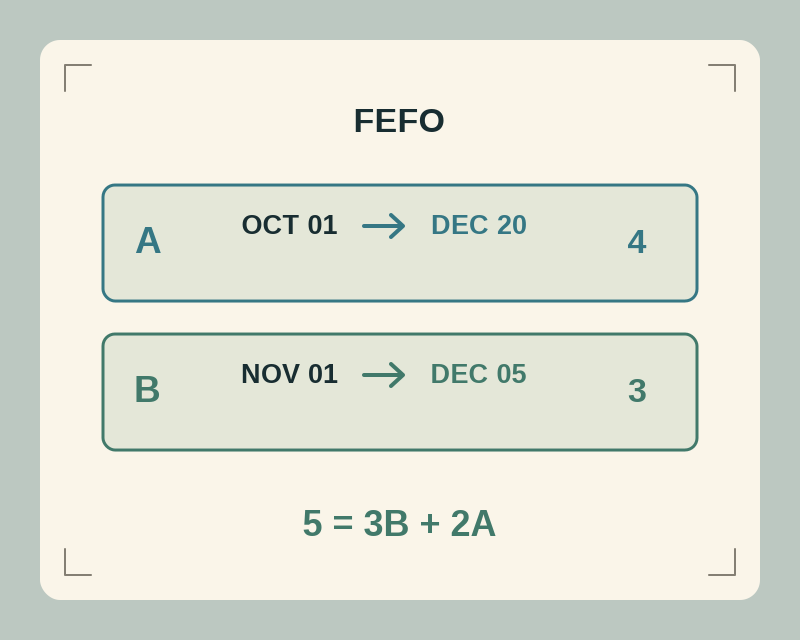
In this generic exercise, both M2 lots satisfy the order requirements as of November 22, 2026. A arrived October 1, expires December 20 and has four available units. B arrived November 1, expires December 5 and has three.
FIFO would start with A because it arrived earlier. FEFO would start with B because it expires sooner. To pick five units under FEFO, the proposal is three from B and two from A. Two remain in A and none in B. The example assumes no storage conditions or industry rules for a real product.
Review exceptions before confirming
An order may require a specific lot or a minimum acceptable expiry date. A reservation or block may change the usable quantity. Do not alter those requirements to match the suggested order.
If two lots share an expiry date, document a tie-break rule consistent with the operation. Do not attribute a universal policy for ties, expired lots or missing data to FEFO: software behavior depends on configuration and the authorized process.
Preserve evidence of the selection
Keep the cutoff date, requirement, eligible lots, proposed quantities and reason for any exception. After picking, compare actual withdrawals with the proposal and record the issue by lot.
Expiry rotation answers which lot to consider first. A reorder point answers when to replenish, while traceability reconstructs movements. Keeping those decisions identifiable prevents justifying a purchase or correcting stock merely because the picking sequence changed.
Follow the evidence.
Sources checked November 22, 2026. The exercise scenarios and figures are fictional. Our editorial standards.