FEFO prioriza la fecha de vencimiento entre lotes elegibles; FIFO prioriza su llegada. Ninguna regla reemplaza la comprobación de disponibilidad y requisitos del pedido.
Define qué fecha ordena la salida
FEFO, first expired, first out, da prioridad a lo que caduca antes. FIFO, first in, first out, comienza por lo recibido antes. Microsoft documenta FEFO en la preparación de inventario de Business Central, con condiciones de configuración propias de ese producto.
La distinción conceptual sirve para revisar una hoja de lotes, pero no demuestra que un sistema tenga activada una política. Antes de usar una propuesta automática, confirma qué fecha considera y qué restricciones está aplicando.
Forma el conjunto elegible
Trabaja con el mismo artículo, variante y unidad. Separa cantidad física, reservada, bloqueada y realmente disponible. Un lote que está antes en la lista por fecha no queda autorizado para cualquier pedido por esa sola razón.
Añade una fila por lote con identificador, llegada, caducidad, ubicación y cantidad disponible. Si falta una fecha obligatoria, registra «pendiente de comprobar» y resuelve el dato; no inventes una fecha lejana para mandarlo al final. Las condiciones de aceptación del pedido se revisan antes de ordenar.
Compara dos lotes con fechas cruzadas
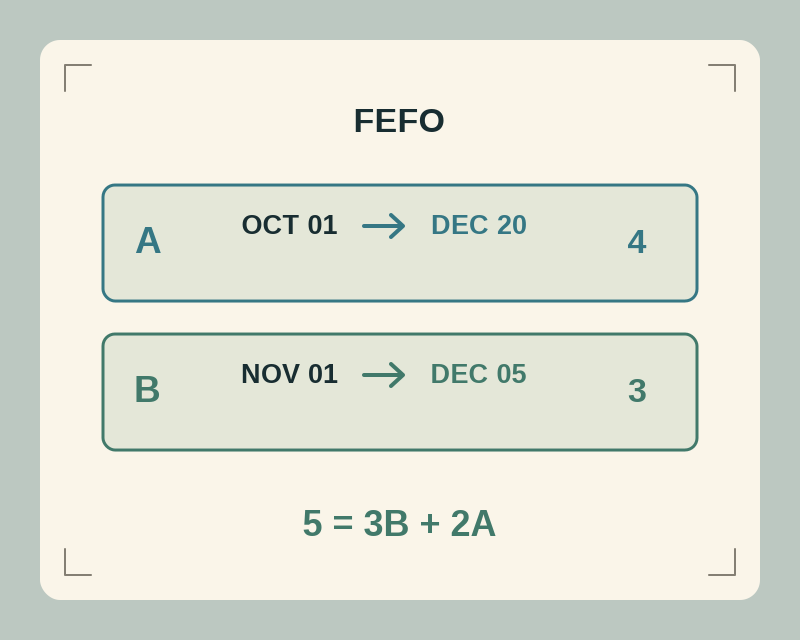
En este ejercicio genérico, al 22 de noviembre de 2026 ambos lotes de M2 cumplen los requisitos del pedido. A llegó el 1 de octubre, vence el 20 de diciembre y tiene cuatro unidades disponibles. B llegó el 1 de noviembre, vence el 5 de diciembre y tiene tres.
FIFO empezaría por A, porque llegó antes. FEFO empezaría por B, porque vence antes. Para preparar cinco unidades mediante FEFO, la propuesta es tres de B y dos de A. Quedan dos de A y ninguna de B. El ejemplo no presupone condiciones de conservación ni reglas sectoriales de un producto real.
Revisa excepciones antes de confirmar
Un pedido puede exigir un lote concreto o una fecha mínima aceptable. Una reserva o un bloqueo puede cambiar la cantidad utilizable. No alteres esos requisitos para que coincidan con el orden sugerido.
Si dos lotes comparten vencimiento, documenta una regla de desempate coherente con la operación. No atribuyas a FEFO una política universal sobre empates, lotes vencidos o datos faltantes: el comportamiento de un software depende de su configuración y del proceso autorizado.
Deja evidencia de la selección
Conserva fecha de corte, requerimiento, lotes elegibles, cantidades propuestas y motivo de cualquier excepción. Después de preparar, contrasta lo realmente retirado con esa propuesta y registra la salida por lote.
La rotación por caducidad responde cuál lote considerar primero. El punto de pedido responde cuándo reponer y la trazabilidad permite reconstruir movimientos. Mantener esas decisiones identificables evita justificar una compra o corregir existencias solo porque cambió la secuencia de preparación.
FEFO: the earliest expiry may belong to a later arrival
Arrival order and expiry order can tell different stories. To decide which lot to pick, first identify which lots can satisfy the order, then apply the chosen issue rule.
FEFO prioritizes expiry dates among eligible lots; FIFO prioritizes arrivals. Neither rule replaces availability and order-requirement checks.
Define which date orders the pick
FEFO, first expired, first out, prioritizes the stock that expires sooner. FIFO, first in, first out, starts with stock received earlier. Microsoft documents FEFO picking in Business Central with configuration conditions specific to that product.
The conceptual distinction helps review a lot worksheet, but it does not establish that a system has a policy enabled. Before using an automatic suggestion, confirm which date it considers and which restrictions it applies.
Establish the eligible set
Use the same item, variant and unit. Separate physical, reserved, blocked and actually available quantities. A lot’s earlier position by date does not authorize its use for every order.
Add one row per lot with its identifier, arrival, expiry, location and available quantity. If a required date is missing, record “pending verification” and resolve it; do not invent a distant date to place the lot last. Check order acceptance conditions before sorting.
Compare lots whose dates cross
In this generic exercise, both M2 lots satisfy the order requirements as of November 22, 2026. A arrived October 1, expires December 20 and has four available units. B arrived November 1, expires December 5 and has three.
FIFO would start with A because it arrived earlier. FEFO would start with B because it expires sooner. To pick five units under FEFO, the proposal is three from B and two from A. Two remain in A and none in B. The example assumes no storage conditions or industry rules for a real product.
Review exceptions before confirming
An order may require a specific lot or a minimum acceptable expiry date. A reservation or block may change the usable quantity. Do not alter those requirements to match the suggested order.
If two lots share an expiry date, document a tie-break rule consistent with the operation. Do not attribute a universal policy for ties, expired lots or missing data to FEFO: software behavior depends on configuration and the authorized process.
Preserve evidence of the selection
Keep the cutoff date, requirement, eligible lots, proposed quantities and reason for any exception. After picking, compare actual withdrawals with the proposal and record the issue by lot.
Expiry rotation answers which lot to consider first. A reorder point answers when to replenish, while traceability reconstructs movements. Keeping those decisions identifiable prevents justifying a purchase or correcting stock merely because the picking sequence changed.
FEFO:先到期的批次可能更晚入库
入库顺序与到期顺序可能不同。决定拣选哪个批次之前,先确定哪些批次符合订单要求,再应用选定的出库规则。
FEFO 在合格批次中优先考虑到期日,FIFO 优先考虑入库时间;两者都不能代替可用数量与订单要求的检查。
明确按哪一个日期排序
FEFO,即 first expired, first out,优先处理较早到期的库存。FIFO,即 first in, first out,从较早收到的库存开始。微软在 Business Central 的拣货文档中介绍 FEFO,并说明该产品特有的配置条件。
这个概念区别可以用于检查批次表,却不能证明某个系统已经启用相关策略。采用自动建议之前,应确认它使用哪个日期,以及应用了哪些限制。
先确定合格集合
比较同一物品、款式和计量单位。分别记录实物数量、预留数量、冻结数量和实际可用数量。按日期排在前面,并不代表该批次适用于所有订单。
每个批次一行,记录编号、到货日期、到期日、库位和可用数量。如果必需的日期缺失,应标为“待核实”并补查,不能编造遥远日期把它放到最后。排序之前先检查订单接受条件。
比较日期顺序相反的两个批次
在这项通用练习中,截至 2026 年 11 月 22 日,M2 的两个批次都符合订单要求。A 于 10 月 1 日入库,12 月 20 日到期,可用四件。B 于 11 月 1 日入库,12 月 5 日到期,可用三件。
FIFO 会先选 A,因为它更早入库。FEFO 会先选 B,因为它更早到期。需要拣选五件时,FEFO 建议从 B 取三件,再从 A 取两件。A 剩两件,B 剩零件。本例不预设真实产品的储存条件或行业规则。
确认之前处理例外
订单可能指定批次,或要求最低可接受的到期日期。预留或冻结也可能改变可用数量。不能为了符合建议顺序而修改这些要求。
两个批次到期日相同时,应记录符合实际操作的并列处理规则。不要把某一种并列、过期批次或缺失数据政策视为 FEFO 的普遍规定;软件行为取决于配置和获授权的流程。
保存选择依据
保留截止时间、需求、合格批次、建议数量和例外原因。拣选之后,把实际取出的数量与建议对照,并按批次记录出库。
按到期日轮转回答先考虑哪个批次;再订货点回答何时补货,追溯记录用于还原流转。保持这些决策清楚可辨,避免仅因拣选顺序改变,就用它解释采购或调整库存数量。
Fuentes y método
Fuentes consultadas el 22 de noviembre de 2026. Los casos y datos numéricos de los ejercicios son ficticios. Editorial standards · Disclosures.