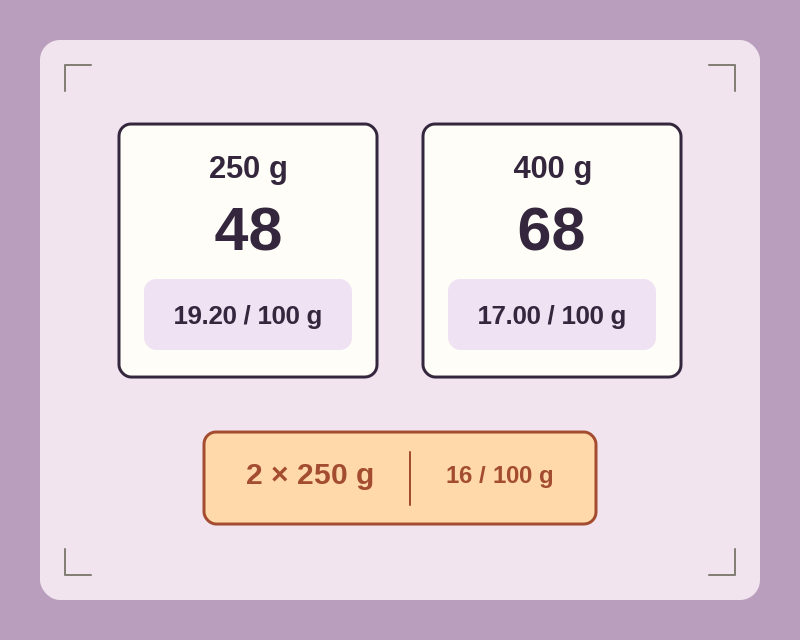
Show the selling price and net contents of each pack. Calculate the price for the same unit and keep any offer condition beside it.
Define which products you will compare
Use packs you can measure in the same unit. The example bags contain the same product and declare net quantity in grams. Check the contents in the product record and keep the pack size associated with each price. Avoid calculating from the gross weight with packaging.
The NIST guide describes price per unit of measure and calls for consistency within a category. This exercise uses a 100-gram basis so both numbers answer the same question.
Calculate before laying out the label
Divide selling price by grams and multiply by one hundred. For the 250 g bag, 48 ÷ 250 × 100 gives 19.20 per 100 g. For the 400 g bag, 68 ÷ 400 × 100 gives 17.00 per 100 g. The monetary amounts are fictional.
Keep the calculation free of intermediate rounding. Display the results at the same precision. Put the unit next to the figure so that 17.00 does not look like the amount paid for the bag.
Keep each condition near its price
The shop tries an offer of two 250 g bags for 80. That is 500 g for 80, or 16.00 per 100 g. A shopper who buys only one still pays 48 and has a comparison price of 19.20. The offer label needs to say how many bags qualify for that calculation.
On a digital product page, recalculate when the size or applicable offer changes. The selected pack and the displayed price should belong to the same combination.
Test what someone else can answer
Show both labels without explaining the formula. Ask how much they would pay for one bag and which has the lower price per 100 g. Then show the offer and ask what they must buy to qualify. Notice whether they look outside the label for a condition.
Keep a publication record
Save the pack size, net contents, price, common unit, calculation and validity period. Check a physical label and a small screen if you use both. When the price changes, verify that the purchase total and its unit price update together.
Follow the evidence.
Sources checked November 10, 2026. The exercise scenarios and figures are fictional. Our editorial standards.