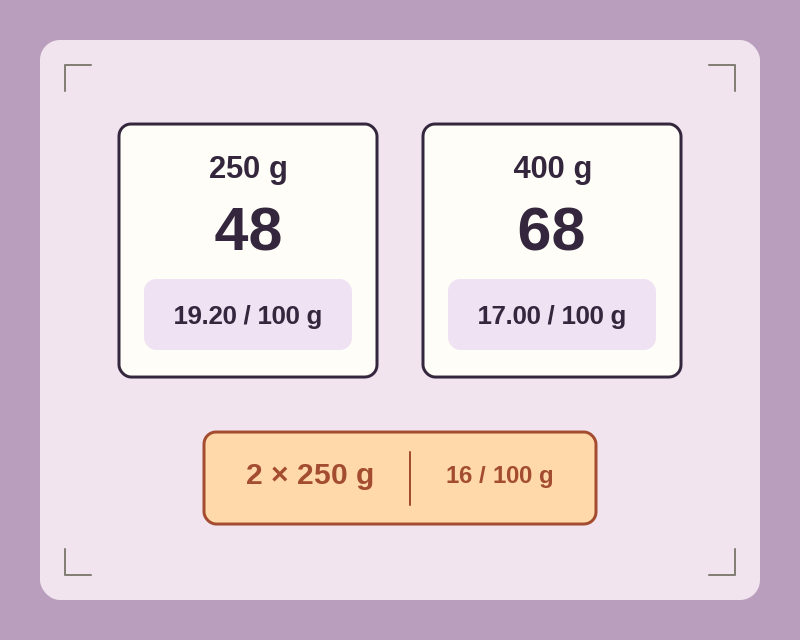
Presenta el precio de venta y el contenido neto de cada empaque. Calcula el precio por la misma unidad y conserva junto a él la condición de cualquier oferta.
Define qué productos vas a comparar
Usa presentaciones que puedas medir con la misma unidad. En el ejemplo las dos bolsas tienen el mismo producto y la cantidad neta se expresa en gramos. Comprueba el contenido en la ficha del producto y conserva la presentación asociada a cada precio. Evita calcular a partir del peso del paquete con su envoltura.
La guía de NIST describe el precio por unidad de medida y propone consistencia dentro de una categoría. Puedes usar una base de 100 gramos en este ejercicio para que ambas cifras respondan a la misma pregunta.
Haz la cuenta antes de componer
Divide el precio de venta entre los gramos y multiplica por cien. Para la bolsa de 250 g, 48 ÷ 250 × 100 da 19,20 por 100 g. Para la de 400 g, 68 ÷ 400 × 100 da 17,00 por 100 g. Las cantidades monetarias son ficticias.
Conserva el cálculo sin redondeos intermedios. Al mostrar el resultado usa la misma precisión para las dos etiquetas. Incluye la unidad al lado de la cifra para que 17,00 no parezca el precio que se paga por la bolsa.
Mantén cada condición cerca de su precio
La tienda ensaya una oferta de dos bolsas de 250 g por 80. Son 500 g por 80, equivalentes a 16,00 por 100 g. Si alguien compra solo una, conserva el precio normal de 48 y su comparación de 19,20. La etiqueta de oferta debe decir cuántas bolsas hacen falta para acceder a ese cálculo.
En una ficha digital, vuelve a calcular cuando cambian el tamaño o la oferta aplicable. La presentación seleccionada y el precio visible deben pertenecer a la misma combinación.
Prueba qué puede responder otra persona
Muestra las dos etiquetas sin explicar la fórmula. Pregunta cuánto pagaría por una bolsa y cuál tiene el menor precio por 100 g. Después presenta la oferta y pregunta qué tiene que comprar para obtenerla. Observa si la persona busca alguna condición fuera de la etiqueta.
Conserva una ficha de publicación
Guarda presentación, contenido neto, precio, unidad común, cálculo y periodo de vigencia. Revisa una etiqueta física y una pantalla pequeña cuando existan ambas. Al cambiar un precio comprueba que se actualicen el total de compra y su precio por unidad.
A price label that helps shoppers compare two pack sizes
In a fictional shop, a 250-gram bag costs 48 and a 400-gram bag costs 68. The first takes less money up front. The second costs less for the same quantity of product. A well-designed label lets a shopper read both answers.
Show the selling price and net contents of each pack. Calculate the price for the same unit and keep any offer condition beside it.
Define which products you will compare
Use packs you can measure in the same unit. The example bags contain the same product and declare net quantity in grams. Check the contents in the product record and keep the pack size associated with each price. Avoid calculating from the gross weight with packaging.
The NIST guide describes price per unit of measure and calls for consistency within a category. This exercise uses a 100-gram basis so both numbers answer the same question.
Calculate before laying out the label
Divide selling price by grams and multiply by one hundred. For the 250 g bag, 48 ÷ 250 × 100 gives 19.20 per 100 g. For the 400 g bag, 68 ÷ 400 × 100 gives 17.00 per 100 g. The monetary amounts are fictional.
Keep the calculation free of intermediate rounding. Display the results at the same precision. Put the unit next to the figure so that 17.00 does not look like the amount paid for the bag.
Keep each condition near its price
The shop tries an offer of two 250 g bags for 80. That is 500 g for 80, or 16.00 per 100 g. A shopper who buys only one still pays 48 and has a comparison price of 19.20. The offer label needs to say how many bags qualify for that calculation.
On a digital product page, recalculate when the size or applicable offer changes. The selected pack and the displayed price should belong to the same combination.
Test what someone else can answer
Show both labels without explaining the formula. Ask how much they would pay for one bag and which has the lower price per 100 g. Then show the offer and ask what they must buy to qualify. Notice whether they look outside the label for a condition.
Keep a publication record
Save the pack size, net contents, price, common unit, calculation and validity period. Check a physical label and a small screen if you use both. When the price changes, verify that the purchase total and its unit price update together.
一张能比较两种包装规格的价格标签
在一家虚构商店里,250 克装售价 48,400 克装售价 68。买前者当下付的钱较少,按同样的重量算,后者更便宜。一张好标签能让顾客同时看懂这两点。
标出每种包装的售价和净含量,用相同单位计算单价,并把优惠条件写在对应价格旁边。
确定要比较的商品
选择可以用同一单位衡量的包装。例子中两袋装的是同一种商品,净含量都以克计。查看商品资料里的净含量,把每个售价与相应规格对应起来。避免用包含包装的毛重计算。
NIST 指南说明了计量单位单价,并建议在同一商品类别内保持一致。这个练习可用每 100 克作基准,让两个数字回答同一个问题。
先计算,再排版
用售价除以克数,再乘 100。250 克装为 48 ÷ 250 × 100,即每 100 克 19.20。400 克装为 68 ÷ 400 × 100,即每 100 克 17.00。这里的金额均为虚构。
计算时避免中间取整,展示时让两张标签保留相同精度。把单位写在数字旁边,免得顾客把 17.00 看成买整袋要付的钱。
把条件放在对应价格旁
商店试行两袋 250 克装共售 80 的优惠。相当于 500 克售价 80,每 100 克 16.00。如果只买一袋,仍按正常售价 48 结算,对应每 100 克 19.20。优惠标签要写清楚买几袋才能按优惠计算。
在线商品页在规格或适用优惠变化后应重新计算。已选规格与展示价格要对应同一组合。
看其他人能回答什么
把两张标签拿给别人看,不解释公式。问买一袋要付多少,以及哪一袋每 100 克价格更低。再展示优惠,问要买什么才能享受。观察对方会不会在标签之外寻找条件。
保留一份发布记录
保存包装规格、净含量、售价、共用单位、计算方法和有效期。如果同时使用实体标签和线上页面,分别检查货架及小屏幕。价格改变后,确认购买总价和对应单价都已更新。
Fuentes y método
Fuentes consultadas el 10 de noviembre de 2026. Los casos y datos numéricos de los ejercicios son ficticios. Editorial standards · Disclosures.