Choose a card, find its navigation element and record its href alongside the resolved URL. Then check the published destination.
Find the address in the element
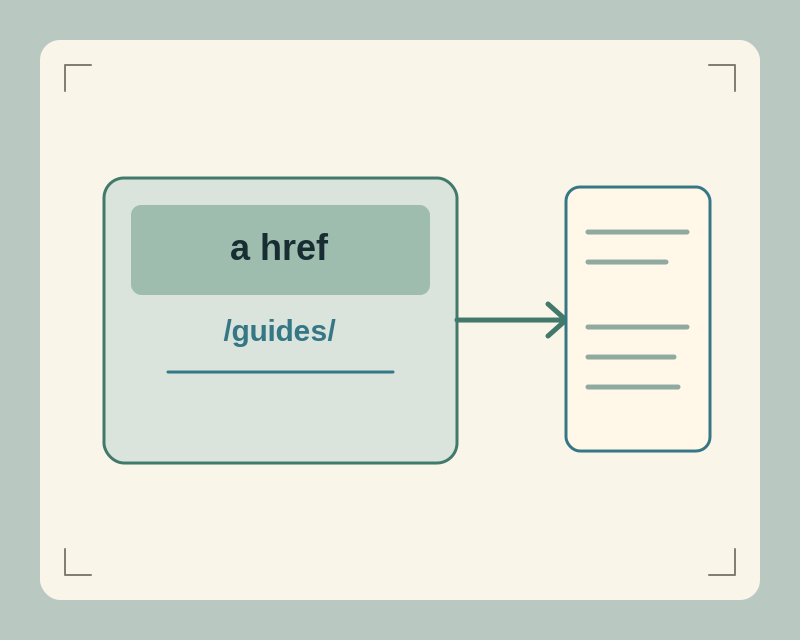
Google documents that it can generally crawl links written with an a element and an href attribute. A button with a JavaScript action or an a without href may let a person navigate, but does not offer that same structure for URL extraction. Inspect the specific link; its visual card styling does not determine the result.
Compare two versions of the example
Version A uses <button onclick="openGuide()"> and stores the address in a function. Version B uses <a href="https://example.org/guides/materials/">Materials to get started</a>. In B, the destination is in the link attribute. It can keep a JavaScript enhancement without removing that href. Choose a label describing the page that will open.
Inspect the JavaScript result too
An absent link in the received HTML does not rule out one inserted later: Google supports JavaScript-added links when they retain appropriate markup. Compare the received source and the DOM after loading. In browser tools, inspect the text and review its closest a element and href; note whether it appears only after an interaction.
Check the resolved address
A relative href such as /guides/materials/ needs a base to form the complete URL. Copy the link address, open it in another tab and confirm the host, path, redirects and final content. If the document contains a base element, check its effect too. A present href can still lead to the wrong or a missing page.
Keep a bounded check
Record the source, text, observed markup, href, resolved address and date. Also test keyboard navigation. This review checks how a destination is exposed and whether it opens the intended content; indexing requires other checks. If the card has only an event handler, the proposed correction is to preserve a real link for page navigation.
Follow the evidence.
Sources checked November 20, 2026. The exercise scenarios and figures are fictional. Our editorial standards.