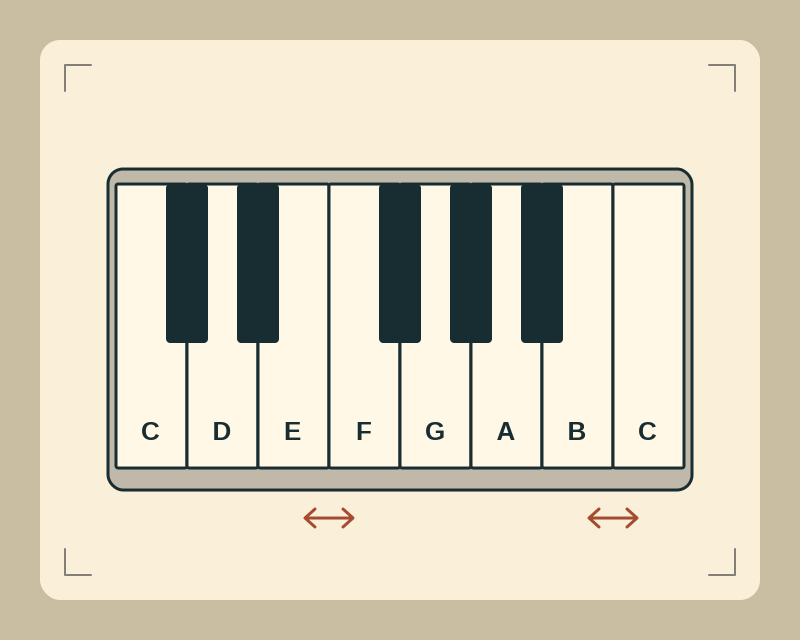
Find C next to a group of two black keys. Go up to the next C and mark E–F and B–C.
Draw a recognizable octave
On a keyboard or drawing, locate the group of two black keys. The white key immediately to its left is C. From there the white keys are C, D, E, F, G, A, B and C. In fixed-do naming they are do, re, mi, fa, sol, la, si and do.
Count the immediately neighboring key
On the usual equal-tempered keyboard, moving to the adjacent key, black or white, is a half step. Two half steps make a whole step. C to D has a black key between them, so it spans two half steps. E to F has no intervening black key and spans one half step.
Follow the scale's pattern
C major follows whole, whole, half, whole, whole, whole, half. Play or point to C–D–E–F–G–A–B–C slowly. Make a small mark between E and F and another between B and the next C. Keep the groups of two and three black keys on the drawing.
Try a five-note phrase
Use the original practice sequence D–E–F–E–D. Its steps are a whole step up, a half step up, a half step down and a whole step down. If you have a keyboard, use one finger and listen without rushing. You can sing the notes in a comfortable range.
Keep the map for another session
Go back from upper C to lower C and find the two short steps again. If you used only a drawing, note which positions you recognize and what you want to hear later. Finish when you can point out E–F and B–C in that octave.
Follow the evidence.
Sources checked November 19, 2026. The exercise scenarios and figures are fictional. Our editorial standards.