Busca un do junto a un grupo de dos teclas negras. Sube hasta el siguiente do y marca los pasos de mi a fa y de si a do.
Dibuja una octava reconocible
En un teclado o en un dibujo, localiza las dos teclas negras agrupadas. La blanca inmediatamente a su izquierda es do, que se escribe C en la notación con letras. Desde ahí las blancas son C, D, E, F, G, A, B y C. Los nombres en español son do, re, mi, fa, sol, la, si y do.
Cuenta la tecla inmediatamente siguiente
En el teclado de afinación temperada habitual, pasar a la tecla contigua, blanca o negra, es un semitono. Dos semitonos forman un tono. De do a re hay una negra entre ambas y el recorrido suma dos semitonos. De mi a fa no hay una negra intermedia y el paso es de un semitono.
Recorre la escala con su patrón
Do mayor sigue tono, tono, semitono, tono, tono, tono y semitono. Toca o señala C–D–E–F–G–A–B–C despacio. Haz una pequeña marca entre E y F y otra entre B y el C siguiente. En el dibujo, conserva también los grupos de dos y tres teclas negras.
Prueba una frase de cinco notas
Usa la secuencia original de práctica D–E–F–E–D. Sus pasos son un tono hacia arriba, un semitono hacia arriba, un semitono hacia abajo y un tono hacia abajo. Si tienes teclado, usa un dedo y escucha cada cambio sin apurarte. Puedes cantar las notas dentro de un registro cómodo.
Guarda el mapa para otra sesión
Vuelve desde el do superior hasta el inferior y localiza otra vez los dos pasos cortos. Si solo trabajaste con el dibujo, anota qué posición reconoces ya y qué quieres escuchar después. El ejercicio termina cuando puedes mostrar dónde están E–F y B–C en esa octava.
C major on the keyboard: find the two shorter steps
A piano's white keys look evenly spaced. Yet some pairs have a black key between them and others do not. Slowly tracing C major connects that layout with a sequence of musical distances.
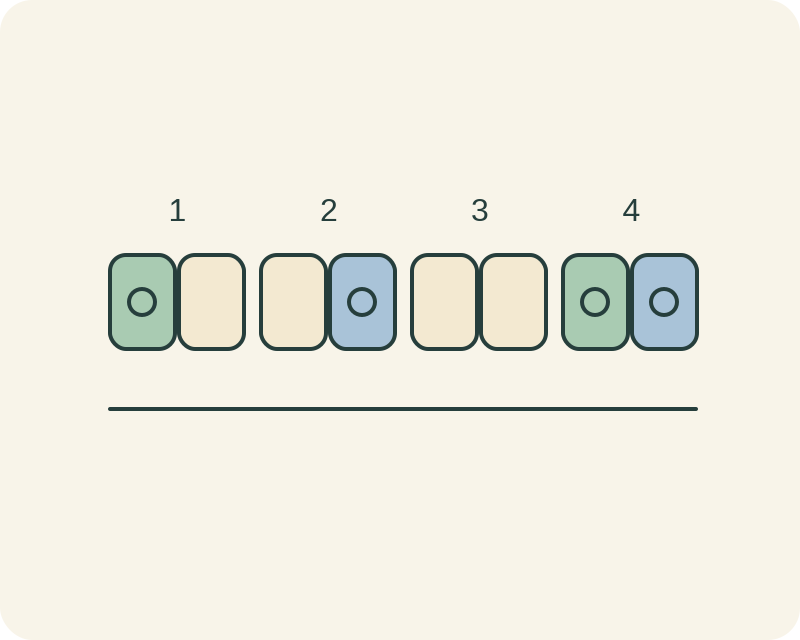
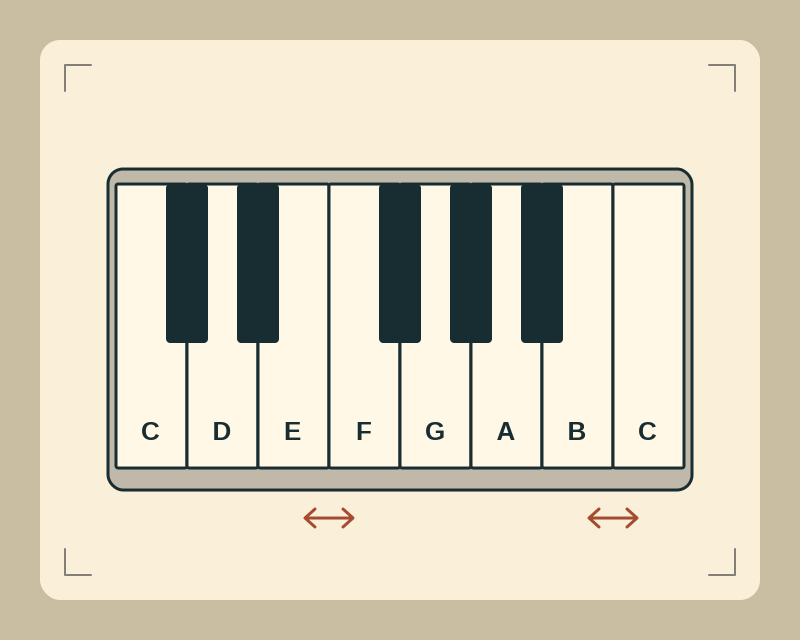
Find C next to a group of two black keys. Go up to the next C and mark E–F and B–C.
Draw a recognizable octave
On a keyboard or drawing, locate the group of two black keys. The white key immediately to its left is C. From there the white keys are C, D, E, F, G, A, B and C. In fixed-do naming they are do, re, mi, fa, sol, la, si and do.
Count the immediately neighboring key
On the usual equal-tempered keyboard, moving to the adjacent key, black or white, is a half step. Two half steps make a whole step. C to D has a black key between them, so it spans two half steps. E to F has no intervening black key and spans one half step.
Follow the scale's pattern
C major follows whole, whole, half, whole, whole, whole, half. Play or point to C–D–E–F–G–A–B–C slowly. Make a small mark between E and F and another between B and the next C. Keep the groups of two and three black keys on the drawing.
Try a five-note phrase
Use the original practice sequence D–E–F–E–D. Its steps are a whole step up, a half step up, a half step down and a whole step down. If you have a keyboard, use one finger and listen without rushing. You can sing the notes in a comfortable range.
Keep the map for another session
Go back from upper C to lower C and find the two short steps again. If you used only a drawing, note which positions you recognize and what you want to hear later. Finish when you can point out E–F and B–C in that octave.
在键盘上找 C 大调的两个短音程
钢琴白键看起来排列均匀,但有些白键之间有黑键,有些没有。慢慢走一遍 C 大调,就能把键盘布局与音程顺序联系起来。
在两个黑键一组的旁边找到 C,向上走到下一个 C,标出 E–F 和 B–C。
画一个能辨认的八度
在键盘或图上找到一组两个黑键,其左侧紧邻的白键是 C。向右的白键依次是 C、D、E、F、G、A、B、C。按固定唱名,对应 do、re、mi、fa、sol、la、si、do。
数紧邻的下一个琴键
在常见的十二平均律键盘上,走到紧邻琴键,无论黑白,都是半音。两个半音构成全音。C 到 D 中间隔着一个黑键,共两个半音;E 到 F 中间没有黑键,只有一个半音。
顺着音阶模式走
C 大调的顺序是全音、全音、半音、全音、全音、全音、半音。慢慢弹或指 C–D–E–F–G–A–B–C,在 E 与 F 之间、B 与上方 C 之间各做一个小标记。图上也保留两黑键和三黑键的分组。
试一个五音练习
使用本练习的原创顺序 D–E–F–E–D。音程依次为向上全音、向上半音、向下半音、向下全音。如果有键盘,用一根手指慢弹,听清每次变化,也可以在舒适的音域里唱出来。
留下地图供下次使用
从上方 C 返回下方 C,再次找到两个短音程。只用图练习时,记下已经认识哪些位置、以后还想听什么。能在这一个八度里指出 E–F 和 B–C,就完成了练习。
Fuentes y método
Fuentes consultadas el 19 de noviembre de 2026. Los casos y datos numéricos de los ejercicios son ficticios. Editorial standards · Disclosures.