Keep annual demand, cost per order and annual holding cost per unit. Then compare the result with quantities the supplier actually allows.
State the exercise assumptions
Demand is known and uniform, replenishment arrives in full, there are no shortages and unit price is constant. The exercise has no volume discounts. Assume 45 to process one order and 3 to hold one unit for a year, in the same currency.
Compare three order sizes
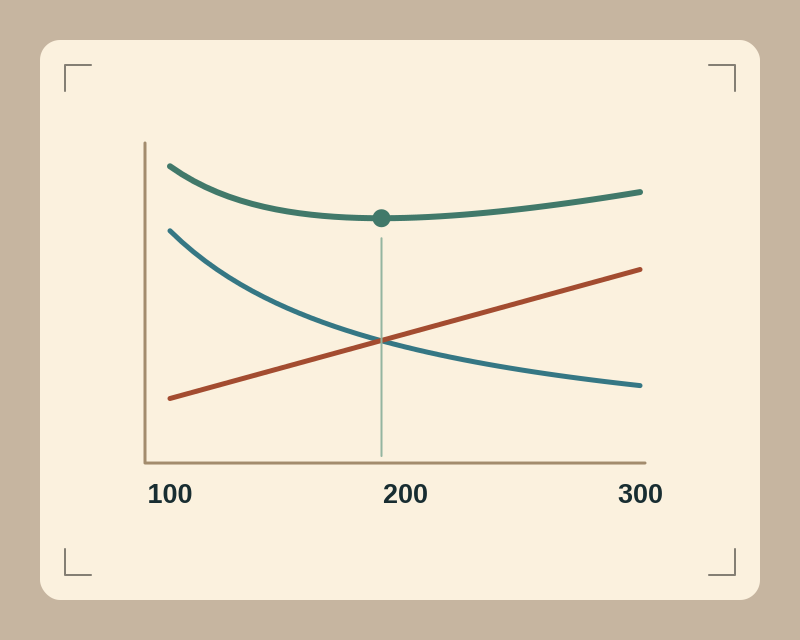
With 100 boxes per order, there are 12 equivalent annual orders. Ordering costs 540 and holding an average stock of 50 costs 150: total 690. With 200, those costs are 270 and 300: total 570. With 300, they are 180 and 450: total 630.
Calculate the model's order size
The formula is the square root of [2 × annual demand × order cost ÷ annual holding cost per unit]. Here the square root of [2 × 1,200 × 45 ÷ 3] gives about 190 boxes. The annual sum of those two cost components would be about 569.21.
Bring the result closer to an order you can place
If the supplier sells in packs of 50, compare nearby permitted quantities such as 150 and 200. Review space, available cash, shelf life and actual terms before choosing. Product purchase cost stayed outside the comparison because price and annual consumption are constant in this case.
Keep quantity and timing separate
Save the model inputs, units, period and calculation. To decide when to place the order, also review lead time, demand during that wait and open orders. If demand stops being uniform, reassess whether the model fits the situation.
Follow the evidence.
Sources checked November 19, 2026. The exercise scenarios and figures are fictional. Our editorial standards.