Elige un periodo común y calcula el valor del uso de cada referencia. Ordena los resultados y prueba frecuencias que tu equipo pueda cumplir.
Decide qué movimientos cuentan
Trabaja con un almacén y con doce meses completos. Define qué salidas corresponden al consumo de producción y cómo tratar devoluciones o traspasos. En este ejercicio se usa un costo constante por referencia. Si el costo cambió, puedes sumar las salidas valoradas a su costo registrado.
Calcula tres valores de uso
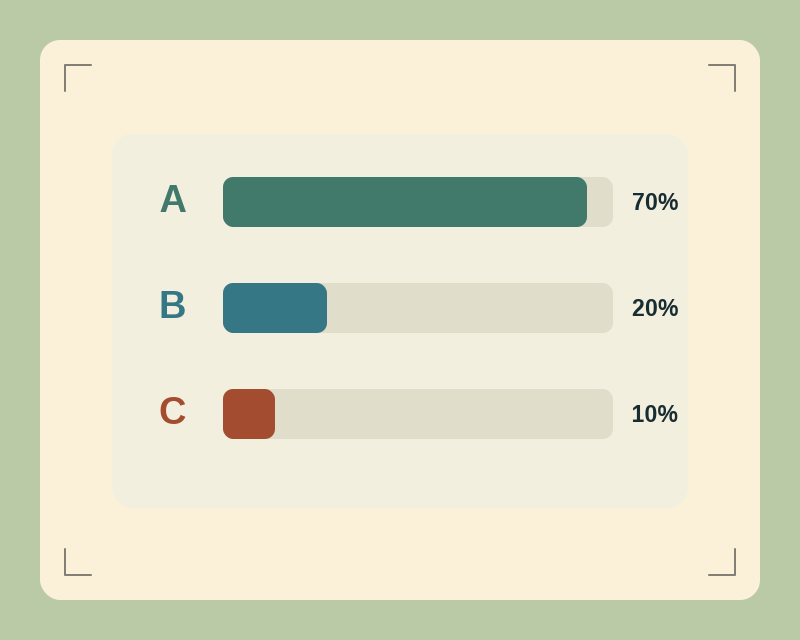
El taller ficticio usó 280 tapas a 25 pesos, 1 000 tornillos a 2 pesos y 500 separadores a 2 pesos. Los valores son 7 000, 2 000 y 1 000. El total es 10 000 y las participaciones son 70 %, 20 % y 10 %. El acumulado al añadir cada categoría es 70 %, 90 % y 100 %. Las tapas encabezan el orden aunque tienen la menor cantidad de unidades consumidas.
Pasa del orden al calendario
El taller asigna A a tapas, B a tornillos y C a separadores. Prueba un conteo semanal para A, mensual para B y trimestral para C. Los cortes son decisiones del ejemplo. Ajusta las frecuencias al tiempo disponible y revisa si los conteos encuentran diferencias que el equipo pueda investigar.
Conserva excepciones justificadas
Si un insumo barato detiene el taller cuando falta, dale una frecuencia mayor y anota el motivo. Una referencia nueva con pocas semanas de uso también necesita revisión antes de compararse con otras que tienen doce meses de historial.
Deja la regla lista para repetir
Guarda periodo, almacén, fórmula, participación acumulada y calendario aprobado. Recalcula al cerrar el siguiente periodo elegido. Para decidir cuándo reponer, consulta también demanda, plazo de entrega y pedidos pendientes.
ABC inventory analysis: what to count more often by usage value
A notebook workshop counts binding screws, covers and dividers at the same frequency. Covers account for much more money in annual usage, even though fewer units move than screws. ABC analysis offers a way to allocate review time.
Choose a common period and calculate the value of each item's usage. Rank the results and test frequencies your team can sustain.
Decide which movements count
Use one storeroom and twelve complete months. Define which issues are for production and how to handle returns or transfers. This exercise uses a constant unit cost per item. If that cost changed, you can add up the outgoing quantities valued at their recorded costs.
Calculate three usage values
The fictional workshop used 280 covers at 25 pesos, 1,000 screws at 2 pesos and 500 dividers at 2 pesos. Their values are 7,000, 2,000 and 1,000. The total is 10,000 and the shares are 70%, 20% and 10%. The cumulative shares are 70%, 90% and 100%. Covers rank first even though they had the fewest units consumed.
Turn the ranking into a schedule
The workshop assigns covers to A, screws to B and dividers to C. It tries weekly counts for A, monthly counts for B and quarterly counts for C. These categories and intervals are choices for the exercise. Adjust the frequency to fit the team's time and check whether counts uncover discrepancies it can investigate.
Keep justified exceptions
If a cheap item stops work when it runs out, count it more often and document why. A new item with just a few weeks of usage needs a review before you compare it with items that have twelve months of history.
Make the rule repeatable
Save the period, storeroom, formula, cumulative share and agreed schedule. Recalculate after the next chosen period closes. To decide when to reorder, also review demand, lead time and pending orders.
ABC 库存分类:按耗用价值决定哪些物料多盘点
一家笔记本工坊以相同频率盘点装订螺钉、封面和隔页。封面用掉的件数比螺钉少,但全年耗用金额高得多。ABC 分类能为分配盘点时间提供依据。
统一统计期间,计算每种物料的耗用金额,排出顺序,再试行团队能持续执行的频率。
决定哪些出库计入
选一个库房和完整的十二个月。定义哪些出库属于生产耗用,以及怎样处理退回或调拨。本练习假设每种物料的单位成本不变。如果成本有变化,可以按各次出库记录里的成本分别计算,再相加。
算三项耗用价值
虚构工坊用了 280 张单价 25 比索的封面、1,000 枚单价 2 比索的螺钉,以及 500 张单价 2 比索的隔页。耗用金额分别为 7,000、2,000 和 1,000 比索。合计 10,000,占比为 70%、20% 和 10%。累计占比依次为 70%、90% 和 100%。封面用量最少,却排在第一。
依据排序安排盘点频率
工坊把封面列为 A,螺钉列为 B,隔页列为 C。试行 A 类每周盘点、B 类每月盘点、C 类每季盘点。分类与频率都是本例的选择。按实际工作时间调整,并观察盘点能否发现团队有能力调查的差异。
保留有依据的例外
某种廉价物料缺货就会使生产停顿,可以提高它的盘点频率,并记下理由。刚开始使用几周的新物料,也应先复核,再与有十二个月历史的物料比较。
写下可重复使用的规则
保存统计期间、库房、计算公式、累计占比和批准的日程。下一个选定期间结束后重算。决定何时补货时,还要查需求量、交付周期和未结订单。
Fuentes y método
Fuentes consultadas el 16 de noviembre de 2026. Los casos y datos numéricos de los ejercicios son ficticios. Editorial standards · Disclosures.