Conserva demanda anual, costo por orden y costo anual de mantener una unidad. Después contrasta el resultado con las cantidades que el proveedor realmente permite pedir.
Escribe los supuestos del ejercicio
La demanda es conocida y uniforme, cada reposición llega completa, no hay faltantes y el precio unitario es constante. El ejercicio no usa descuentos por volumen. Se supone un costo de 45 por tramitar una orden y de 3 por mantener una unidad durante un año, en la misma moneda.
Compara tres tamaños
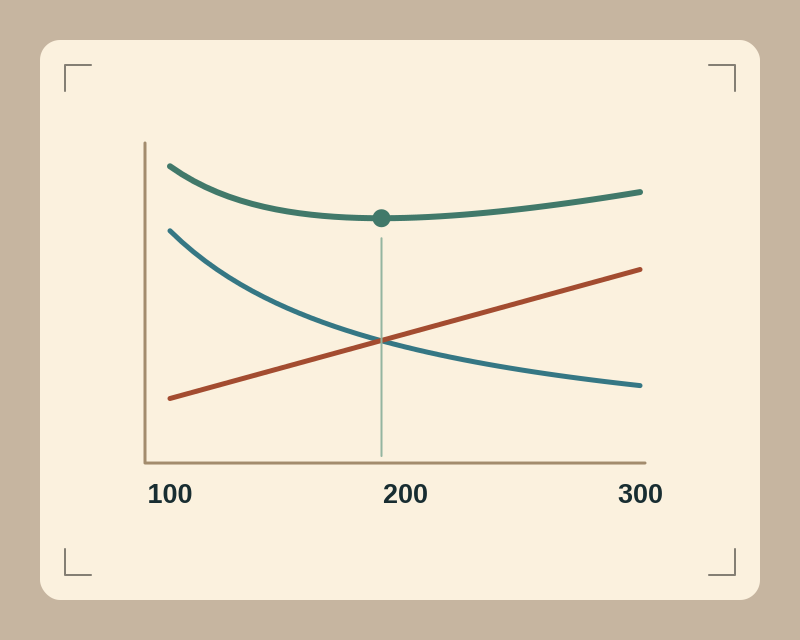
Con 100 cajas por pedido, hay 12 órdenes anuales equivalentes. Ordenar cuesta 540 y mantener el inventario medio de 50 cuesta 150: total 690. Con 200, los costos son 270 y 300: total 570. Con 300, son 180 y 450: total 630.
Calcula el tamaño del modelo
La fórmula es la raíz cuadrada de [2 × demanda anual × costo por orden ÷ costo anual de mantener una unidad]. Aquí, raíz de [2 × 1 200 × 45 ÷ 3] da aproximadamente 190 cajas. El costo anual de esos dos componentes sería aproximadamente 569,21.
Acerca el cálculo al pedido posible
Si el proveedor vende en paquetes de 50, compara las cantidades permitidas cercanas, como 150 y 200. Revisa espacio, caja disponible, caducidad y condiciones reales antes de elegir. El costo de compra del producto se mantuvo fuera de la comparación porque el precio y el consumo anual son constantes en este caso.
Guarda cantidad y momento por separado
Registra las entradas del modelo, unidades, periodo y cálculo. Para decidir cuándo emitir la orden, revisa también el plazo de entrega, la demanda durante la espera y los pedidos abiertos. Si la demanda deja de ser uniforme, vuelve a evaluar si este modelo representa la situación.
Economic order quantity: compare frequent small orders with larger lots
A fictional shop uses 1,200 identical boxes a year. Small purchases require more orders; large purchases raise the stock that must be held. The economic order quantity model puts those two costs into the same calculation.
Keep annual demand, cost per order and annual holding cost per unit. Then compare the result with quantities the supplier actually allows.
State the exercise assumptions
Demand is known and uniform, replenishment arrives in full, there are no shortages and unit price is constant. The exercise has no volume discounts. Assume 45 to process one order and 3 to hold one unit for a year, in the same currency.
Compare three order sizes
With 100 boxes per order, there are 12 equivalent annual orders. Ordering costs 540 and holding an average stock of 50 costs 150: total 690. With 200, those costs are 270 and 300: total 570. With 300, they are 180 and 450: total 630.
Calculate the model's order size
The formula is the square root of [2 × annual demand × order cost ÷ annual holding cost per unit]. Here the square root of [2 × 1,200 × 45 ÷ 3] gives about 190 boxes. The annual sum of those two cost components would be about 569.21.
Bring the result closer to an order you can place
If the supplier sells in packs of 50, compare nearby permitted quantities such as 150 and 200. Review space, available cash, shelf life and actual terms before choosing. Product purchase cost stayed outside the comparison because price and annual consumption are constant in this case.
Keep quantity and timing separate
Save the model inputs, units, period and calculation. To decide when to place the order, also review lead time, demand during that wait and open orders. If demand stops being uniform, reassess whether the model fits the situation.
经济订货量:比较小批勤购和大批订货
一家虚构商店一年耗用 1,200 只同款箱子。每次买得少,订单就多;每次买得多,库存就高。经济订货量模型把这两类成本放到同一次计算里。
保留年需求量、每单成本和每件每年的持有成本,再把结果与供应商实际接受的数量比较。
写清练习假设
需求已知且均匀,每次补货整批到达,不缺货,单价不变。本例没有数量折扣。假设办理一张订单成本为 45,每件存放一年的成本为 3,币种一致。
比较三种订货量
每单 100 只,相当于每年 12 单。订货成本 540,平均库存 50 只的持有成本 150,合计 690。每单 200 只,两项成本为 270 和 300,合计 570。每单 300 只,则为 180 和 450,合计 630。
计算模型的订货量
公式为 [2 × 年需求量 × 每单成本 ÷ 每件年度持有成本] 的平方根。本例 [2 × 1,200 × 45 ÷ 3] 开平方,约为 190 只。两项年度成本合计约为 569.21。
接近实际可下单的数量
如果供应商每包 50 只,比较附近可订的数量,例如 150 和 200。决定前检查空间、可用现金、保质期和实际条款。本例单价与全年耗用量不变,因此商品采购成本未列入这次比较。
分别记录数量与时点
保存模型输入、单位、期间和算式。决定何时下单,还要检查交货周期、等待期间需求和未结订单。如果需求不再均匀,重新判断模型是否适合实际情况。
Fuentes y método
Fuentes consultadas el 19 de noviembre de 2026. Los casos y datos numéricos de los ejercicios son ficticios. Editorial standards · Disclosures.