Divide el peso local del sector entre el peso del mismo sector en la referencia. Conserva los cuatro conteos, el periodo y el alcance al explicar el resultado.
Define sector, territorio y medida
El programa QCEW de la Oficina de Estadísticas Laborales de Estados Unidos publica cocientes de localización y explica cómo usa al país como referencia. En su ejemplo de empleo, calcula primero qué proporción del empleo total corresponde a un sector en cada territorio. Después divide ambas proporciones.
Antes de calcular, alinea periodo, clasificación sectorial y universo cubierto. Si el numerador solo incluye empleo privado y el denominador abarca todos los tipos de propiedad, conserva esa definición en las dos áreas.
Calcula el peso local y el de referencia
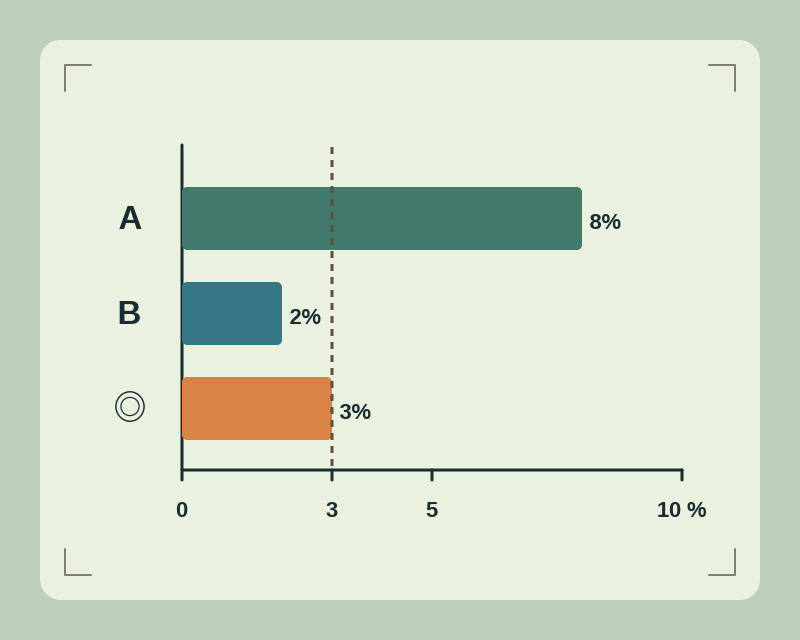
En el país ficticio hay 30 000 empleos en fabricación de muebles y un millón de empleos en total. El peso de referencia es 3 %. La ciudad A tiene 800 puestos del sector sobre 10 000 en total. Su peso es 8 %. El cociente de A es 8 ÷ 3, aproximadamente 2,67.
La ciudad B tiene 1 600 puestos del sector sobre 80 000. Su peso es 2 % y su cociente es 2 ÷ 3, aproximadamente 0,67. B cuenta con el doble de puestos del sector que A, con una base de empleo ocho veces mayor.
Lee el uno como punto de comparación
Un cociente de uno indica que ambas participaciones son iguales. Por encima de uno, el sector tiene más peso en el empleo local que en la referencia. Por debajo, tiene menos. En A, la participación del sector es unas 2,67 veces la nacional.
La cifra habla de la composición del empleo. Para conocer salarios, producción o crecimiento, recupera la medida y el periodo correspondientes. Para saber cuántas personas trabajan en el sector, conserva el conteo al lado del cociente.
Prueba qué cambia si se mueve el denominador
Supón que A conserva 800 puestos sectoriales y el empleo total sube a 12 500. Con una referencia aún en 3 %, el peso local pasa a 6,4 % y el cociente a aproximadamente 2,13. El cambio refleja una base local mayor en este escenario. En un informe real también puede variar la referencia.
Deja la cuenta a la vista
Presenta los cuatro conteos y el cociente sin redondear las proporciones antes de dividir. Si una cifra está suprimida o el peso de referencia es cero, identifica el cálculo como no disponible. En el ejemplo puedes escribir que A tiene 800 puestos del sector y un cociente de 2,67 frente al país ficticio. Cada dato contesta una parte distinta de la pregunta.
Using location quotients to compare an industry’s employment share
A local report says furniture manufacturing accounts for more of employment in a small city than in a larger one. The next two statements can both be true. The small city has fewer jobs in the industry. Those jobs make up a greater share of the city’s employment.
Divide the local industry share by the share of the same industry in the reference area. Keep the four counts, period and coverage when explaining the result.
Define the industry, geography and measure
The US Bureau of Labor Statistics QCEW program publishes location quotients and explains how it uses the country as the reference area. In its employment example, it first calculates the industry’s share of total employment in each geography. It then divides those shares.
Before calculating, align the period, industry classification and coverage. If the numerator includes private employment only and the denominator covers all ownership types, keep that definition in both areas.
Calculate the local and reference shares
The fictional country has 30,000 furniture manufacturing jobs and one million jobs in total. Its reference share is 3%. City A has 800 industry jobs out of 10,000. Its share is 8%. A’s quotient is 8 ÷ 3, or about 2.67.
City B has 1,600 industry jobs out of 80,000. Its share is 2% and its quotient is 2 ÷ 3, or about 0.67. B has twice as many industry jobs as A and an employment base eight times as large.
Read one as the point of comparison
A quotient of one means both shares are equal. Above one, the industry accounts for more of local employment than in the reference area. Below one, it accounts for less. In A the industry share is about 2.67 times the national share.
The figure describes the composition of employment. To understand wages, output or growth, retrieve the corresponding measure and period. To know how many people work in the industry, keep the count beside the quotient.
Test what happens when the denominator moves
Suppose A keeps 800 industry jobs and total employment rises to 12,500. With the reference share still at 3%, the local share falls to 6.4% and the quotient to about 2.13. A larger local base explains the change in this scenario. In a real report the reference share may move too.
Keep the calculation visible
Show the four counts and the quotient without rounding the shares before division. If a count is suppressed or the reference share is zero, mark the calculation unavailable. In the example you can say that A has 800 industry jobs and a quotient of 2.67 against the fictional country. Each figure answers a different part of the question.
用区位商比较某个行业在就业中的比重
一份地方报告说,家具制造在小城市就业中的比重比在大城市更高。以下两句话可以同时成立。小城市的行业岗位较少,这些岗位却占了当地就业更大的一部分。
用本地行业占比除以参照地区同一行业的占比。解释结果时保留四个计数、时期及统计范围。
确定行业、地区和衡量口径
美国劳工统计局的 QCEW 项目发布区位商,并说明它如何以全国为参照。在就业例子中,先计算每个地区该行业占全部就业的比例,再将两项比例相除。
计算前对齐时期、行业分类及覆盖范围。如果分子只含私营部门就业,分母覆盖所有所有制类型,就在两个地区保持相同定义。
计算本地和参照占比
这个虚构国家有 30,000 个家具制造岗位,总岗位为 100 万。参照占比为 3%。A 市的行业岗位有 800 个,总岗位有 10,000 个,占比 8%。A 市区位商是 8 ÷ 3,约为 2.67。
B 市在 80,000 个岗位中有 1,600 个行业岗位,占比 2%,区位商是 2 ÷ 3,约为 0.67。B 市的行业岗位是 A 市的两倍,总就业却是 A 市的八倍。
把一作为比较点
区位商为一表示两边占比相等。大于一表示行业在本地就业中的比重高于参照地区。小于一则表示比重更低。A 市的行业占比约是全国的 2.67 倍。
这个数描述就业构成。要了解工资、产出或增长,需要找到相应的指标和时期。想知道行业里有多少人工作,就在区位商旁保留岗位数。
试试分母变化会发生什么
假设 A 市仍有 800 个行业岗位,总就业增至 12,500 个。参照占比仍为 3% 时,本地占比降到 6.4%,区位商约为 2.13。本例的变化来自本地总量扩大。实际报告中的参照占比也可能变化。
让人看得见计算过程
同时给出四个计数和区位商,除法之前别把占比四舍五入。如果某个计数未披露,或参照占比为零,就将结果标为无法计算。在例子里,可以写 A 市有 800 个行业岗位,以虚构国家为参照的区位商为 2.67。两个数字分别回答问题的不同部分。
Fuentes y método
- US Bureau of Labor Statistics · QCEW Location Quotient Details ↗
- US Bureau of Labor Statistics · QCEW Overview ↗
Fuentes consultadas el 9 de noviembre de 2026. Los casos y datos numéricos de los ejercicios son ficticios. Editorial standards · Disclosures.