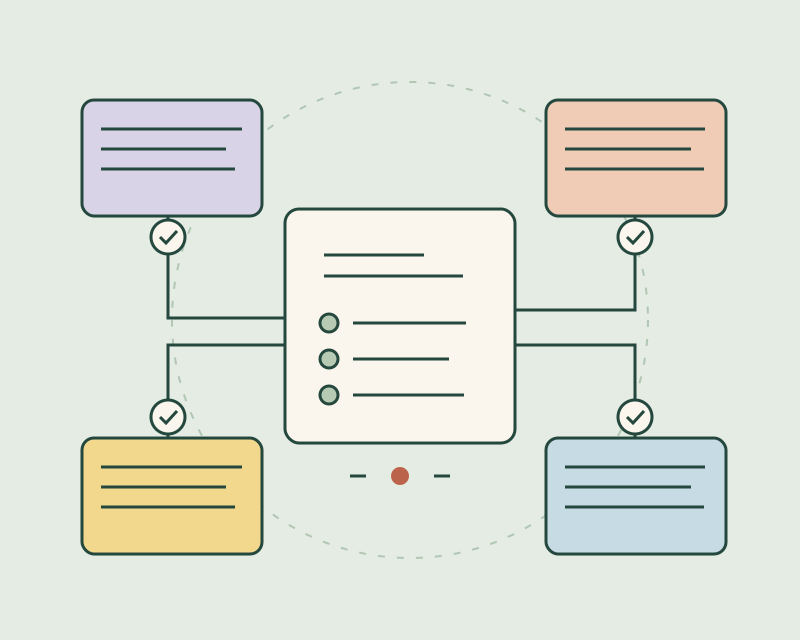
Maintain one verifiable fact sheet, check access conditions and answer evidence separately for each platform, and fix concrete gaps. Publication, citation and customer acquisition are different outcomes.
1. Choose the kind of answer you want to improve
Start with a reader question: “What does this service include?” “How do the two delivery options differ?” or “What should I prepare before requesting a quote?” Then choose the products, languages and entry points your audience actually uses. Your list might include Google’s AI search features, ChatGPT search, Perplexity, or the Kimi, Doubao and DeepSeek products your audience uses. Platform count is not a reason to expand the work.
Record the product, observation date, region, language, web-search setting and sign-in state for each entry point. A conversation that did not retrieve web pages and a web-enabled answer citing a different source present different questions. Do not apply one provider’s crawler documentation to another product or combine unlike modes into a single “internet-wide ranking” table.
We suggest beginning with three decision questions about one product or service. That makes the whole path from fact to page to answer inspectable. Our SEO, GEO and AEO guide explains the broader terminology; this guide focuses on delivering a defined piece of work.
2. Build a fact sheet that an answer can be checked against
List the business name, scope, intended customer, conditions, exclusions and next step. Give each fact a public source and an owner. Put unsupported claims of superiority in a verification queue. This sheet keeps information consistent; it is not a request to upload internal documents into every AI product.
| Customer question | Fact to publish | Support and boundary |
|---|---|---|
| What is included? | One requirements brief, two page prototypes and one consolidated revision. | The service scope page; additional pages require a separate agreement. |
| When does the delivery period begin? | On the agreed date after materials are complete and requirements are confirmed. | The preparation checklist and confirmation record; an enquiry is not a project start. |
| What is needed for a quote? | The page purpose, existing materials, a responsible contact and desired timing. | The quotation guide; public pages do not collect confidential customer material. |
This studio and its terms are fictional, illustrative examples. For your own project, first locate real service descriptions, product documentation or approved public facts. Update the sheet and corresponding pages together when conditions change, keeping the revision date.
3. Publish a complete answer rather than a keyword list
Choose one stable page for each main decision. Answer directly, then explain conditions, boundaries and the next step. Questions belonging to the same service can share a well-organized page; link to a full explanation when another question needs its own treatment. Avoid creating near-identical landing pages for different platforms.
A fictional answer based on the sheet: “Qinghe Design Studio’s basic service includes one requirements brief, two page prototypes and one consolidated revision. Additional pages are outside this scope. The delivery period begins on the agreed date after materials are complete and requirements are confirmed. For a quote, prepare the page purpose, existing materials, a responsible contact and desired timing.”
The answer provides checkable scope and conditions. State real pricing, geographic or timing limits when relevant. Chinese names, English names and other editions should identify the same business and retain the same conditions. Translation must not invent discounts or promises. Maintain the scope page and link to it from introductions, relevant guides and quotation information. See our answer-focused content guide for the writing process.
4. Review access conditions for each platform
| Target entry point | What to review | Evidence to retain |
|---|---|---|
| Google’s AI search features | Indexing, snippet eligibility and SEO foundations; no dedicated AI markup is required. | Official inspection for the exact URL, its response and page content. |
| ChatGPT search | Access policy for OAI-SearchBot, independently of GPTBot training controls. | Current robots.txt, hosting logs and verifiable crawler identity. |
| Perplexity | PerplexityBot search access requirements and the officially published IP sources. | Rules, request records and access to the exact page. |
| Selected Chinese product entry point | That product’s current web-search mode, public documentation and observed citations. | The specific product, mode, question, answer time and cited page. |
Google’s guidance applies existing SEO foundations to its AI features; eligibility does not guarantee display. OpenAI’s crawler documentation separates search and training uses. Perplexity’s documentation describes its search crawler and identity sources. These policies apply to their respective providers.
A page opening in your browser does not prove a target crawler accessed it. Sending a request with a changed User-Agent also does not authenticate a real crawler. Investigate the particular request, rule and failure before making a narrow adjustment. Our Robots.txt Tester checks pasted rules; it does not replace hosting logs or official inspection. This workflow does not call for switching off security protection.
5. Check facts, citations and conditions in the answer
Ask factual, comparison and next-step questions in sessions whose modes you have recorded. Save the original question and answer. Then check whether the brand is mentioned, a citation can be opened, that source supports the relevant sentence, and the answer preserves the necessary conditions. Repeat with comparable questions and settings; keep personalized conversations separate from fresh sessions.
| Observation | Check first | An evidence-based next step |
|---|---|---|
| The answer promises unlimited revisions | Whether the cited page clearly states one consolidated revision, and whether conflicting old pages exist. | Correct ambiguous or outdated scope information and record later observations. |
| A different studio with the same name is cited | The name, region, business description and citation destination. | Clarify public identity and necessary distinctions without inventing partnerships. |
| The answer is accurate but contains no clickable citation | The product mode and complete output for that session. | Record an answer without a link; do not count a referral visit. |
| The studio is not mentioned | Question relevance, web-search setting, page access and source quality. | Investigate a concrete gap; one absence does not establish a ban. |
Keep the content version, reason for the change and follow-up record. An answer may change while other factors also change; a single before-and-after observation does not establish causation. Leave uncertain facts marked unknown.
6. Define service deliverables that can be reviewed
If another team does the work, ask for a question-and-platform inventory, approved public facts, the exact pages to change, an itemized change record, access findings and dated answer observations with sources. Acceptance should allow someone to inspect the work rather than receive only a visibility score without its calculation method.
Separate deliverable work from outcomes outside the team’s control. You can check that a scope page was corrected, a citation supports a fact and a record can be reviewed. You cannot promise that every platform updates its answer by a fixed date. “Top three everywhere” and “guaranteed recommendations” are not demonstrated capabilities. Our GEO agency selection checklist develops the supplier questions.
7. Measure citations, visits and business outcomes separately
Keep three clearly defined records: observed answers and citations; referral visits actually measured by the website; and enquiries or other meaningful actions that can be connected to those visits. Use unknown when tracking is unavailable. Do not convert citation counts directly into customers or add metrics with different definitions across platforms.
Bing’s AI Performance documentation describes citation metrics within its supported coverage. Citation counts do not indicate answer ranking or placement, and they do not represent every AI product. Use our citation and referral reporting guide when preparing a report, retaining the platform, reporting period and source.
Let concrete problems determine priorities. Correct wrong terms first, locate the cause of access failures, and add real evidence when a page fails to answer a comparison question. A brand mention belongs in an observation record; it is not a conclusion about an entire service’s effectiveness.
Download the worksheet and start with one question
Download the multi-platform answer optimization worksheet (Markdown). It includes scope, facts, platform conditions, answer observations, changes and acceptance fields. Copy it into a team document, use real information, preserve unknowns and exclude private material.
- Choose one customer question and relevant product entry points.
- Confirm public facts and the exact page supporting them.
- Fix a gap that actually exists on the page.
- Check access conditions and retain complete answers and citations.
- Use the observations to select the next change, measuring visits and business outcomes separately.
This guide contains editorial recommendations and fictional examples. It is not a completed multi-platform performance experiment and does not claim access to special recommendation channels.
Follow the evidence.
- Google 搜索中心 · AI 功能和您的网站 ↗
- OpenAI · Overview of OpenAI Crawlers ↗
- Perplexity · Perplexity Crawlers ↗
- Bing Webmaster Blog · Introducing AI Performance in Bing Webmaster Tools ↗
References checked Oct 18, 2026. Examples and workflow recommendations are editorial illustrations, not measured results. Provider guidance may change. Our editorial standards.